From Knowledge to Knowing

What is the difference between knowledge and knowing? Webster's online dictionary defines knowledge in this way - "the fact or condition of knowing something with familiarity gained through experience or association..." It can also be defined as, "the sum of what is known, body of knowledge..." The word knowing is defined - "having or reflecting knowledge, information or intelligence."

Pixabay

Pixabay

From these definitions it would seem to be the case, we can all have some sort of knowledge about many things. I know that two plus two equals four. I also know, water is made up of two hydrogen atoms and one oxygen atom. However, knowing two plus two equals four does not mean I know how to do math. Nor does knowing water is made up of hydrogen and oxygen make me hydrated. Knowledge that becomes knowing is a direct result of acting on that knowledge. 

To take knowledge from our heads and make it a part of our lives takes effort. We are not sponges. We do not absorb knowledge and have it make us into a super human computer. We have to do something with the knowledge. Knowing what a number is, and a few, often quoted facts, does not mean we know how to add, subtract, multiply and divide, let alone do more complex functions, like algebraic equations and geometric formulas. To take this step from knowledge to knowing we have to learn. We must sit under the tutelage of one who knows and understands mathematics in order to come to a point of knowing it ourselves. 

water fountain

In a similar fashion, knowing what components make up water, does not give me the hydration so important for life. I must take the water and actually drink it. That is the only way my body will obtain the life giving qualities that water has. 

In our lives as Christians, we come to have a body of knowledge. We know the Bible is God's word. We know from various passages in scripture of God's love, justice and mercy. We also know about Jesus; His birth, life, death, and resurrection. But how to we take knowledge in our spiritual lives and making it knowing?

Pixabay

Pixabay

Anyone can have knowledge of God. Plug the word God into Google and see what comes up. However, having knowledge of God does not mean you are a person of faith. I have knowledge of Allah, but I am not a Muslim. I have knowledge of Buddha, but I am not a Buddhist. So what takes us from knowledge to knowing, when it comes to faith?  

Belief is not the result of an intellectual act, but the result of an act of my will whereby I deliberately commit myself.
— Oswald Chambers - My Utmost for His Highest - December 22nd

I personally believe that when we do as Oswald says in the above quote, we go from knowledge to knowing. When we apply our will and deliberately commit ourselves to God in a relationship we no longer have knowledge, we know. How does this take place? In a supernatural way, through the Holy Spirit. 

In Biblical times, the word know was associated with sexual intercourse. It implied intimacy. A person who has sex with another in this fashion, goes from knowledge of that person to knowing that person in an intimate way. One of the issues with sex outside the parameters of a committed relationship is the inability to truly know each other. This might partially explain why so many relationships fail. The partners involved have never gone from knowledge of each other to knowing each other. 

The type of knowledge that we want to have of God and of His son Jesus is an intimate one. We want to commit ourselves to Him in a deep, vulnerable way, so that we no longer just know facts and statements made about Him, but the deep inner layers of the Almighty Himself. This is not an intellectual act, other than the thought, "I want to commit myself to God." It is an act of the will, just as much as saying "I do" is an act of the heart. 

For example, read the following verse.

Shout for joy, you heavens;
rejoice, you earth;
burst into song, you mountains!
For the Lord comforts his people
and will have compassion on his afflicted ones.
— Isaiah 49:13 (NIV)

In the midst of chaos, I can read that verse and with the eye roll of a junior higher think, "Yeah, right."

Pixabay

Pixabay

Or, I can commit my will to believe and suddenly it becomes the firm, heart felt statement of, "Yeah! Right!" Now, I get it. God really does comfort and have compassion. I know, because I know (intimately), that He will comfort and have compassion. I have felt it and I have seen it. 

Do you see what happened there? I went from knowledge to knowing. I committed myself to believe the promises in His word and His response to my commitment was to draw me into the deeper knowing of Himself. 

It is God and His Spirit who take us from knowledge to knowing - knowing Him; His mercy and grace; His long suffering and goodness. Merely reading, gaining knowledge and nodding our heads that we believe does not a believer make. It is our act of the will, our choices day in and day out, moment by moment that move us from rote belief and knowledge to true, heart felt faith; to knowing God. 

Mulling It Over - Part 1

Last year I did a Mulling It Over series on Ephesians 6:10-18. It took me a period of months to dig deeply into that passage on the armor of God. This year I would like to use the same format to dig into a few other passages that are worth chewing on slowly. According to Webster's online dictionary, the word ruminate means to go over in the mind repeatedly, often in a slow, casual fashion or to chew repeatedly for an extended period of time. That is what we are going to do with these passages. 

Pixabay - this little guy looks like he'll be chewing for a while!

Pixabay - this little guy looks like he'll be chewing for a while!

The books of 1st and 2nd Timothy in the New Testament were letters written by Paul to Timothy, pastor of the church at Ephesus. Timothy had journeyed with Paul on his second and third missionary journeys. The two knew each other and had spent plenty of time working and ministering side by side. Paul's purpose in these letters was to encourage and give practical advice and instruction for the pastor of a church. 

First Timothy presents the most explicit and complete instructions for church leadership and organization in the entire Bible. This includes sections on appropriate conduct in worship gatherings, the qualifications of elders and deacons, and the proper order of church discipline.
— Chuck Swindoll (from Insight for Living Ministries)

With regards to 2 Timothy:

Paul knew that Timothy’s task of keeping the church within the bounds of sound doctrine while encouraging believers to live their lives well for the sake of Christ would be an often thankless and difficult task. Though hardship would come, Paul wanted Timothy to continue in those things he had learned, drawing on the rich heritage of faith that had been passed down to the young pastor, not just from Paul but also from his mother and grandmother
— Chuck Swindoll (from Insight for Living Ministries)

Both letters written to Timothy are worth mulling over, but for the next few months, I want to look at just a few verses from 2 Timothy 2.

20 Now in a large house there are not only gold and silver vessels, but also vessels of wood and of earthenware, and some to honor and some to dishonor.
21 Therefore, if anyone cleanses himself from these things, he will be a vessel for honor, sanctified, useful to the Master, prepared for every good work.
22 Now flee from youthful lusts and pursue righteousness, faith, love and peace, with those who call on the Lord from a pure heart.
23 But refuse foolish and ignorant speculations, knowing that they produce quarrels.
24 The Lord’s bond-servant must not be quarrelsome, but be kind to all, able to teach, patient when wronged,
25 with gentleness correcting those who are in opposition, if perhaps God may grant them repentance leading to the knowledge of the truth,
26 and they may come to their senses and escape from the snare of the devil, having been held captive by him to do his will.
— 2 Timothy 2:20-26 (NASB)


Let me preface the discussion with a key point:

This was written to the church leadership. This is important to remember when we look at the terminology in the passage. I would add, it is written to any mature Christian, since it is included in the Bible. I added the word mature, because part of this passage talks about teaching and I think it is important that we have Christians who know God's word and not only understand it, but live it in leadership and teaching positions.

All that being said, let's take a look at the first verse:

Now in a large house there are not only gold and silver vessels, but also vessels of wood and of earthenware, and some to honor and some to dishonor.
— 2 Timothy 2:20 (NASB)

How can we dissect this verse to squeeze as much out of it as possible? I like to take each phrase and ruminate on it. 

Pixabay

Pixabay

1. Now in a large house....

I believe the idea Paul  is trying to get across is that the church is a big institution. We are not talking the physical size of each individual church, but the body as a whole. A large house, in Paul's day would have indicated power and wealth. While this is still true today (ever watch that series Lifestyles of the Rich and Famous), there can be instances of large houses that are completely abandoned. 

Pixabay

Pixabay

2. ...there are not only gold and silver vessels...

This was another clue that Paul was making a comparison to a house of wealth and power. There were people in the church, just as today, who were wealthy. The church has always had a mix of rich, middle class and poor and it is often the rich and middle class who are giving of their surplus to aid those who go without. 

Gold and silver vessels were akin to us bringing out the good silver ware for a holiday dinner, at least that is something my mother used to do. I don't have any good silver ware. It is what it is. Ha, ha. But back in the day, this was an important thing to do when entertaining guests. Cleaning, polishing and making everything comfortable is the way we have chosen to honor the guests brought into our homes for centuries. 

Pixabay

Pixabay

3. ...but also vessels of wood and earthenware...

Not all vessels are the same. There are gold and silver, those vessels used for special occasions, but there are also vessels of wood and earthenware. Are you following the analogy? Paul is not talking about actual cups and bowls, he is talking about people! All of us are vessels. Some of us are gold and silver. We are flashy and showy. We bring in a crowd or we brighten up a room. Some us us are wood and earthenware. We are stable, consistent and incredibly functional, but we are not recognized beyond that. 

Pixabay

4. ...and some to honor and some to dishonor...

What exactly does Paul mean in this phrase? Simply put, we are all capable of honoring God, but we are also all capable of dishonoring Him.

Timothy was a young pastor and not everyone in his congregation thought he was up to the task. Rather than encouraging him and trying to work with him, a few of his congregants became obsessed with his age and felt he didn't have enough experience to properly pastor a church. He also had congregants who were involved in some less than savory things, but more on that next month. 

So what can we learn from this one verse today:

1. We are part of His body - the big house.

2. We are all vessels.

3. Not all of us are gold or silver. Some of us are wood or earthenware.

4. We are all capable of honoring or dishonoring God.

I hope and pray that as you read this post you will realize that we are all important in His body, or house - the church. I also hope you will see your worth. It doesn't matter who you are, what you look like or what you do as a job or how much money you make, you are important to the body of Christ. 

Have a great day!


Walking with the Psalmist

Last month I began a discussion on the first song in the book of Psalms in the Old Testament. While we do not know for sure who wrote this psalm, it is clear, by its inclusion in the Scripture, it is important. I explained that Psalm 1 describes two men, a righteous one and a wicked one. Last month I concentrated on the righteous man and found ten characteristics that a righteous man will have. This month, I want to look more closely at the wicked man.

1 How blessed is the man who does not walk in the counsel of the wicked,
Nor stand in the path of sinners,
Nor sit in the seat of scoffers!
2 But his delight is in the law of the Lord,
And in His law he meditates day and night.
3 He will be like a tree firmly planted by streams of water,
Which yields its fruit in its season
And its leaf does not wither;
And in whatever he does, he prospers.
4 The wicked are not so,
But they are like chaff which the wind drives away.
5 Therefore the wicked will not stand in the judgment,
Nor sinners in the assembly of the righteous.
6 For the Lord knows the way of the righteous,
But the way of the wicked will perish.
— Psalm 1:1-6 (NASB)
Pixabay

Pixabay

What sort of characteristics describe the wicked man.

1. They are not like the righteous man.

Verse 4 begins with the phrase, "The wicked are not so." It would logically follow that all of the traits that were listed to describe the righteous man are not traits the wicked man has. In other words this man does not love God's word, they hang out with other's who do not love God's word and they are not firmly rooted in God's law. 

2. They are like chaff.

What exactly is chaff? In this Old Testament context the word chaff was used to describe the outer hulls of seeds and other debris separated from the seed when threshing grain. Before the age of huge farm machinery, threshing was a laborious task done by hand on a threshing floor. The stalks of grain were beaten with a piece of wood called a flail. Chaff is not useful for anything and was thrown away. 

It might seem to us, calling a person chaff, is rather mean, but these words were inspired by a holy and righteous God. The point was to give us a comparison with no doubt involved. Righteous is righteous and wicked is wicked. 

3. They are driven away by the wind.

I think we can derive two ideas from this. First of all, the chaff in the threshing process was often swept up to blow away in the wind. It was meant to be discarded, just as our modern combine separates the chaff from the seed out in the field. Have you ever driven by a field when the combine is working and noticed a cloud of dust flying up in the air? That is not just dirt!

The second idea that came to my mind is, often people who do not know God are driven to and fro by the changing winds of life. They try anything and everything to fill the emptiness that exists inside of them and they most often are looking out for their own interests willing to step on others to feel fulfilled.

Pixabay - judgment

4. The wicked will not stand in the judgment.

The idea of judgment has become the elephant in the room. No one wants to talk about judgment. No one wants to discuss the consequences of sin. How often do you hear a sermon about sin, hell or the anger of a righteous God? Not as often as we used to, I'd venture to say. While I think we need to show love, wait for the right opportunities and reply with gentleness, we also can't stop talking about the idea that God is a holy and perfect God and we are not. That was and still is the reason Jesus became a man, walked on this earth, died on a cross and rose again. If we stop talking about judgment we might as well stop talking about Jesus. 

Jesus Christ is who differentiates us from all other religions. It is His blood that covers a righteous man and it is only His blood that allows the righteous man to stand at the final judgment. The wicked man will not stand because he has not recognized Christ as the way, the truth and the life.

For us to say, "I don't believe in hell or a judgment," is like saying, "Seventeen people didn't get shot at a high school in Florida." Just because it is terrible, doesn't mean our ignoring it or wishing it away makes it any less a reality. 

5. The wicked will not stand in the assembly of the righteous. 

I am not sure in this case whether it is similar to the judgment, they won't be able to, because their wickedness separates them from the righteous, or if it has to do with their own desire. The wicked do not want to stand in the assembly of the righteous. We have churches closing their doors at an alarming rate. For further info on this Dr. Richard Krejcir of churchleadership.org wrote an eye opening article titled Statistics and Reasons for Church Decline. Ken Ham of Answers in Genesis, wrote a book a few years ago titled Already Gone, which addresses the exodus of many young people from the church. If those who would be righteous aren't even staying in the assembly of the righteous, then the wicked certainly won't be drawn to the church. 

St. Albans Cathedral - England trip 2012

St. Albans Cathedral - England trip 2012

This is just my take on the verse. It is more likely that the wicked won't be able to stand in the assembly of the righteous because of their wickedness. 

6. The wicked will perish.

This isn't a pleasant thought. It might be easy to think of someone like Hitler perishing, because we could easily point out his wickedness, but the scripture is clear:

for all have sinned and fall short of the glory of God,
— Romans 3:23 (NASB)
For the wages of sin is death, but the free gift of God is eternal life in Christ Jesus our Lord.
— Romans 6:23 (NASB)
that if you confess with your mouth Jesus as Lord, and believe in your heart that God raised Him from the dead, you will be saved;
— Romans 10:9 (NASB)

While the standing of the wicked man compared to the righteous man is not pleasant, there is hope. If you are a Christ follower, then you are already familiar with that hope. You are also in a position to help someone who doesn't have that hope. Live your life in Christ out loud, so all the world can see. I leave you with these verses, which I will feature next week on my Mulling It Over column.

23 But refuse foolish and ignorant speculations, knowing that they produce quarrels.
24 The Lord’s bond-servant must not be quarrelsome, but be kind to all, able to teach, patient when wronged,
25 with gentleness correcting those who are in opposition, if perhaps God may grant them repentance leading to the knowledge of the truth, 26 and they may come to their senses and escape from the snare of the devil, having been held captive by him to do his will.
— 2 Timothy 2:23-26 (NASB)

The Real Romance

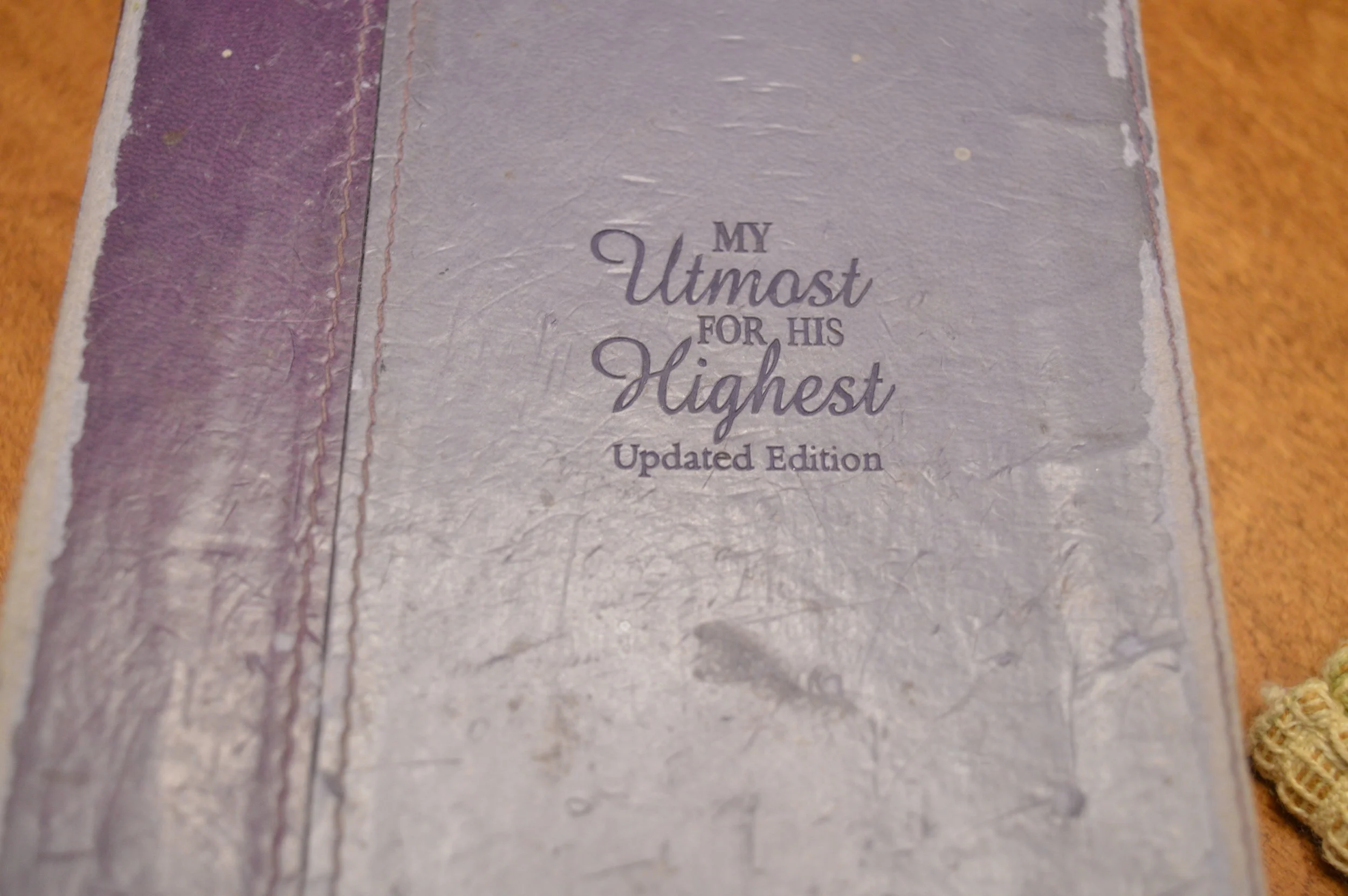
My regular devotional book is My Utmost for His Highest, by Oswald Chambers. If you have never heard of him, he is one of those men of the past that, like David, seemed to be a man after God's own heart. The wisdom he had as a young man and his passion for Christ drove him to eventually start the Bible Training College in London. I have used this devotional book for years and it never grows old. 

Oswald Chambers devotional book

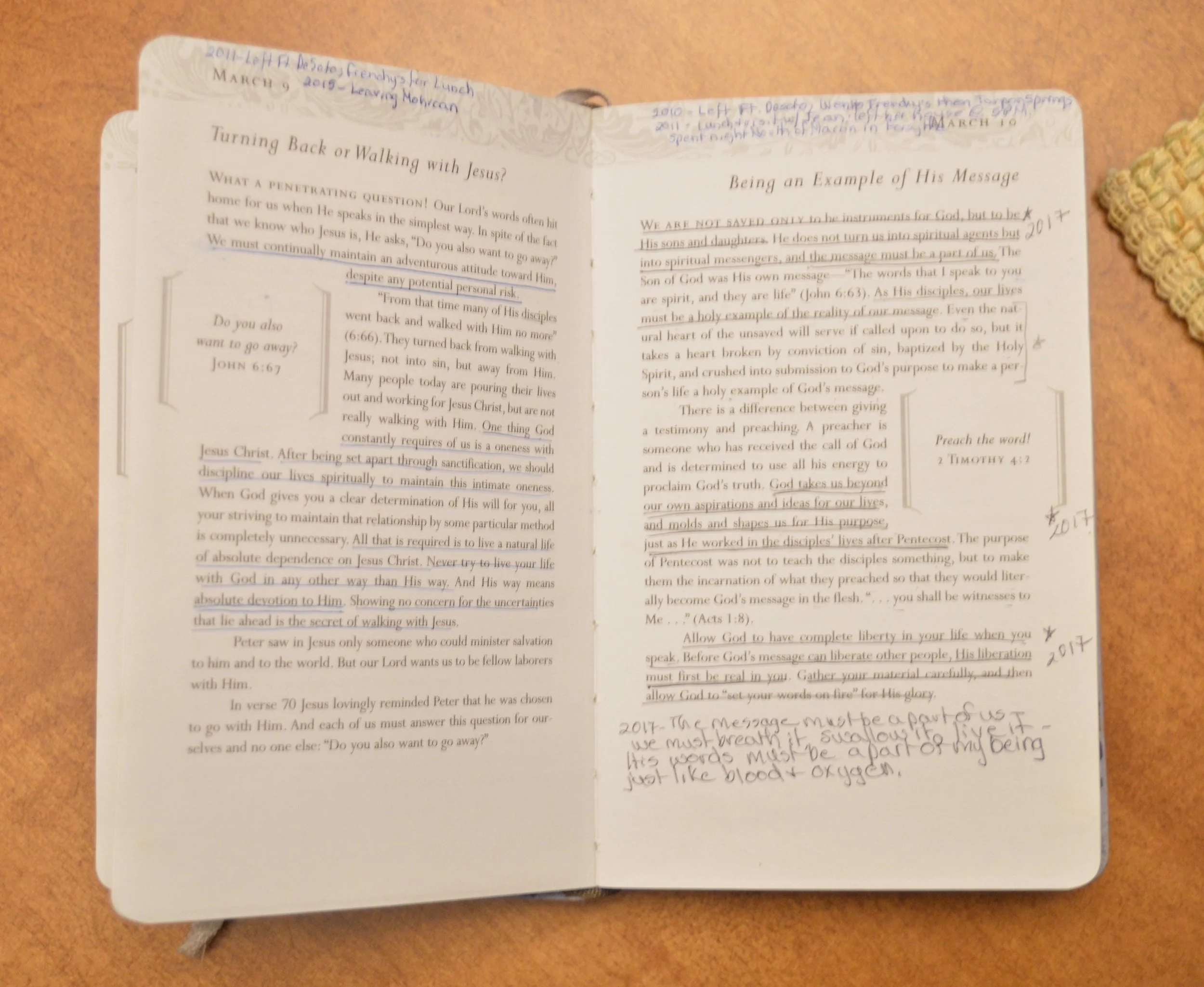
Over the years, I started writing in the margin at the top of the page what various events had occurred on that particular date. It has become a way to keep track of life. I always write the year and the event that took place. For instance on September 15, 2010 it says, "Quintin Arthur Vern Christensen born." That is my grandson. On May 31st 2014 it says, "Rebecca Christensen marries Daniel Trumbull." That is when I gained a son-in-law. There are pages filled with vacation travels, birthdays and family gatherings. It is also filled with broken engagements, hospital stays, unwed pregnancies and deaths. 

Oswald Chambers - devotional

It seems apropos that a devotional book that reminds us over and over to draw closer to Christ, hold a record of the very events that have caused that closeness to take place. The good events caused me to pour out my heart in thanksgiving and praise for blessing. The bad events caused me to pour out my heart in despair and grief. This correlation brings me to today's reading from the devotional and one quote in particular. 

Without the sovereign hand of God Himself, nothing touches our lives. Do we discern His hand at work, or do we see things as mere occurrences? Get into the habit of saying, ‘Speak, Lord,’ and life will become a romance.
— Oswald Chambers - My Utmost for His Highest - January 30th

There are several truths we can pull from this quote.

1. God is Sovereign.

The Lord has established His throne in the heavens, And His sovereignty rules over all.
— Psalm 103:19 (NASB)

God is all. ALL powerful. ALL present. ALL good. ALL loving. ALL knowing. How can a being like that not be sovereign. The word itself means, one who holds supreme power. I have a feeling that this word that was first noted to be used in the 13th century, does not begin to describe the sovereignty of God. 

2. Nothing touches our lives that doesn't pass through Him. 

Now there was a day when the sons of God came to present themselves before the Lord, and Satan also came among them.
The Lord said to Satan, ‘From where do you come?’
Then Satan answered the Lord and said, ‘From roaming about on the earth and walking around on it.’
The Lord said to Satan, ‘Have you considered My servant Job? For there is no one like him on the earth, a blameless and upright man, fearing God and turning away from evil.’
Then Satan answered the Lord, ‘Does Job fear God for nothing? Have You not made a hedge about him and his house and all that he has, on every side? You have blessed the work of his hands, and his possessions have increased in the land. But put forth Your hand now and touch all that he has; he will surely curse You to Your face.’
Then the Lord said to Satan, ‘Behold, all that he has is in your power, only do not put forth your hand on him.’
So Satan departed from the presence of the Lord.
— Job 1:6-12 (NASB)

This passage from Job is the perfect example of God's sovereignty and how He filters the events that touch our lives. 

What exactly does that mean? It means that no matter what is going on in your life, He is aware of it and He allowed it. That may seem a bit overwhelming and bring questions to your mind like, "If He's all good and all loving, why are all these bad things happening?" Quite simply, God knows you and your circumstances even better than you do. He knows what will push you towards Him or away from Him. 

If we allow ourselves the freedom of trusting Him, then we know that He's got us, no matter what is happening. If we bend to His will and sovereignty in our lives we will enter into an amazing relationship with Him. More on that in a minute. 

3. We have choices. 

If it is disagreeable in your sight to serve the Lord, choose for yourselves today whom you will serve: whether the gods which your fathers served which were beyond the River, or the gods of the Amorites in whose land you are living; but as for me and my house, we will serve the Lord.”
— Joshua 24:15 (NASB)

I've said this before and I will say it again. We have choices. We can decide to trust His sovereignty or not. We can accept His truth or reject it. Each of those choices we make will have an affect on how we think and how we maneuver through life. 

If you read the Old Testament at all you know that the Israelites were constantly changing their choices. One day they chose God, the next day they chose idols. On and on, over and over. When they chose God, they prospered. When they chose idols, they floundered. Our choice to believe God's sovereignty will make life more stable and peaceful. It doesn't mean life will be smooth sailing, but it does mean we will always have someone to rely on and who will give us supernatural means to deal with the hard things in life. 

If we look back at Joshua, who lead the children of Israel into the promised land, we know he had to conquer cities, and battle for every inch of land, but God was with Him and as long as they put God first and worshipped and trusted Him they were victorious. That didn't mean people didn't die, or get sick or have marital conflict or....fill in the blank. But God was there through it all. In all honesty, if I have the choice to have an all loving and all powerful being, walking with me through those dark and treacherous valleys, I'll take it. 

4. Life with Him can be a romance.

that the Lord called Samuel; and he said, “Here I am.
— I Samuel 3:4 (NASB)

Who doesn't love romance? Even the most jaded person, if they do a little soul searching will admit, they want to be pursued and loved. Romance has to be nurtured. When you are in a romantic relationship it isn't about getting what you want, it is a beautiful dance of giving, receiving, listening and talking. We can have that with our Lord. Isn't that amazing? The all powerful, supreme being who created the universe from nothing wants to woo us and have a romance with us. 

With February starting tomorrow and Valentine's Day right around the corner, wouldn't this be a good time to reevaluate our romance with Jesus? Are we spending time with Him? Are we pursuing Him, just as He daily pursues us? Are we taking the time to converse with Him and quietly listening for His sweet whispers to our souls? Are we looking for Him in the simple and mundane things of life as well as the big and beautiful things? 

O taste and see that the Lord is good; How blessed is the man who takes refuge in Him!
— Psalm 34:8 (NASB)

Beauty from Ash

There it was. A single, dark green leaf, beginning to unfurl. It had been conceived in darkness. A tiny seed that lay dormant, not dead, merely asleep in the cozy warmth of the dark earth. While it was sleeping the dragon had done his damage. He had ravaged the landscape, burning every tree and every living thing until all was nothing but ash. He thought he had destroyed life, but what he had meant for death, the One had meant for life. 

The ash lay heavy on the earth. It became, not a grave blanket of death, but a rich, comforting layer of warmth and nutrients. Gradually, over time, the rains came and the ash cooled and lingering life seeped into the black earth below. 

Pixabay

Pixabay

The seed drank the death life and began to swell. Swollen and full, it opened, releasing a shoot into the fertile soil above. Pushing, struggling, reaching, it climbed upward. It knew, above the darkness there was light and the light was what it wanted. The light was what it needed. The shoot didn't know how it knew, but it knew it had to reach for the light. It knew the light would help it grow. It knew the light would give it life.

Pixabay

Pixabay

Soon the pushing, struggling and reaching paid off. At the very tip of it's furthest point the shoot felt an odd sensation, warmth. It had only ever known the coolness of the earth in which it lay. It had only ever known the darkness, but now...now it reached. With one last ambitious push it poked through the earth and ash and found the light.  

*          *          *          *           *

Are we not like the seed? Were we not conceived in darkness? Did we not, when we were full with the nutrients of our mother's womb, the womb that would die after our life, death life, did we not move toward the light? We knew when it was time, as our mother's womb knew when it was time to help us, push, and reach and struggle, that we must find the light. We needed the light. 

Pixabay

Pixabay

Why then, when we know the light is good, do we stop seeking it? Why, when we know the light gives us life and helps us grow, do we we hide from it? Why do we prefer to cover ourselves back up with the dragon's ash, trying to hide rather than growing to the potential that the One had meant for us? 

It is because we are afraid. 

Do not fear the light, or the One from which the light has its source. Rather, push, struggle, reach for Him. He will tend you like a tender shoot and raise you up into a mighty tree.

He alone can bring beauty from ash. 

(Written by Amy D. Christensen)


A Look Back at 2017 - My Favorite Faith Posts

I did this on my fashion page so I thought it would be good to do on my faith page as well. Since we are into a new year, I thought it would be fun to look back at my favorite posts from 2017. I picked one from each month. If you haven't read them and are interested, just click on the link below the picture. 

It is good to look back at where we have been, so we can get a better feel for where we need to go. As far as my faith posts are concerned, I want to keep writing and posting things that I hope will be an encouragement to you. We, as older women, are such a valuable part of society. We are capable, strong and worn, and that is just where God wants us to be. 

Here are my favorite faith posts from my blog from 2017.

January

February

March

April

May

June

July

August

September

October

November

December

I hope you enjoyed this look back at my favorite blog posts from 2017. As we move forward into 2018, I hope to grow my blog in various ways, while still being true to my belief and faith in Jesus Christ. 

If you have any suggestions or things you would like to see me talk about on the blog, please leave me a comment in the comments section or you can send me a message on Facebook. I appreciate all your input and support. I am looking forward to what this year will bring and hope you will join me on the blog! 

Lessons Learned from Ernest Saves Christmas

I don't know how many of you are familiar with Jim Varney, As a young person he became interested in the theater. By age 17 he was performing professionally in night clubs and coffee houses. He played Jed Clampett in the 1993 movie version of the Beverly Hillbillies and is also known as the voice of Slinky Dog in Toy Story 1 and Toy Story 2. However, the persona that ushered Jim into fame was Ernest P. Worrell, a bumbling, annoying, but lovable character that began to show up in adds for everything from grocery and appliance stores to Disney itself. The first appearance of the character of Ernest on the big screen was in 1987 with Ernest Goes to Camp.

In Ernest Saves Christmas, we find Ernest working as a Christmas loving taxi driver. Little does he know, one of his passengers turns out to be Santa himself. Santa, played by British classical actor, Douglas Seale, is searching for a replacement. He has done the job, one he loved, for too long, and knows it is time to pass on the magic. His choice, Joe Caruthers,  a mild mannered actor who does a children's television show, The show being canceled, leads Santa to believe that this is the perfect time for Joe to take over. However, passing the torch is not going to be easy for Santa to do.

There are many funny scenes in this movie and it is hard to really find a scene that speaks specifically to the lessons I want to talk about, therefore I will give you the lessons I learned in a list, then leave you with a few of my best loved scenes. 

Lesson 1 - Stay True to Your Gifts

Joe Caruthers loves children. He likes to teach them and you can tell he is more comfortable around kids than most of the adults in the movie. When his children's show gets canceled, he knows he has to find work elsewhere. His agent, Marty, finds a producer who is willing to give Joe a tryout for a movie. Unbeknownst to Joe, the movie turns out to be a horror flick. When he is told to swear in front of two children to show his emotion, Joe says he can't do it. 

Eventually, after turning down Santa's proposal, Joe realizes that this elderly gentleman is Santa and that the job proposal was real. Joe is overjoyed, for he knows he has found his true calling. 

What are you passionate about? What do you like to do? God has given each of us abilities and yes, spiritual gifts that when used for His purposes will uplift and encourage ourselves and the body. I love to write. Other than being a grandma or a shopper, I would rather spend my days reading a good book or trying to write one. 

I will confess, I have been struggling with the idea of becoming a writer, wondering if that is a realistic goal. After all there are so many good writers already out there, telling captivating and inspiring stories. How could I possibly make a difference? But after watching this movie last night and today thinking about the lessons I can pull from it, I have realized I must stay true to the gifting that God has given me. I don't know if I will ever publish a novel, but I will keep trying to tell stories. 

Whatever you do, do your work heartily, as for the Lord rather than for men,
— Colossians 3:23 (NASB)

Lesson 2 - Don't Give Up Hope

After Joe refuses Santa, saying he is going to do the movie, and a teenage runaway, steals Santa's magic sack, the elderly gentlemen is ready to give up hope. It is easy to feel hopeless when things are not going well. Life can get overwhelming, especially when there is illness, job loss or difficulties in family relations. As I've mentioned before on the blog, hope can be rather elusive. (You can see that post here.) But in the end, isn't God the Father, our Lord Jesus Christ and the Holy Spirit the ones from which true, solid hope flows?

Santa felt that all hope was lost, but in the end, Joe accepts the job and becomes Santa, the runaway returns the magic sack and decides to go home and Ernest delivers the sleigh so the new Santa can get the toys delivered to children all over the world. Hope wins. 

Never give up hope. 

Be strong and let your heart take courage, All you who hope in the Lord.
— Psalm 31:24 (NASB)

Lesson 3 - Be Genuine

This is a bit similar to the first idea of staying true to your gifts, but this is more about how you present yourself to the rest of the world. The teenage runaway in this movie left home after her parents went through some rough times in their marriage. She felt abandoned by them at a critical time in her own development. Pamela or Harmony Star, as she wants to be called, puts on a facade of confidence and bravado, even though inside she is struggling to grow up and deal with her parents' situation. 

Harmony hooks up with Ernest and Santa when she jumps into the taxi Ernest is driving to get away from the restaurant owner she hasn't paid. She hangs out with the for a while, not believing Santa is real, until she finds out about the magic sack. After that she looks for the best opportunity to steal the bag and get away. 

We all have times in our lives where we put on a face. I don't mean putting on make up, I'm talking about that happy face we wear, when inside we feel like dying or feel like we are invisible. Christian recording artist Mandisa has a great song that addresses this very issue. 

God doesn't want us to live fake lives. The best way to help each other is to be real. Obviously, it is good to do that with an attitude of love and tact, but if we all tried to convey the truth about who we are and who God made us, I think, like Harmony, we would realize we could give the "sack" of all our troubles and issues, back to God. 

Bear one another’s burdens, and thereby fulfill the law of Christ.
— Galatians 6:2 (NASB)

I hope you learned something along with me from Ernest Saves Christmas. If you have the time, this is a great movie to watch with the family and will provide clean, kid-friendly fun. Enjoy a few of my favorite scenes in fond memory of Jim Varney, who passed away at age 50.

This next few show a number of Ernest's many personalities!

Merry Christmas everyone!

Lessons Learned from The Santa Clause

In my opinion, next to Galaxy Quest, The Santa Clause is one of Tim Allen's best movies. It is a family friendly film, that both young and old can enjoy. The basic premise of the movie finds toy maker Scott Calvin (Allen), suddenly taking on the job of being Santa Claus. The fact that their initials are the same is only one of the fun little details in this movie. 

Pixabay

Pixabay

Calvin is divorced and like so many dads in that situation has his son certain days and times. This particular Christmas, Scott has his son, Charlie, Christmas Eve over night. Being a good dad, although a bit jaded from the divorce, Scott reads Twas the Night Before Christmas, before Charlie goes to sleep. After, Scott turns off the light, strange things begin to happen that lead to a life altering event for this father and his son.

There are lessons we can glean from this comedy. These are a few of the things that I learned.

1. We Can Always Approach our Heavenly Father. Charlie knew when he started to hear strange noises on the roof that he could go wake up his dad and his dad would know what to do. This is a perfect example of child like faith. Children trust their parents to take care of them and provide for them. This is one of the reasons it is so devastating for a child when there is abuse or neglect involved. The very nature that God instilled in a child to trust their parents is the same nature that He instilled in each one of us to come to Him when we are troubled or afraid. 

Look at the birds of the air, that they do not sow, nor reap nor gather into barns, and yet your heavenly Father feeds them. Are you not worth much more than they?
— Matthew 6:26 (NASB)

A father or mother who love their children will always be looking out for them. Even when our children become adults we still want what is best for them and quite often it is hard to watch them make choices we know are not good. Letting them flounder is part of letting God care for them and bring them into a right relationship with Him. He always cares for them and always knows what is best. 

Life becomes much more complicated for Scott Calvin. When he put on the Santa suit to appease Charlie, he didn't realize he was about to have a dramatic career change. 

2. Think Through Your Actions. Scott didn't give a second thought to putting on the suit, other than shuddering that he didn't know where the suit had been. It was warm and comfy, sort of like a heavy pair of pj's. After the sleigh, lead by the famous eight is done delivering toys for the night, it heads back to the North Pole. Scott and Charlie suddenly find themselves in the middle of Santa's workshop.

While our decisions won't necessarily lead us to the North Pole, they can have long term, life changing consequences. Not only do our actions have ramifications, but our words and our thoughts. 

Trust in the Lord with all your heart
And do not lean on your own understanding.
In all your ways acknowledge Him,
And He will make your paths straight.
Do not be wise in your own eyes;
Fear the Lord and turn away from evil.
It will be healing to your body
And refreshment to your bones.
— Proverbs 3:5-8 (NASB)

God knows that we will often be tempted to make poor decisions, whether it is that second piece of pie at a Christmas gathering, or going out with a guy that is into drugs, He encouraged us to lean on Him, not on our own understanding. 

Scott Calvin, clearly believes he is wise in this movie. He thinks he has life all figured out, including how to deal with his ex-wife, her new husband and Charlie. As time goes along, and his job changes from that of toy maker to the being known as Santa, he realizes he really doesn't have it all figured out and he is willing to accept help to really see and understand.

3. Seeing Isn't Believing. Believing is Seeing. This is probably the most important message this movie makes. In a walk of faith, that is precisely what it is, faith. We don't see God, yet our belief in Him, enables us to see. Just like Judy the elf says, children don't have to see the North Pole to know that it is there, they just know. So too, in our lives as Christ followers, when we take that step to believe in Jesus, all of a sudden so many things that were hidden become perfectly clear.  We can't see God, but we just know that He is. His choice to reinforce our belief with the written Word, is a gift to us, that makes our faith even more solid. 

for with the heart a person believes, resulting in righteousness, and with the mouth he confesses, resulting in salvation.
— Romans 10:10 (NASB)

As Scott begins the journey from unbelief to belief he changes. He suddenly becomes aware of things that were unknown to him before, like the ideas of selflessness, love and sharing. He realizes that his life is changed and once he embraces that he is able to see that there is so much more to life than being the man on top. There is forgiveness, and the ability to adapt.

I hope you enjoyed hearing about the lessons I have learned from The Santa Clause. If you haven't see the movie, I hope you will give it a try. It is a fun view for the whole family. (Note: there is some language and mild suggestive elements so you may want to read a full review on IBMD.)

Lessons Learned from Miracle on 34th Street

Last year I did a series on lessons that I learned from a few of my favorite Christmas movies. You can see those by clicking on the title of the posts below:

A Christmas Lesson Learned from Charlie Brown                                                                                          Christmas Lessons Learned from the Grinch                                                                                                 "Come in, --- come in! and know me better, man!                                                                                               It's a Wonderful Life...or is it?

I thought it would be fun to look at a few other movies that I enjoy watching at this time of year and talk about what I have learned from them.

Pixabay

Pixabay

If you have seen Miracle on 34th Street, either the 1947 version with Maureen O'Hara and Edmund Gwenn as Kris Kringle or the 1994 version with Elizabeth Perkins and Richard Attenborough, you know the basic premise of the movie deals with belief. An elderly man claims to be Kris Kringle, not a man with the same name, but the genuine article. A woman, Mrs. Walker, must be convinced that there is more to Mr. Kringle than just a nice old man. 

"....if you can't believe, if you can't accept anything on faith, then you are doomed for a life dominated by doubt." 

That line, spoken by Mr. Kringle in the video clip above is very powerful and may well sum up what is wrong with our world as a whole. How often, are we as Christians guilty of doubting the truths that God has given us? Do we really believe He is the good shepherd? Do we really have faith that He came to save the lost? Or are our lives dominated by doubt? 

We all live lives of faith. We have faith or believe the sun will rise tomorrow, when I flip a switch the light will come on and the bank I use is taking good care of my money. Whether people want to admit it or not, most of life is a walk of faith. Unfortunately, we often place our faith in people or things that don't deliver. 

When my children were small, I wanted them to know the truth about Christmas, so I told them about Jesus. However, I also told them that Santa, as a man in a sleigh with flying reindeer wan't real. I chose to teach them about Saint Nicolas, the source of the legend of Santa Claus. My motivation was well intended, but I wonder that I did damage to their ability to believe in things that were simply meant to be magical and fun. 

The beauty of putting your faith in Jesus Christ is that everything else falls into its proper place. If I would have had more faith in Him as I raised my children, I think I would have had more fun with them, rather than being obsessed that they come to know Jesus and live for Him. I think we as parents often forget that our children are watching us and the best way to show them Jesus is to live a life in the Spirit out loud. Of course, we all want our children to follow Jesus, but we must have faith in Him, and in His ability to bring it about in His timing. Hard, I know!

In this movie when Kris Kringle is sent to jail for being a menace and mentally unstable it is up to Mrs. Walker, her daughter and a lawyer friend to get him out. The case goes to trial and arguments ensue to try to prove that Santa Claus exists and Mr. Kringle is him. In the more modern version, perhaps my favorite scene takes place when Judge Henry Harper has a most helpful revelation.

I love that Judge Harper is so satisfied with himself at the end of his speech, undoubtedly because he was able to get out of a very sticky situation. Ha, ha. 

Isn't it true? We, the people of the United States of America put our trust as a collective whole in a being we do not see. Perhaps, we need to revisit why the statement, "In God We Trust" was originally put on our currency. 

I have often thought that the church has gotten too far away from the basic tenants of our faith. We don't talk about things like the virgin birth of Christ, the problem of sin or the outcome of that sin. We have a tendency to dance around the issue. The issue is, we need Jesus. Jesus is the reason we celebrate Christmas. We need to get back to that. 

One of the best things we can do as we walk out our journey on this planet is to be teachable. God is always bringing new lessons to be learned and drawing us deeper into His amazing layers. Sometimes He even uses movies to teach us things we need to know. 

Do you like this movie? Have you learned anything from watching a Christmas movie? I hope you'll share your ideas in the comments section. I'd love to learn something from you. 

Preparing for Christ

The holiday of Thanksgiving is the perfect spring board for our leap into the Christmas season. It seems rather odd that we celebrate a day of giving thanks and then scramble to find the perfect gifts for those we love, as if they don't have enough already. Don't get me wrong, I love Christmas and one of my love languages is gifts. I love to find gifts for people and I also love to receive gifts from others. Especially, when the person doing the giving has really thought about the person receiving the gift. 

In my last few posts I referred to giving thanks as that which brings us back to center, or back to where God wants us to be in our relationship with Him. What better thing to do before we enter into the hectic mayhem of the holidays. It is often hard to keep our focus on the reason for the season, which as most of you know is the birth of Jesus. 

Pixabay

Pixabay

It seems in our society today belief in God is a common occurrence. If you ask someone if they believe in a higher power or an intelligent designer, many will say yes. They also will tell you that this being is good and would never condemn people to a place  ofeternal damnation. What has become lost in the chaos of our daily lives is the need for a Savior. 

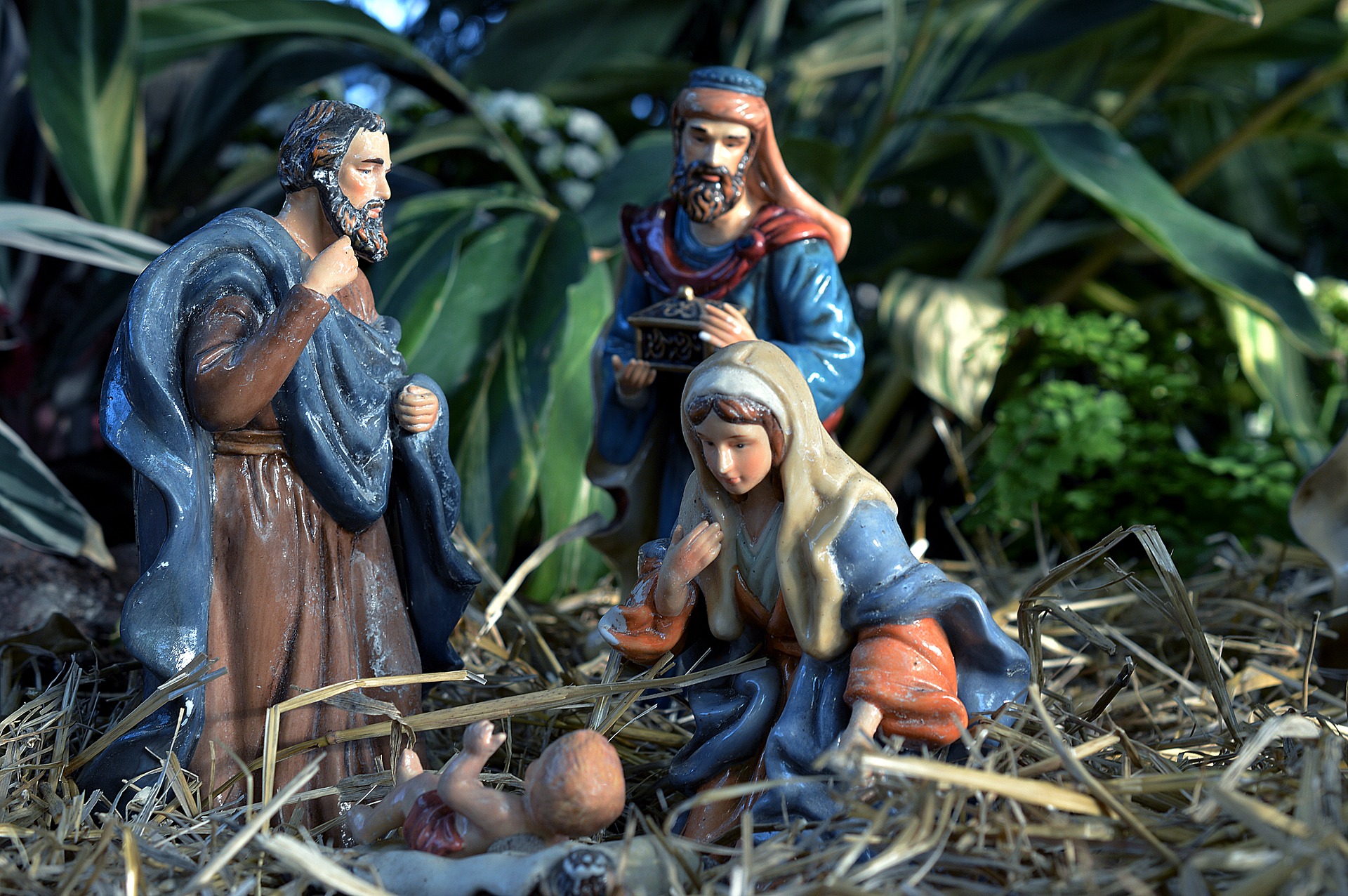
What did Jesus come for? Did He come, so that we might have a holiday to celebrate? Did the shepherds leave their flocks to come see where the baby Jesus was born, so we could have colored lights in the windows and pretty trees in our living rooms? Did the three wisemen leave their homes and travel for months to give gifts to the Christ child so we could give gifts to each other? No. They came because He was and is the Son of God. 

Jesus came so that we might have life and life more abundantly. The book of Romans in the New Testament explains:

for all have sinned and fall short of the glory of God,
— Romans 3:23 (NASB)
For the wages of sin is death, but the free gift of God is eternal life in Christ Jesus our Lord.
— Romans 6:23 (NASB)
But God demonstrates His own love toward us, in that while we were yet sinners, Christ died for us.
— Romans 5:8 (NASB)
that if you confess with your mouth Jesus as Lord, and believe in your heart that God raised Him from the dead, you will be saved;
— Romans 10:9 (NASB)

The holiday of Christmas must lead to the holiday of Easter. The manger makes way for a cross. We cannot have one without the other. So you see, Jesus really is the reason for this season; a season of love, giving and caring.

In the words of Jesus Himself, 

I am the way, and the truth, and the life; no one comes to the Father but through Me.
— John 14:6 (NASB)

As we begin our Christmas preparations, I pray we will not lose sight of the one who prepared the way for each one of us.

Mulling It Over - Part 10: Ephesians 6:18

Last month we learned about the sword of the spirit, which is the first of our offensive weapons in this passage on the armor of God. In this final post in my series on the armor of God I want to focus in on verse 18 and our second offensive weapon in our fight against the enemy.

With all prayer and petition pray at all times in the Spirit, and with this in view, be on the alert with all perseverance and petition for all the saints,
— Ephesians 6:18 (NASB)
Pixabay

Pixabay

Besides our sword, which we now know is God's word, we have the offensive weapon of prayer. Let me take a few sentences to clarify the difference between defensive versus offensive. Defensive pieces are those which protect us from the onslaught of the enemy. Our armor, including the helmet and the shield are all pieces that we use to protect ourselves. Offensive pieces are those with which we can actually do damage to the enemy, through the Spirit of Jesus Christ. 

I think it is important to note that most of this passage in Ephesians 6:10-18 is spent describing the defensive pieces or the armor, which we are to put on. This suggests that our part as followers of Christ is to make sure we are battle ready and able to stand firm when the arrows fly. There are times when life is too overwhelming to actually fight back. Those are the times we have to let God, the almighty One, have His way and let Him fight for us. I firmly believe there are myriads of skirmishes going on all around us in the heavenly realms that we do not participate in. However, I also believe there are times that God calls us to pick up that sword and go to war. This leads us back to verse 18 and the offensive weapon of prayer. 

Let's look at what prayer does as an offensive weapon.

1. Puts us in contact with the commander. In what army are the soldiers not aware of who their commander is? From the generals at the top, to the sergeants in the enlisted ranks, soldiers are aware that there is a chain of command. They know who they report to and who reports to them. As Christians prayer puts us in direct contact with the highest head of all the armies at His command. Isn't that awesome? How much more time should we be spending in prayer, knowing that this is the way to get right to the top?

2. Places us under the headship of the Holy Spirit. When we really are seeking God and are trying to pray as He would want us to pray, we are placing ourselves under the movement and persuasion of the Holy Spirit. 

But the Helper, the Holy Spirit, whom the Father will send in My name, He will teach you all things, and bring to your remembrance all that I said to you.
— John 14:26 (NASB)

Jesus tells us that the Helper will teach you all things. I think that includes teaching us how to pray. You might think that's a bit silly, but I'm not talking about saying a prayer before dinner or even reciting the Lord's prayer. I am referring to intense, battle worthy praying that gets us prostrate on the floor or pacing around the house with tears streaming down our faces and our hands raised in the air. This is Holy Spirit lead warring prayer. 

Please do not jump to the conclusion that I think this is the only time the Holy Spirit directs our prayer, because it is not. He leads us in prayers of worship, prayers of thanksgiving, prayers of confession and prayers of humble petition as well. But there is something about warring prayer that makes praying in the Spirit seem even more real. 

3. Perseveres for the saints. Battle prayers are most often connected to others who need our added strength to help them get through a particularly difficult situation. Verse 18 encourages us to: "With all prayer and petition, pray at all times in the Spirit, and with this in view (the idea that we are to be praying all prayers at all times in the Spirit) be on the alert (for the enemy, as well as for peeps who need our prayers) with all perseverance and petition for all the saints.

Did you notice how many alls are in that verse. I bolded them so you could see them more clearly. Whoa! This idea of prayer is pretty important. I Thessalonians 5:17 says, "pray without ceasing." There isn't a command that is much more straight forward than that. Don't stop praying. 

Praying does not mean that life will suddenly be filled with sunshine and flowers. In fact, often times when we begin the intense prayer of warring praying, we may find the enemy's assaults also intensify. Don't give up. It is even more important when the battle is continuous and overwhelming. Someone needs you to pray, maybe even your own self. Remember you are fighting because the Commander has called you to. He knows who needs those prayers. 

Many of you, like me are older. Your children are grown and you may no longer be as involved as you once were in their lives. Don't stop praying for them. Now, more than ever, they need your prayers, because one thing is sure, our enemy is a roaring lion seeking to devour. He wants our sons and daughters, our spouses, our grandchildren, our friends, our churches and our nation. If you can't sleep at night, God wants you to pray. If you have a few moments alone, God wants you to pray. If you are sick, you can still pray. Driving in the car, pray. Taking a shower, pray.

When you have gotten to the end of yourself and think you can no longer pray, then let go and He will pray for you. Now how cool is that? He will pray for you, until you are able to stand, put on the armor and go to battle again. 

In the same way the Spirit also helps our weakness; for we do not know how to pray as we should, but the Spirit Himself intercedes for us with groanings too deep for words;
— Romans 8:26 (NASB)
and He who searches the hearts knows what the mind of the Spirit is, because He intercedes for the saints according to the will of God.
— Romans 8:27 (NASB)
who is the one who condemns? Christ Jesus is He who died, yes, rather who was raised, who is at the right hand of God, who also intercedes for us.
— Romans 8:34 (NASB)

You can see the rest of this series by clicking on the links below. 

Part 1, Part 2, Part 3, Part 4, Part 5, Part 6, Part 7, Part 8, and Part 9.

It's Already November! What??

Can you believe it is already November 1st? Or are you like me, still gasping, trying to catch your breath and function through the sugar induced headache of post-Halloween fun? I knew it was coming. Winter always comes, as does Thanksgiving and Christmas. Let's get real here, the holidays do start today, the day after Halloween. Is it any wonder that most stores have Christmas trees, decorated to the hilt, already stunningly displayed before the Snickers bars are even marked half off?

Pixabay - Halloween candy

Since we are only a few weeks out from Thanksgiving, I want to revisit the command Paul gives to us in I Thessalonians 5:18.

in everything give thanks; for this is God’s will for you in Christ Jesus.
— I Thessalonians 5:18 (NASB)

My plan is to spend a few weeks looking at this idea of gratitude. Next week I will finish up my Mulling It Over series on the Armor of God, but this week and the two Wednesdays before Thanksgiving I will be concentrating on thankfulness. 

Pixabay - thanksgiving

Last year I talked about this subject in two different blog posts. Three Little Commands - Give Thanksand It is Good to Give Thanks both touch on the importance of giving thanks. You can read those posts by clicking on the titles. It might seem a bit repetitive to spend more time on this topic, but as with so many things in my Christian walk, it is good be reminded. I know many things about the Christian life, but I don't consistently live all of those. In addition, the Holy Spirit is more than capable of teaching me new things, as I pointed out a few weeks ago in the post, Even He Called Him Lord.

Today, I would like to lay a foundation for the act of thanksgiving. The first mention of what looked like thanksgiving in the Bible is found in Genesis 4.

So it came about in the course of time that Cain brought an offering to the Lord of the fruit of the ground. Abel, on his part also brought of the firstlings of his flock and of their fat portions. And the Lord had regard for Abel and for his offering; but for Cain and for his offering He had no regard. So Cain became very angry and his countenance fell.
— Genesis 4:3-5 (NASB)
Pixabay - Autumn

I do not know if this was a thanksgiving offering, but it is clear that God had already established a system of offerings to honor and worship Him. This was some years after Adam and Eve were driven from the Garden of Eden for their choice to sin against God. The fact that both their sons brought an offering to the Lord, shows that they had been taught that this was something important that needed to be done. The word thanksgiving does not show up until years later in Leviticus 7:11-12 where Moses is directed to write about the law of sacrifice of peace offerings. 

The whole system of sacrifice was instituted by God after Adam and Eve sinned. It says,

The Lord God made garments of skin for Adam and his wife, and clothed them.
— Genesis 3:21 (NASB)

While we are not told that God sacrificed animals to make those clothes, it can be safely assumed that He didn't get them at the local Walmart. It would seem to make sense that the first blood letting was done by God Himself in a gesture, both of compassion and instruction, for those children He had created. He already had the plan in place for Jesus, His Son, to be the ultimate sacrifice for our redemption.

By the time Moses becomes the chosen leader of the nation called Israel, God's plan included teaching His people all about sacrifice. The entirety of the book of Leviticus spells out the different offerings, laws and acceptable sacrifices for a variety of life situations. 

Pixabay - bread and oil
‘Now this is the law of the sacrifice of peace offerings which shall be presented to the Lord. If he offers it by way of thanksgiving, then along with the sacrifice of thanksgiving he shall offer unleavened cakes mixed with oil, and unleavened wafers spread with oil, and cakes of well stirred fine flour mixed with oil.’
— Leviticus 7:11-12 (NASB)

As you can see, the laws of offering and sacrifice were very specific.

You might be wondering why I am spending so much time on this idea of sacrifice, but the act of thanksgiving is an act of sacrifice. While we no longer require all the offerings of sheep and cows, or bread and oil, thanksgiving requires a giving up of our worries and cares, bringing them to the altar and letting God burn them away, so that all that is left is purest worship and adoration of the Creator.

As we head into the holiday season I hope you will journey with me along this thanksgiving road. It will be the perfect lead in, to the season of Advent. 

Stay tuned for more! 

Our Great and Mighty Purpose

Do you ever struggle with your purpose? Do you ever feel as though the things you do are meaningless? Do you ever feel invisible? I do! I have struggled most of my life with feeling less than whole. I have too often been swayed by other's opinions of how I look, how I act or react and what my value is. Being a Christian does not eliminate the struggles, but it does put them in their proper perspective. 

You see, we are all sinners. We all fall short. 

for all have sinned and fall short of the glory of God,
— Romans 3:23 (NASB)

However, the blood of Christ made it possible that I can now have a relationship with God and with His Son. What does that mean for my purpose? It makes all the difference. 

A Christian worker has to learn how to be God’s man or woman of great worth and excellence in the midst of a multitude of meager and worthless things.
— Oswald Chambers - My Utmost for His Highest - October 25th
Pixabay

Pixabay

Life is full of worthless and meager tasks. Cleaning toilets, doing laundry and mopping the kitchen floor all too often seem worthless. You know the cycle. Just when you get those dishes washed, another stack of bowls and spoons appear. Both our daughters are out of the house, so I am not quite sure how we use so many spoons. Ha, ha. Don't forget laundry. When the girls were growing up I made up a creature called the laundry monster and had a song that I sang when I saw him rearing his ugly head, Now that they are out of the house he is not as prominent, but those loads add up. And the cycle continues over and over and over. 

Pixabay

Pixabay

If you have a job outside the home, it too can become seemingly worthless and meager. If you work retail like I do, the hours can be long, when the days are slow and the customers can be less than thankful when the days are busy. And the cycle continues over and over and over.

So how do we become those men and women of great worth and excellence as Oswald says? I think there are a few things we need to consider to realize our great and mighty purpose.

1. We are all human. There are very few of us who don't have to do dishes, laundry, take care of kids or aging family, meet the needs of a significant other or do some sort of work that wouldn't necessarily be considered fun. Obviously, there are wealthy people who can hire others to do many of those meager tasks, but they still have to bathe and groom themselves or at least wipe their own behinds when they go to the bathroom; a task that is not worth a lot, but we all do it or the world would be a pretty stinky place. 

2. We all start out ordinary. No one starts out as a movie star or the president of a company or a football player who gets paid millions whether he stands, sits or kneels. 

Pixabay

Pixabay

All God’s people are ordinary people who have been made extraordinary by the purpose He has given them.
— Oswald Chambers - My Utmost for His Highest - October 25th

I love this thought, because not only does it put us all on the same playing field, but it also reminds me that God is in control. If you are a mom, God put you there. If you are a corporate VP, God put you there. If you are a missionary to a foreign country, God put you there. We must come to grips with this idea that God allows the good, the bad and the mundane. 

And we know that God causes all things to work together for good to those who love God, to those who are called according to His purpose.
— Roman's 8:28 (NASB)

3. God is always at work. God's purpose in our lives is to make us into the image of Christ. He desires that we draw closer and closer to Him. What better way to do that than to put us in circumstances that move us closer to being what He wants us to be. 

Pixabay

Pixabay

It is not that you have gotten God, but that He has gotten you. God is at work bending, breaking, molding, and doing exactly as He chooses. And why is He doing it? He is doing it for only one purpose - that He may be able to say, ‘This is My man, and this is My woman.’”
— Oswald Chambers - My Utmost for His Highest - 0ctober 25th

4. Our great and mighty purpose is to glorify Him. Paul knew this was the case when he was transformed from a hater and persecutor of Christians to being one of the greatest evangelists that ever lived. 

...I have become all things to all men, so that I may by all means save some. I do all things for the sake of the gospel, so that I may become a fellow partaker of it.
— I Corinthians 9:22-23 (NASB)


It doesn't matter where you are or what you do, your purpose is to glorify Him. How do we glorify God? We glorify Him when our actions, words and attitudes reflect the humility and love of Christ. 

Therefore if there is any encouragement in Christ, if there is any consolation of love, if there is any fellowship of the Spirit, if any affection and compassion,
2 make my joy complete by being of the same mind, maintaining the same love, united in spirit, intent on one purpose.
3 Do nothing from selfishness or empty conceit, but with humility of mind regard one another as more important than yourselves;
4 do not merely look out for your own personal interests, but also for the interests of others.
5 Have this attitude in yourselves which was also in Christ Jesus,
6 who, although He existed in the form of God, did not regard equality with God a thing to be grasped, 7 but emptied Himself, taking the form of a bond-servant, and being made in the likeness of men.
8 Being found in appearance as a man, He humbled Himself by becoming obedient to the point of death, even death on a cross.
9 For this reason also, God highly exalted Him, and bestowed on Him the name which is above every name,
10 so that at the name of Jesus every knee will bow, of those who are in heaven and on earth and under the earth,
11 and that every tongue will confess that Jesus Christ is Lord, to the glory of God the Father.
— Philippians 2:1-11 (NASB)

Wash that load of a laundry with a song in your heart. Change that baby's diaper with thanksgiving. Deal with that cantankerous customer with kindness. Write, walk, work, love, play to the glory of our Lord and Savior Jesus Christ. 

This is our great and mighty purpose. 

Mulling It Over - Part 9: Ephesians 6:17

Last time in this Mulling It Over series, I looked at the beginning of Ephesians 6:17. This week, I'd like to mull over the last part of that verse. 

And take the helmet of salvation, and the sword of the Spirit, which is the word of God.
— Ephesians 6:17 (NASB)

The helmet of salvation was the last of our defensive pieces of armor. All of the defensive pieces are articles that are worn on the body, or as in the shield of faith, are used to protect the body from assaults from the enemy. The sword of the Spirit, is the first weapon listed. 

Pixabay

Pixabay

We might wonder why God gives us so many pieces of armor to protect ourselves and only two weapons with which to actually attack the enemy. Obviously God knows what is best and I hope to illuminate why this is the case.

First, I think we need to look at 2 Corinthians 10

For though we walk in the flesh, we do not war according to the flesh, for the weapons of our warfare are not of the flesh, but divinely powerful for the destruction of fortresses. We are destroying speculations and every lofty thing raised up against the knowledge of God, and we are taking every thought captive to the obedience of Christ,
— 2 Corinthians 10:3-4 (NASB)

These verses clearly state the weapons of our warfare are not of the flesh, but divinely powerful. In other words, our weapons are divinely empowered. In essence God does the fighting for us. Our job is to stand firm (Ephesians 6:10-13) and resist in that evil day. Our job also involves destroying wrong thinking and taking all of our own thoughts captive to the obedience of Christ. 

Next we need to look at what exactly this sword of the spirit is. We all know what a sword is. A long sharp weapon that was meant for slicing, chopping and stabbing. It was meant to inflict harm and even kill. There are numerous types of swords from the Roman Gladius, to the English Broadsword, to the modern foil used in competitive fencing. For the most part a sword was meant for close combat. While we occasionally see in a movie a sword being flung long distances and making its mark, the sword is meant to be used when the enemy is at arm's length.

Pixabay

Pixabay

I find it interesting that God directed Paul to write the sword of the Spirit, not the axe or the spear, both of which were often thrown from a distance. The axe, especially one used during the Viking era, was often used in close combat to chop, hack and bash, but a sword enabled the user to finalize his victim with a well placed point to the heart or a slicing slash along the throat. 

Pixabay

Pixabay

This sword we are given to use is meant to be taken up when we are in close combat with the enemy. This sword is of the Spirit and is the word of God. God's word is a powerful, offensive weapon for us to use when we are face to face with our enemy, the devil. 

What does this look like in real life. I know for me, when I am really struggling with some specific difficulty, using God's word is the best way to kill the wrong thinking that is so often associated with sin. For instance, more recently I have had anxiety. Nothing new right? We all deal with anxiety. However, anxiety left unresolved and allowed to run rampant will becoming a raging bull, one that we will not be able to control.

When faced with anxiety I have learned to use God's word to remind me of His truth. His word says this in regards to anxiety and fear:

Be anxious for nothing, but in everything by prayer and supplication with thanksgiving let your requests be made known to God.
— Philippians 4:6 (NASB)
For God hath not given us the spirit of fear; but of power, and of love, and of a sound mind.
— 2 Timothy 1:7 (KJV)

I love the 2 Timothy verse in the King James Version because it uses the word fear and it also uses the phrase sound mind. What is more chaotic and confused than the anxious mind? 

Here are a few more scriptures that have to do with fear.

So do not fear; you are more valuable than many sparrows.
— Matthew 10:31 (NASB)
For you have not received a spirit of slavery leading to fear again, but you have received a spirit of adoption as sons by which we cry out, “Abba! Father!”
— Romans 8:15 (NASB)
Even though I walk through the valley of the shadow of death, I fear no evil, for You are with me; Your rod and Your staff, they comfort me.
— Psalm 23:4 (NASB)

These are just a few of the verses in scripture that deal with fear. Perhaps your issue is not fear, but anger, or lust or pride. God's sword is capable of delivering fatal blows to all of our enemy's minions. Let me say, it may not happen immediately. When I was in college I was struggling against several different sins that kept coming back to haunt me, but as I matured in my walk with Christ and began to take His word seriously I just kept using it when the temptations returned. Over and over, I stabbed and jabbed, sometimes on my knees, sometimes laying flat on the floor and sometimes pacing with my fist in the air, but eventually that sword did its job. 

Often when we struggle against the same recurring lies of the enemy it might be our "thorn in the flesh" so to speak, but God's word is still faithful, no matter how many times the enemy returns to attack us. If you have His Spirit in you and you are able to yield the sword of His word, victory will come.

Don't forget when you put on your armor in the morning to grab that sword before you walk out the door. 


Words from the Past

Every now and then, I like to share something I have learned from someone who is no longer with us. Men such as A.W. Tozer, Andrew Murray, D.L. Moody and others, left behind a treasure chest filled with nuggets of wisdom that God gave to them. Whether it be through their preaching, writing or through others who watched them walk with God, we have access to these nuggets. 

I became a Christian at the age of twelve. Within a few years of that I began writing. I dabbled with stories and poems, but what I wrote most consistently were journals. I have been keeping my thoughts and my prayers in those little lined books for many years. Every now and then, I look back through the pages and it surprises me, how much God has used my writing to teach me about Him and about my place in His world. 

I came across this piece I wrote on September 21, 2012. Since it references fall, I thought it appropriate to publish here for you to read. I was going through a very difficult time in my life at that point and was getting counsel from a godly counselor. We talked about my vision of what I thought life would look like at this point and how in reality things didn't line up. He gently told me that in order to move on, I needed to put that vision to death. 

Pixabay

Pixabay

At the same time, I was also reading Ann VosKamp's work, One Thousand Gifts, in which she refers to those situations in life that we never wanted or expected as ugly-beautiful. It is amazing how God can bring all these scattered pieces together and give us an acutely clear perspective.

*     *     *     *     *

fall leaves

At times loss can be beautiful - ugly-beautiful.

This season, fall, trees begin a transformation of loss. Their leaves, once green and supple, change in color and become dry, even crispy. 

Gradually, they let go, both the tree and the leaf.

The tree, in its God given wisdom knows that it will bloom again; its stark branches will feel the excitement of new growth.

Does the leaf know its life is over?

Does it accept the loss of the tree and the giddiness of the wind to send it wherever it desires?

Does it breath a sigh of relief when its final resting place slowly swallows it down and it is remembered no more?

There are aspects of my life, I need to let go of. I need to quit clinging and let those leaves fall silently to the ground. 

That is the only way for new life to begin.

(Written by Amy D. Christensen - 9/21, 2012)

*     *     *     *     *

Even though I am at a different point in my life than I was when I wrote that, I believe it still holds true. Don't we all have leaves in our life that we are clinging to, challenging the wind to tear them from us? Yet, each season has a purpose and we need to know when that season has passed and we must let God create newness in our lives. I know it is hard, but God knows what is best and how very much He cares for you.

The Lord appeared to him from afar, saying, “I have loved you with an everlasting love; Therefore I have drawn you with lovingkindness.
— Jeremiah 31:3 (NASB)
For I am confident of this very thing, that He who began a good work in you will perfect it until the day of Christ Jesus
— Philippians 1:6 (NASB)


Mulling it Over: Part 7 - Ephesians 6:16

Today in my Mulling It Over series on the Armor of God I am looking at Ephesians 6:16. This piece of armor is essential as protection. While the other pieces, so far, have been actual body armor - the belt, the breastplate and the shoes, this piece is defensive, but not attached to the body. 

in addition to all, taking up the shield of faith with which you will be able to extinguish all the flaming arrows of the evil one.
— Ephesians 6:16 (NASB)

Piece # 4 - Shield of Faith

There were three types of Roman shields. The legionaire scutum was a long oval or rectangular shield used by foot soldiers. It was particularly effective in battle when a group of soldiers would stand side by side. The scutum created a wall which was almost impenetrable. The shields could also be turned skyward to keep arrows from hitting their targets.

Pixabay

Pixabay

The other two types of Roman shields were the parma and the clipeus. Both of these shields were round. The parma was used by soldiers on horseback and was easier to maneuver. They were, however, made with an iron frame and were heavy. These eventually were replaced with the clipeus which was designed similarly to the Greek aspis. (This info was gleaned from this article by Graham Land.)

Pixabay

Pixabay

There are several points I would like to make regarding this piece of armor. Once again, I would like to dissect the verse to squeeze the most out of it we can.

1. In addition to all...

This phrase at the beginning of the verse causes me to think there is something important to derive from it. This would seem to refer back to the pieces of armor that were listed before hand. In other words once you have put on the belt of truth, the breastplate of righteousness and the shoes of the gospel of piece, now it is time...

2. ...taking up....

It is time to take up...don't just leave that shield sitting on the floor, or the bedside table or on a shelf in the closet. Get it out and pick it up. Carry it. Use it. Protect yourself with it. That is exactly what it is intended to be used for.

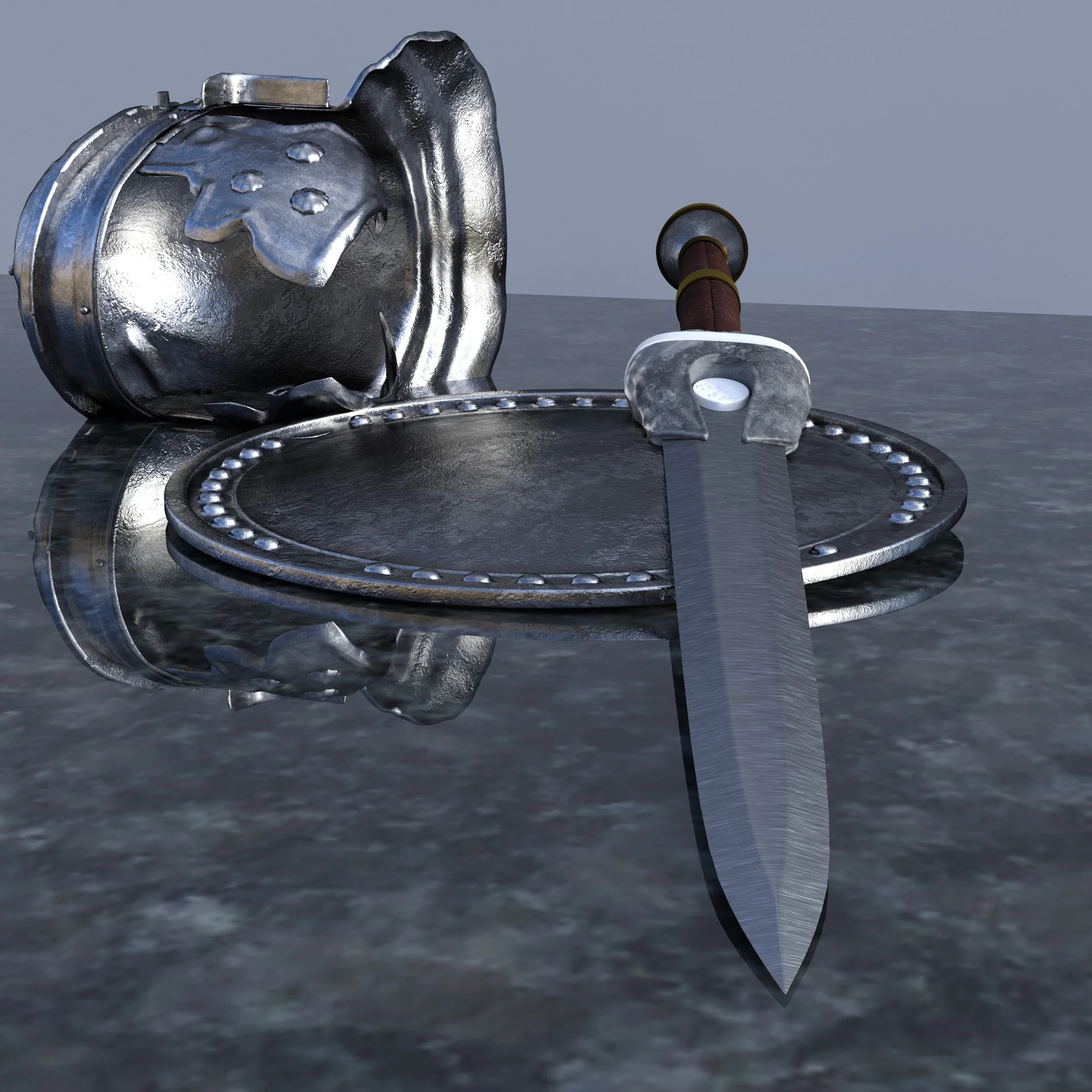
Pixabay - helm, sword, shield

3. ...the shield of faith....

So what is the shield of faith? Let's have a little discussion on faith. Faith is essentially belief. A belief in something or someone. For us as Christ followers we place our faith or our belief in Jesus Christ. When we take that step or make that choice to believe we now have faith. 

Everyone has some sort of faith. When you go to sit in a chair you have faith the chair will hold you. When you get up in the morning you have faith the sun will rise. We have faith in the medicine we take, the food we eat and the police that keep us safe. 

Our faith in Jesus is much deeper and more life changing that the faith that allows me to sit in a chair. My faith is in Christ, a person. Yes He is also God, which is a real plus!

Now faith is the assurance of things hoped for, the conviction of things not seen. For by it the men of old gained approval.By faith we understand that the worlds were prepared by the word of God, so that what is seen was not made out of things which are visible.
— Hebrews 11:1-3 (NASB)

Why does Paul refer to our faith as a shield? Ask yourself this question, what would my life be like without my faith? My answer would be, empty. A living and active faith, one that believes in a living and active God, fills our life with the breath of the Almighty and the firm foundation of a risen Savior. My faith affects everything I do, or at least it should. It should affect our choices, what we do, where we go, how we act and react. There are 378 verses in the Bible that contain the word faith (or a derivation such as faithful or faithfully, etc.). There are 259 verses in the Bible that use the word believe

Now, think about the things that affect your faith. What sorts of things shake you? What events challenge your faith? What difficulties crimp your faith and which ones cause your faith to grow? Can you think of a time that you started to doubt? Doubt that God exists, cares or loves you? Imagine if you allowed that doubt to grow? What would happen to your faith and what would happen to your life?

Faith is our shield. To fully understand how this works, let's look at the last part of Ephesians 6:16.

Pixabay - arrow/archer

4. ...with which you will be able to extinguish all the flaming arrows of the evil one.

Whoa! That's some pretty hefty battle damage, extinguishing all the flaming arrows of the evil one! It doesn't say one or two arrows, or even a few dozen, it says all. This shield of faith is capable of combatting any arrow Satan throws at us. Did you get that? All the flaming arrows.

If you want to know what these arrows look like, think about any negative thought that pops into your mind: worry, fear, despair, hopelessness, envy, lust, anger, malice, gossip....I'm sure you can add more. These are Satan's arrows. It is our faith that protects us from these fire tipped barbs. 

"I'm worried about my job....God says do not be anxious."

"I'm afraid...God has not given me a spirit of fear, but of power, love and a sound mind."

"I feel hopeless...my hope is in the Lord."

"I wish I had that...as Paul said, 'Not that I speak from want, for I have learned to be content in whatever circumstances I am.'"

"I am so angry...God's word says to cease from anger and forsake wrath, fretting only leads to evil doing."

Satan knows the greatest battle is in our mind. Look at the world we live in. Opposing ideologies, racism, terrorism, acceptance of so many things that were once seen as taboo. It would seem that our enemy is walking out in the open, reveling in every moment. Even Christians are being taken in by the lies of our enemy. That is exactly why we need to raise our shield of faith. 

It is my faith in God and His word, that enables me to take up the shield and use it against my enemy. We need to recognize the fiery arrows of our enemy and raise our shield against him. Battle on warriors! Battle on!