Embracing Sadness and Finding Joy: A Study of Our Life in Christ During the Holidays - Part 3: Bending our Knees Like the Shepherds

Merry Christmas, everyone! If you have been following along, you know I have been doing a series on embracing the emotion of sadness during the holidays as it pertains to our life in Christ. In Part 1, we looked at why it is okay to be sad, that God is the author of emotions, and tips for maneuvering grief during the holidays. In Part 2, we looked back at God’s faithfulness and how that pertains to dealing with sadness, and mulled over why remembering His faithfulness is like a wall of defense for our minds.

Today we are going to go directly to the Christmas story and look at what we can learn from the Shepherds and how that enables us to have joy, even in the midst of heartache and grief.

Image by Eduin Escobar from Pixabay

8 In the same region there were some shepherds staying out in the fields and keeping watch over their flock by night.
9 And an angel of the Lord suddenly stood before them, and the glory of the Lord shone around them; and they were terribly frightened.
10 But the angel said to them, “Do not be afraid; for behold, I bring you good news of great joy which will be for all the people;
11 for today in the city of David there has been born for you a Savior, who is Christ the Lord.
12 This will be a sign for you: you will find a baby wrapped in cloths and lying in a manger.”
13 And suddenly there appeared with the angel a multitude of the heavenly host praising God and saying,
14 “Glory to God in the highest,
And on earth peace among men with whom He is pleased.”
15 When the angels had gone away from them into heaven, the shepherds began saying to one another, “Let us go straight to Bethlehem then, and see this thing that has happened which the Lord has made known to us.”
16 So they came in a hurry and found their way to Mary and Joseph, and the baby as He lay in the manger.
17 When they had seen this, they made known the statement which had been told them about this Child.
18 And all who heard it wondered at the things which were told them by the shepherds.
19 But Mary treasured all these things, pondering them in her heart.
20 The shepherds went back, glorifying and praising God for all that they had heard and seen, just as had been told them.
— Luke 2:8-20 (NASB 1995)

Shepherding was a vital industry all throughout the Old Testament with numerous “big names” in Biblical history doing this difficult, outdoor, sometimes life threatening job. Abel, Abraham, Issac, Moses and David were all shepherds. Though the socioeconomic status of a shepherd had declined by the time of Jesus’ birth, the commitment of shepherds to care for their flocks still stood strong. They regularly faced predators that included wolves, lions, bears, hyenas, and leopards. They walked many miles to find feeding areas, as well as water. Shepherds were always vigilant. Even after the sheep were led into the fold for the night, a shepherd would place his body across the doorway to keep out unwanted predators. Apparently there were occasions where shepherds would mix their herds together for the evening to split the guarding shifts. In the morning they were easily able to sort the sheep by the sound of each shepherd’s voice.

It might be, on the night the angel came to these shepherds that was the case. Perhaps four or five shepherds had come together, and while a few of them slept the others kept watch over the sheep. I am pretty sure they were all wide awake when that angel showed up!

Image by Jeff Jacobs from Pixabay

There are many things we can learn from the shepherds that can help us in our season of sadness around the holidays. Let’s take a look.

1 - Shepherds were living life. These shepherds were doing their work. They were guarding their sheep: leading, guiding, feeding, watching, giving aid, tending to wounds, and certainly searching for any lambs that may have wandered away. Any one of those shepherds or shepherdesses (yes, women were shepherds too…talk about bad a**) could have been feeling sad. They could have been grieving the loss of a family member, the loss of a sheep (they were required to pay for any sheep lost or killed); they could have been struggling with illness, or blisters on their feet, or maybe they were discouraged because they really wanted to be a singer in the temple choir, but here they are tending sheep.

When we are dealing with sadness or grief, one of the best things to do, is keep living life. Go to work, meet with friends, get groceries, work on a closet, clean a bathroom; even the most mundane tasks that contribute to living life help us to process and get through. Listen to this quick snippet that reminds us why even making the bed can help.

2. Shepherds were brave and intelligent. Frankly I find it fascinating that shepherds were not seen as super heroes. I mean, beating off wolves, bears, an occasional lion or two had to be a tough job. These people were not weak, nor were they soft. They were weathered, strong, and probably wiry. They also had to have job intelligence, meaning they knew where to go to feed the sheep, where to find water, which in itself was a challenge in an arid climate. Sheep being what they are don’t like to drink from moving water, as it spooks them. They needed still water that wasn’t tainted with bacteria or other things that would make the sheep sick.

Image by Richard Haddeman from Pixabay

If you are working through a time of grief, learn what works for you to not only process that grief, but also the things that help you to continue living life. That will look different for every person. I personally like the “grief blanket” idea. I can allow myself to feel sadness for a time, and then get up and do other things. Maybe for you dealing with sadness is easier when you keep busy while also allowing your mind to remember why you are sad. Know what things will cause you to give in to the sickness of despair and depression, and find “safe water” to drink - like the water of God’s truth in His word.

3 - The shepherds were curious. After they got over the initial shock of seeing angelic beings, the shepherds high tailed it for Bethlehem to see the child of which they were told. In your sadness, be curious. Ask God what He wants you to learn about His character, yourself, or someone else. Be curious about Biblical accounts of people who dealt with grief and sadness. Read about Sarah, Hannah, Naomi, David, Nehemiah, Job (read the whole book to not only understand his grief, but know better the God who deals, reveals and restores,) and even Jesus as he is moved with compassion, and yes grief in the Gospel accounts.

Image by Ag Ku from Pixabay

4 - The shepherds were humble. I will acknowledge I am making an assumption about the shepherds’ humility. However, seeing the type of job they had and the lifestyle they lived I do not think they were the type of people who would put on airs and act as though they knew everything or had it all together. They really strike me as just regular, hard working people, that maybe were a bit smelly. Ha, ha. But they were real. The thing I love about this Biblical account is their unbridled enthusiasm. Why does that make them humble? Because they didn’t care about what people would think, they didn’t care that they were the best dressed, or clean, or had lots of money. They just wanted Jesus, and isn’t wanting Jesus all about humility?

Wanting the true Jesus of the Bible is about choosing to give up ourselves: our preconceived ideas, our knowledge base, our education, our upbringing, our trauma, our grief, our discouragement, our wealth, our status, our identity, and letting it all go to embrace the baby in the manger - the Wonderful Counselor, the Mighty God, the Everlasting Father, and the Prince of Peace.

For a child will be born to us, a son will be given to us;
And the government will rest on His shoulders;
And His name will be called Wonderful Counselor, Mighty God,
Eternal Father, Prince of Peace.
— Isaiah 9:6 (NASB 1995)


Embracing Sadness and Finding Joy: A Study of our Life in Jesus during the Holidays - Part 2: Remembering God's Faithfulness

If you are following along this December, I am doing a short series on the emotion of sadness during the holidays. Holidays for many are not the bright, merry celebrations we tend to hear about. Instead, they are filled with pain, hurt, anger, sadness and despair. The reasons are many, from the death of a spouse or child, to divorce, to the loss of a job or health, to the state of our country. Many people are struggling with feeling depressed and overwhelmed.

Image by Armando Orozco from Pixabay

The reason I decided to broach this topic was in part to share what I have learned about carrying sadness on a regular basis, but still being able to function and live a full and productive life. Sadness isn’t something that we necessarily need to be free of, but rather something we need to embrace and learn how to accept and manage.

Last week we looked at what embracing sadness looks like and explored a few thoughts on how we can manage our own sadness, or how we can help others who are feeling more down than usual at this time of year. Tips included: having a grieving blanket, physical activity, artistic pursuits, and allowing others to help carry the burden. Another suggestion was to remember the faithfulness of God, and that is what we are going to look at this week.

The Old and New Testaments of the Bible are full of examples of God’s faithfulness. If we are in a particular dark state of mind we might read some of the Biblical accounts and only see God’s wrath, judgment and impatience, but as with all things if we look only for the darkness, we will only encounter darkness. True freedom lies in following and embracing the light of Christ.

Image by Daniel Reche from Pixabay

1 In the beginning was the Word, and the Word was with God, and the Word was God.
2 He was in the beginning with God.
3 All things were made through him, and without him was not any thing made that was made.
4 In him was life, and the life was the light of men.
5 The light shines in the darkness, and the darkness has not overcome it.
6 There was a man sent from God, whose name was John.
7 He came as a witness, to bear witness about the light, that all might believe through him.
8 He was not the light, but came to bear witness about the light.
9 The true light, which gives light to everyone, was coming into the world.
10 He was in the world, and the world was made through him, yet the world did not know him.
11 He came to his own, and his own people did not receive him.
12 But to all who did receive him, who believed in his name, he gave the right to become children of God,
13 who were born, not of blood nor of the will of the flesh nor of the will of man, but of God.
14 And the Word became flesh and dwelt among us, and we have seen his glory, glory as of the only Son from the Father, full of grace and truth.
15 (John bore witness about him, and cried out, “This was he of whom I said, ‘He who comes after me ranks before me, because he was before me.’”)
16 For from his fullness we have all received, grace upon grace.
17 For the law was given through Moses; grace and truth came through Jesus Christ.
18 No one has ever seen God; God the only Son, who is at the Father’s side, he has made him known.
— John 1:1-18 (ESV)

God provides everything that we need to live life in this dark world, but the most important thing He provided was the Light, the life of His Son Jesus Christ. Try to imagine living in a world with no light. How would you be able to live life? There is the rather comedic aspect of running into walls, crashing into cars, and stepping on Legos in the living room, but it goes much deeper than that. Light is essential for plants to grow, which in turn produce oxygen, which gives us the ability to breath. Light is essential for our mental health. Take it from a sufferer of Seasonal Affective Disorder, sunlight is absolutely necessary for me to feel human. Light is also an important element in the deterrence of crime, otherwise, why would so many business owners leave lights on around their property?

Probably the most important aspect to light is that it lets us see. There is the physical aspect of sight which keeps us from running into things and helps us to recognize things and people. It also allows us to learn and study. Similarly, spiritual sight, given to us through the Holy Spirit, allows us to know God and His Word better. Abiding in the light enables to turn from the darkness and recognize God’s constant faithfulness.

“The Rock! His work is perfect, For all His ways are just; A God of faithfulness and without injustice, Righteous and upright is He.
— Deuteronomy 32:4 (NASB 1995)
Your lovingkindness, O Lord, extends to the heavens, Your faithfulness reaches to the skies.
— Psalm 36:5 (NASB 1995)
He will cover you with His pinions, And under His wings you may seek refuge; His faithfulness is a shield and bulwark.
— Psalm 91:4 (NASB 1995)

I find this last verse interesting. “His faithfulness is a shield and bulwark.” We all know what a shield is, but what is a bulwark? Websters online dictionary defines bulwark as: a solid wall-like structure raised for defense; a seawall; a strong support or protection. If God’s faithfulness is a shield and bulwark, then that means His faithfulness is supporting and protecting us. Might it also mean, that when we choose to remember His faithfulness, it helps protect our minds from spending too much time in the darkness? Perhaps recalling God’s faithfulness is the best way to protect ourselves from the unbridled pain and despair we can feel when we are grieving.

In other versions of the Bible instead of the word, bulwark, or rampart the word is buckler. A buckler is a small shield and to my understanding it was a shield that was used during hand to hand combat. It was a shield that was held close to the body, and could also be maneuvered to block the enemy’s strikes. Whether you like the idea of a strong wall of defense or a small shield used in daily battle with the enemy, the reality is both are true. God is our defense, and His faithfulness allows us to extinguish the flaming arrows of despair, bitterness and hatred that Satan sends our way.

As I said in my first post, sadness is an emotion God gave us and by embracing it we allow ourselves to process those strong feelings in a healthy way, but if we allow ourselves to only see the sadness, and not remember the joy, or the laughter, we risk becoming shrouded in a darkness that might lead to a place of no return.

So, how do we remember God’s faithfulness when we are feeling overwhelmed by the sad? Let’s look at a few ideas.

1 - Pray. Ask God to help you to remember His faithfulness. Perhaps you prayed for something specific and that prayer was answered. Maybe you needed direction regarding a decision and He gave it to you. Remember God is not just faithful in the big things, He’s also faithful in the tiny details. Ask Him to help you remember those times and write those things down.

I did this recently, and God brought to my mind His faithfulness to me as a child. Growing up in a Bible believing church, I was fortunate to be surrounded by Biblical teaching, but hearing God’s word, does not necessarily mean we will follow Him. When I was very young, perhaps in kindergarten or 1st grade I had a Sunday School teacher named Miss Draper. An older, single woman, she was all vim and vinegar, but she genuinely cared about her students. I remember she took a trip to Europe. When she came back she had gifts for each of the children in her class. When I opened mine it was a little chalet of sorts. The roof opened and from within came the most beautiful music. Her gesture of kindness set me on a road of wanting to know Jesus. Oh what the love of a person living in obedience to Christ can do to change the world.

Image by Steve Haselden from Pixabay

2 - Read Scripture. I know these suggestions are not anything new, but how much more we need to be seeking our precious Lord, when we are in the throes of sadness and heartbreak. Scripture is full of examples of God’s faithfulness. Think of His provision for Adam and Eve’s nakedness after the fall (Genesis 3:21); or what about His faithfulness to Noah and His family during a catastrophic, world wide flood (Genesis 7:23); and don’t forget the restoration He gave to Job after allowing Satan to take everything away (Job 42:10-17); and one of my favorite accounts of His lovingkindness was to Ruth, a woman not even a Jew, given a place in the lineage of Jesus our King of Kings (Ruth 4). Start to finish, the Bible is a ribbon of God’s faithfulness, provision, love and intervention on the behalf of humanity, the greatest of these being Christ’s entry into our world as a baby.

mage by Ingela Skullman from Pixabay

3 - Look for God’s faithfulness and provision in the day to day. All may seem bleak until we start exercising the eyes of our hearts. Our physical eyes might only see the darkness; the pain, the despair, the unknown, but our spiritual eyes can see things beyond this physical world.

15 For this reason I too, having heard of the faith in the Lord Jesus which exists among you and your love for all the saints,
16 do not cease giving thanks for you, while making mention of you in my prayers;
17 that the God of our Lord Jesus Christ, the Father of glory, may give to you a spirit of wisdom and of revelation in the knowledge of Him.
18 I pray that the eyes of your heart may be enlightened, so that you will know what is the hope of His calling, what are the riches of the glory of His inheritance in the saints,
19 and what is the surpassing greatness of His power toward us who believe. These are in accordance with the working of the strength of His might
20 which He brought about in Christ, when He raised Him from the dead and seated Him at His right hand in the heavenly places,
21 far above all rule and authority and power and dominion, and every name that is named, not only in this age but also in the one to come.
22 And He put all things in subjection under His feet, and gave Him as head over all things to the church,
23 which is His body, the fullness of Him who fills all in all.
— Ephesians 1:15-23 (NASB 1995)

Paul’s prayer pertains to us when we are grieving. He prays that we would see with the eyes of our hearts so that: we would know the hope of His calling, the riches of the glory of His inheritance in the saints, and what is the surpassing greatness of His power toward us who believe. Look and see.

Image by Adrian from Pixabay

4 - Treasure thanksgiving. Having just celebrated Thanksgiving a few weeks ago here in the U.S. it is good to take this idea into the Christmas holidays, especially when we are sad. Giving thanks is not only a mood lifter, but it forces us to refocus our mind from the darkness to the light. Start small if that is all you can manage. Thank God for a warm bed, a hot shower, food, clean water, and a place to live. Even if all of these were striped away from us, we could still be thankful for Him; for His presence; for His character; for the fact that He does not change. Is it always easy to give thanks? No. But it is desired by our Creator.

in everything give thanks; for this is God’s will for you in Christ Jesus.
— 1 Thessalonians 5:18 (NASB 1995)

I hope this week you will find many moments to remember God’s faithfulness.

Embracing Sadness and Finding Joy: A Study of our Life in Jesus During the Holidays - Part 1: Embracing the Sad

The Holy Spirit inspired me one morning while I was doing my devotions to put together a short series for the month of December. The holidays can be a wonderful time of year, filled with activity, family and friends. However, for many, they can also be a time of great sadness and depression. People who have experienced loss can feel the holidays to be more of a prison, than a time of levity and light. Christmas, while exciting and full of anticipation, can become dark and foreboding for people who are struggling.

Image by patrycja1670 from Pixabay

In this post, I want to look at a few important points to remember when we are maneuvering the holidays, whether we are experiencing sadness ourselves, or we are walking with others through their feelings of grief and anxiety.

1 - Sadness is an emotion God gave us.

Being created in the image of God we were made, not to be robots programed from the great beyond with no ability to show emotion, but to have a broad range of feelings from happiness and joy, to fear and worry, to anger and frustration. Emotions were given to us, not to make us weak, but to give us greater strength to survive, live and to have a relationship with others and with our Creator.

26 Then God said, “Let us make man in our image, after our likeness. And let them have dominion over the fish of the sea and over the birds of the heavens and over the livestock and over all the earth and over every creeping thing that creeps on the earth.”
27 So God created man in his own image,
in the image of God he created him;
male and female he created them.
— Genesis 1:26-27 (ESV)

How would we have relationships without emotion? How would we know the emotion of peace, if we did not experience fear? How would we know the feeling of joy if we did not experience sorrow? How would we know love if we did not experience loss?

Emotions are a part of who we were created to be, and when given over to God, can be an integral part in making us whole as a person, and more suited to serve God and others. Here is a good article from Focus on the Family - What Does the Bible Say About Emotions?

2 - Sadness needs to be acknowledged and felt.

In one of my therapy sessions a few months ago, I told my counselor that my husband and I often feel we are experiencing “existential fatigue in the land of eternal sadness.” She thought that was a very interesting way to describe our lives at that point in time. She went on to explain that sadness was not a bad thing. In fact feeling sad was how our minds acknowledged that something was or is very important to us.

Grief is a very real emotion and is felt by more than just someone who has lost a loved one. Grief is felt by partners who are in the midst of divorce; by children who now have to split their time between parents; by the man who just lost his job of 30 years; by the woman who lost a breast to cancer; and even by the employee who now has to learn yet another new computer program to do their work. The difficulty comes when we push the sadness down and try to get past it without truly processing it.

When my father passed away back in 2006, I had never really experienced grief before other than the loss of a pet. I had never known my maternal grandparents, and we did not see my paternal grandparents all that often. When my grandfather died, I was pretty young, and when my grandmother passed I was in college and didn’t even get home for her funeral. However, my dad passing away was different. I remember quite distinctly wondering if he was cold as he lay in that grave that first cold January night after he was buried.

I began a grief journal which allowed me to process, and I began to think of grief as a blanket. When I needed to feel that sadness, I would wrap up in that imaginary blanket and feel the pain. I would remember good things and even some of the bad about my dad and growing up as the youngest of three. When I felt I processed enough for a while, I would mentally fold the blanket back up and put it in an imaginary trunk where it would be ready for the next time I needed it.

We see the psalmist in the Old Testament grieving out loud in many of the psalms. Let’s look at a few.

1 I cry aloud to God,
aloud to God, and he will hear me.
2 In the day of my trouble I seek the Lord;
in the night my hand is stretched out without wearying;
my soul refuses to be comforted.
3 When I remember God, I moan;
when I meditate, my spirit faints. Selah
4 You hold my eyelids open;
I am so troubled that I cannot speak.
5 I consider the days of old,
the years long ago.
6 I said, “Let me remember my song in the night;
let me meditate in my heart.”
Then my spirit made a diligent search:
7 “Will the Lord spurn forever,
and never again be favorable?
8 Has his steadfast love forever ceased?
Are his promises at an end for all time?
9 Has God forgotten to be gracious?
Has he in anger shut up his compassion?” Selah
— Psalm 77:1-9 (ESV)

In this psalm the writer is so grieved he feels that God has forgotten him. God is not offended by these feelings. He knows our hearts and He wants us to acknowledge these feelings and bring them to Him.

1 Save me, O God!
For the waters have come up to my neck.
2 I sink in deep mire,
where there is no foothold;
I have come into deep waters,
and the flood sweeps over me.
3 I am weary with my crying out;
my throat is parched.
My eyes grow dim
with waiting for my God.
— Psalm 69:1-3 (ESV)

I think most of us have felt this way at some point in time….up to our neck in the mire of trouble, fear and sadness. Acknowledging these emotions God gave us is important for our mental health and for our relationships.

3. Embracing the sad without losing our minds.

How then, do we embrace sadness without being overcome with the many other emotions that surround grief like anger, frustration, or fear? In addition, how do I walk through grief without heading down the road of depression, or anxiety? Seeing as I am not a psychiatrist, or a certified counselor, the tips I am going to list here are suggestions, and in no way should replace the sound advice of a professional. If you feel too overwhelmed to navigate sadness on your own, please seek help.

A - Take out the blanket. I think having an actual, physical blanket that you use specifically for grieving is a great way to not only have a physical connection to sadness, but also a way to be kind to yourself by cuddling up in a cozy, soft blanket. In addition it allows a set time for you to purposefully feel sadness.

Image by PublicDomainPictures from Pixabay

B - Turn to physical activity. I am not just talking about exercise, although that is at the top of the list, but even activity done with your hands like dishes, laundry, mending, ironing, or baking. Not only are you getting your mind off the grief for a little while, but you may be getting a few things done. Let’s face it, in times of sadness a lot of things go undone, because we are just trying to survive.

Walking, especially outdoors is another great physical activity that allows us to turn from sadness to feeling the chill in the air, or smelling the wonderful smells of the changing seasons. If you can stand being in a crowd, go to the mall and people watch, or take yourself out for lunch. Being kind to ourselves during times of sadness is very important.

C - Allow the tears. Crying is a great way to release pent up cortisol, and too much cortisol can result in feelings of anxiety, panic and shutting down. God knows every one of our tears, so like the psalmist, don’t be afraid or ashamed to cry out to Him.

Image by Md Nirob Bhuiyan from Pixabay

D - Incorporate artistic snippets into your daily routine. Look for music, art, small craft projects, or even coloring to do in your down time. Music is always a mood booster, or even a mood embracer. Listening to sad music, or watching a sad movie, might also help with that cortisol release. There are hundreds of adult coloring books that provide mindless activity, but also enable you to keep busy creating a colorful picture without the pressure to perform.

E - Get up. Take a shower. Get dressed. When a person is in the throes of heart wrenching grief, even those first steps each day of getting up, taking a shower and getting dressed are steps towards the future; of moving on without that loved one; of acknowledging I am important too and need to keep going.

Image by Olya Adamovich from Pixabay

F - Remember. This is two-fold. There may be times when you don’t have the time to take out the blanket and properly grieve, but it is okay to remember. Memories are part of the process to acknowledge grief, and also move on at the same time.

In addition, if you are a Christ follower, remember God’s faithfulness. The psalmist did just that.

10 Then I said, “I will appeal to this,
to the years of the right hand of the Most High.”
11 I will remember the deeds of the Lord;
yes, I will remember your wonders of old.
12 I will ponder all your work,
and meditate on your mighty deeds.
13 Your way, O God, is holy.
What god is great like our God?
14 You are the God who works wonders;
you have made known your might among the peoples.
15 You with your arm redeemed your people,
the children of Jacob and Joseph. Selah
16 When the waters saw you, O God,
when the waters saw you, they were afraid;
indeed, the deep trembled.
17 The clouds poured out water;
the skies gave forth thunder;
your arrows flashed on every side.
18 The crash of your thunder was in the whirlwind;
your lightnings lighted up the world;
the earth trembled and shook.
19 Your way was through the sea,
your path through the great waters;
yet your footprints were unseen.
20 You led your people like a flock
by the hand of Moses and Aaron.
— Psalm 77:10-20 (ESV)

G - Don’t try to carry sad on your own. God meant for us to depend, not only on Him, but on others. Whether you make an appointment to speak with a counselor, or you have a lunch date with a family member, or you take a walk with a friend, allow people to know what you are carrying and ask them to help.

H - Help others. Helping others, especially during the holiday season is another way to help us through a time of sadness and grief. It reminds us that others are struggling too, and I can still help out, even though I am experiencing sadness.

This brings me to my final point. How do I help others who are going through the sadness, especially at the holidays?

Image by Vinzent Weinbeer from Pixabay

1 - Check in on people. Don’t let people maneuver their grief alone. Learn how to help by asking questions. Maybe they don’t need your advice, but a home cooked meal and your presence to eat it with them can make all the difference.

2 - Pray, and share God’s words of encouragement. We all know the holidays can be extra hard, especially for people who are grieving the loss of a loved one, or the loss of their own health. They need you to check in, but they also need you to pray for them. I know for me personally someone who takes the time to pray with me over the phone or in person reminds me I am seen and cared for.

3 - Don’t assume. It is easy to assume that people are doing just fine because they are past whatever initially made them sad in the first place, but often that is not the case. People can grieve for months over things like job loss and health problems, or years over the loss of a spouse or child. Don’t assume they have moved on. The best way to know is to talk to people and be curious without being pushy.

4 - Be there. I know life is crazy busy, but when you can, make the choice to be present in the other person’s life. Call, text, send them a note, invite them to share a meal, take them to a movie or an event. Be a true friend by showing them you care with your time.

Next week we will be looking more closely at remembering God’s faithfulness when we are in a season of sad. Until then, I wish you moments of utmost joy as you head towards this Christmas!

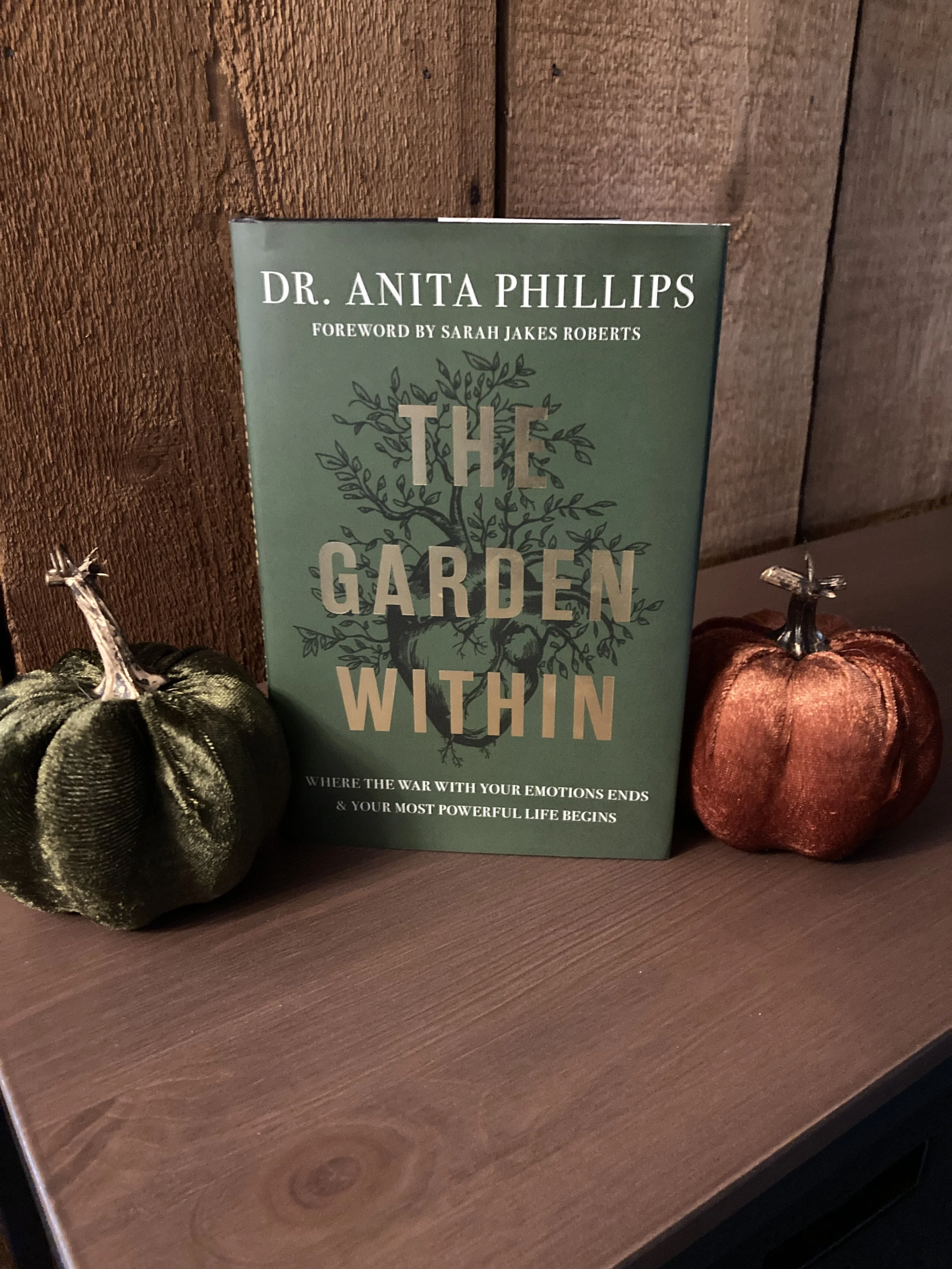
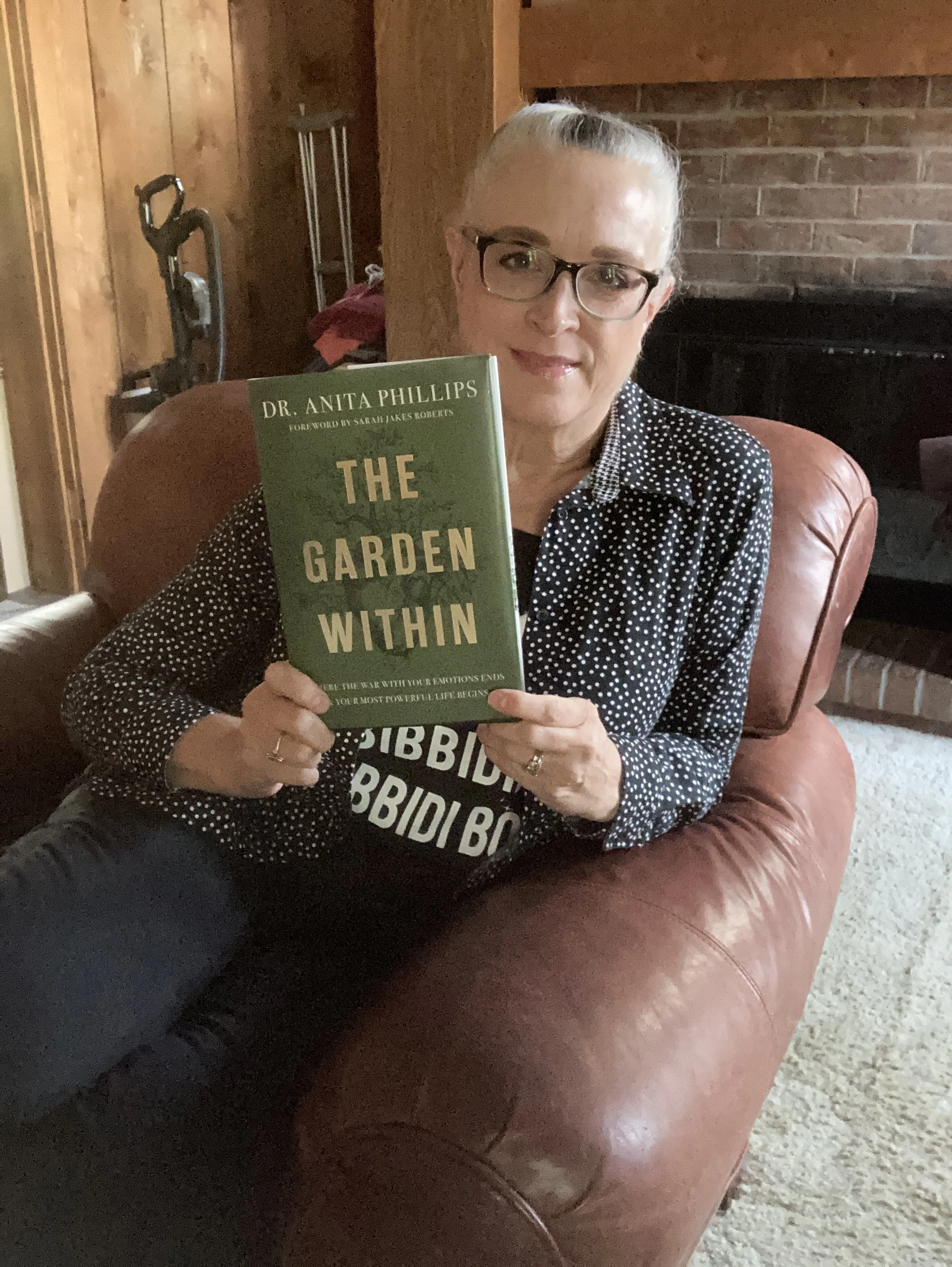
Book Review - The Garden Within by Dr. Anita Phillips

I was given the opportunity by Frontgate Media to review another book. In exchange for the review I am provided with a free copy of the book. I like to be choosy about which things I review and recommend to you, the readers and subscribers of my blog. I try to choose things that speak to where we are as women, and more specifically, women of faith.

The Garden Within by Dr. Anita Phillips is another book I found compelling and useful. Dr. Phillips is a minister, therapist, and life coach.

Widely recognized as a thought leader at the intersection of mental health, faith and culture, Dr. Anita holds degrees from the University of Maryland and Regent University and completed a postdoctoral fellowship at the Johns Hopkins Bloomberg School of Public Health.
— The Garden Within - Book Jacket

In this book Dr. Phillips discusses why embracing our emotions is key to living a truly powerful life. She combines ideas from neurobiology, faith and her own research in showing how strengthening our emotional well being will also help to strengthen our physical bodies, renew our minds and reawaken our spiritual joy.

She believes God created us with the heart as the center of the human experience, rather than the mind. She also believes Jesus, who was completely in touch with His emotions, understood this to be true, and offers examples from the scripture from weeping in front of Lazarus’ tomb (John 11:35), to anger in the temple over the money changers (Matt. 21:12), to wrestling in the garden with the anguish of what awaited him on the cross (Luke 22:42).

You don’t need to overthrow your emotions to experience a revolution in your life. You just need to overthrow the lies you have believed about your emotions. The Creator designed your heart to be a garden, not a war zone. A truly powerful life isn’t won. It’s cultivated.
— The Garden Within - p. xxv

The Garden Within is divided into three sections: Part 1 - Soil Power, Part 2 - Deeply Rooted, and Part 3 - The Embodied Garden. Each of these sections takes a look at our emotional tapestry through the analogy of a garden.

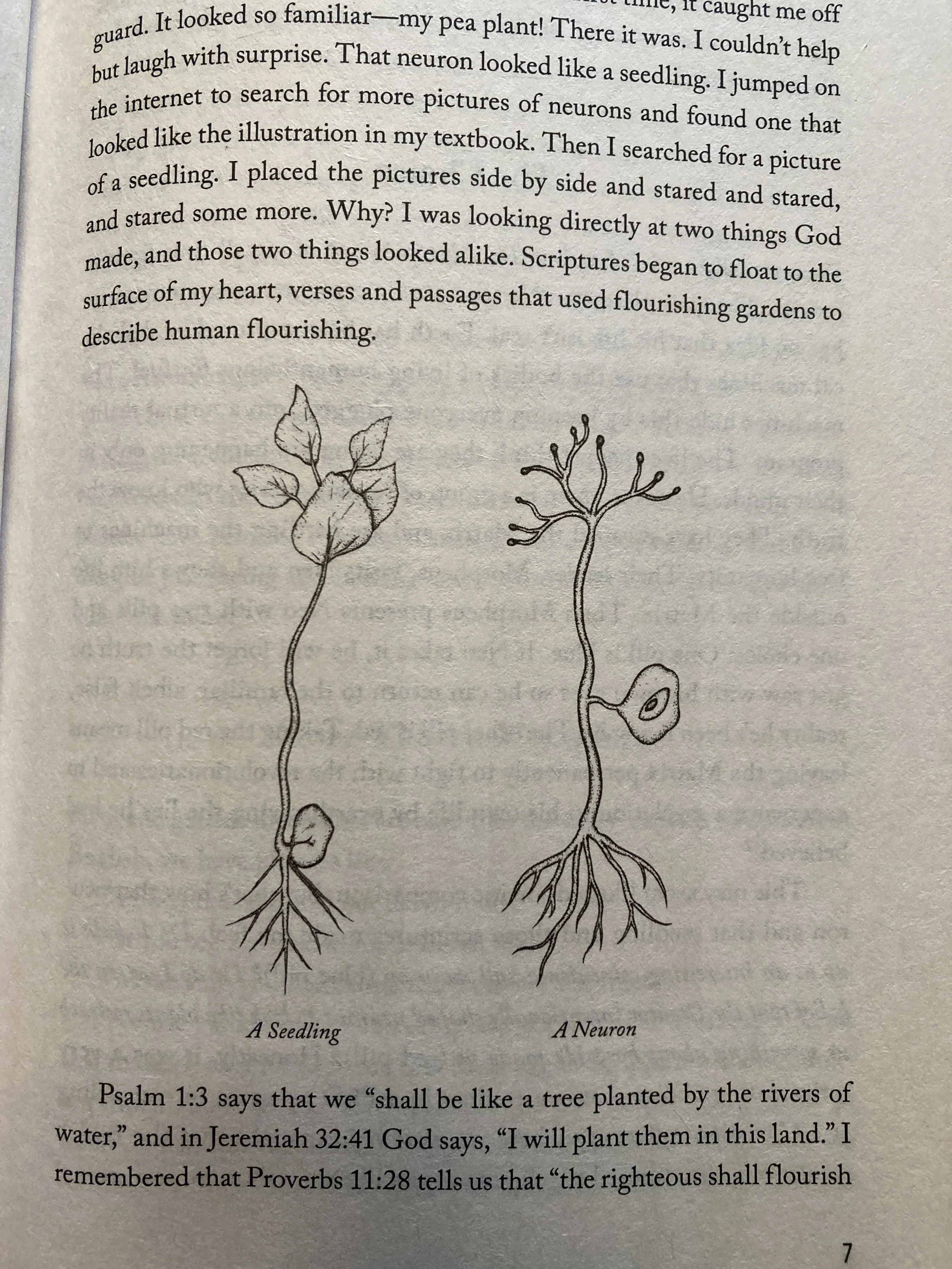
When Anita was a child in 5th grade science class she was fascinated by her teacher’s assignment of growing a pea plant in wet paper towels rather than dirt. Her teacher wanted the students to understand how much growth went on before the plant was ever above the soil. Her fascination with plants continued all throughout her education, but when she was a mother of two, a licensed therapist and working on her PhD she found herself again in a science class.

At the same time Anita was delving into a study of the book of Romans. Only a few verses into the first chapter she was stunned by Romans 1:20.

20 For since the creation of the world His invisible attributes are clearly seen, being understood by the things that are made, even His eternal power and Godhead, so that they are without excuse,
— Romans 1:20 (NKJV)

The next day her assigned reading was an introduction to neurons. Upon, seeing a picture of a neuron she was flabbergasted to see it looked almost exactly like her pea plant. God had made both the pea plant and the neuron. Anita realized there were to many passages in scripture that had to do with plants, trees and gardens. These passages were used to teach spiritual lessons and guidelines for living. She felt God was revealing to her a deep connection between the world as He created it and the world He created inside of us in the form of our emotions, thoughts and actions.

Illustration from The Garden Within - p. 7

Dr. Phillips found herself searching for answers to a number of questions and this is what she discovered:

1 - How does Scripture define well-being? As a garden. (Isaiah 58:11)

2 - What is mean to grow in the garden? Relationships, purpose and legacy - things that give our life meaning.

3 - Where is the garden planted? In the soil of our hearts.

4 - What makes that soil fertile? Faith, hope and love.

5 - What is emotional well-being? Our capacity - and willingness - to be aware of, acknowledge, and experience all our emotions.

6 - What happens when we cultivate emotional well-being? We unleash, sustain and nourish the full power of the word-seeds that we choose to plant in our garden within.

7 - Is this what it means to live a powerful life? Yes.

(Points taken from The Garden Within - pp. 43-44)

Anita uses the events of Creation, and the Parable of the Sower and the Seed to further expand on these points and show us how to begin cultivating our own garden within by first determining what we want to grow in the three zones of relationships, purpose and legacy. We then prepare our soil, or our hearts by pulling weeds and cleaning and checking the soil by being aware of how we are doing emotionally. Next we set up a watering system. Just as gardens have to be intentionally watered, so too our emotional well being needs to be taken care of. Finally, we determine to plant good seeds.

Our spiritual well being hinges on the quality of the word-seeds sown because they determine what we believe is true about God and ourselves. Each seed is a potential blessing or potential curse.”
— The Garden Within - p. 71

Anita points out that these word-seeds come to us from all directions including things we tell ourselves. What we choose to plant, or listen to, will determine what grows in the garden of our hearts.

There is a lot of information in this book and I personally feel it will require several readings to fully grasp all the concepts and wisdom within its pages. However, Dr. Phillips does address a number of prominent emotions: sadness (including loneliness and grief), anger, and fear. She gives examples and outlines a therapeutic processes for each emotion to help dig in and cultivate the soil in our hearts.

I would recommend this book for anyone who has gone through emotional trauma, or who has just been part of the “don’t express it, or talk about it” culture. I am going to be reading through this again and taking notes to glean even more. If yo would like to buy your own copy of The Garden Within by Dr. Anita Phillips, just click on the link.