Faith Musings: Nothing to Boast About - Part 8

I have been doing a series that looks more in depth at the first couple of chapters of 1 Corinthians. You can see each of the previous parts in this series by clicking on the following links: Part 1, Part 2, Part 3, Part 4, Part 5, Part 6, and Part 7. Today we are going to dive deeper into the role of the Holy Spirit in our lives.

Image by Aritha from Pixabay

10 For to us God revealed them through the Spirit; for the Spirit searches all things, even the depths of God.
11 For who among men knows the thoughts of a man except the spirit of the man which is in him? Even so the thoughts of God no one knows except the Spirit of God.
12 Now we have received, not the spirit of the world, but the Spirit who is from God, so that we may know the things freely given to us by God,
13 which things we also speak, not in words taught by human wisdom, but in those taught by the Spirit, combining spiritual thoughts with spiritual words.
14 But a natural man does not accept the things of the Spirit of God, for they are foolishness to him; and he cannot understand them, because they are spiritually appraised.
15 But he who is spiritual appraises all things, yet he himself is appraised by no one.
16 For who has known the mind of the Lord, that he will instruct Him? But we have the mind of Christ.
— 1 Corinthians 2:10-16 (NASB 1995)

Let’s get a running start at the next few verses.

Now we have received, not the spirit of the world, but the Spirit who is from God, so that we may know the things freely given to us by God,

If you read through last week’s post you know that when we receive Christ as our Lord and Savior we do not receive the spirit of the world, which has to do with the mindset of the world, a mindset that is against God and all He wants us to know. We receive the Spirit who is from God, or the Holy Spirit. We are given the Holy Spirit as a help so that we might know the things of God which are freely given to us.

In other words, the Holy Spirit is the one who gives us understanding of God’s mind and ways. He gives us understanding of the Words of God in the Holy Scriptures, and He enables us to have God’s wisdom in all situations.

…which things we also speak…

Image by Naveen Goyal from Pixabay

Paul was referring to himself and the preaching, teaching and letter writing he was doing for the churches

…not in words taught by human wisdom, but in those taught by the Spirit…

Image by Raindom from Pixabay

Paul, is one of the most famous of the apostles, whose own testimony tells of him persecuting the Christian church with a fervor that included having many believers imprisoned and killed. On the road to Damascus Jesus appeared to him (at the time Saul) in a bright, blinding light and questioned, “Saul, Saul, why are you persecuting me?” (See Acts 9.) Saul became Paul and became a major contributor to the spread of the Gospel.

This same Paul was not teaching or preaching words that came from his own human wisdom, but words taught to him by the Holy Spirit. While he was alive at the time of many of the disciples, he was not one of the twelve that originally lived and walked with Jesus. His learning was not first hand, but through the work of the Holy Spirit, just as ours is.

I love this, especially when I feel utterly stupid in my Christian faith. Obviously, I know lots of things, just as Paul did, but my book learning is not what drives me to write these posts. I do it as a ministry of the Holy Spirit to encourage anyone in their Christian walk. Believe me, I have had numerous moments where I have been ready to give it all up, but it is then that I get that little prodding in the back of my mind. Even if only one person benefits there is a ripple affect with a single drop of water.

…combining spiritual thoughts with spiritual words

Image by Hans from Pixabay

27 As for you, the anointing which you received from Him abides in you, and you have no need for anyone to teach you; but as His anointing teaches you about all things, and is true and is not a lie, and just as it has taught you, you abide in Him.
— I John 2:27 (NASB 1995)

I came across this verse in 1 John some months ago and and it keeps coming back around to me. It talks about our anointing which we received from Him and abides in us. This anointing is not something special that only comes to those who are prayed over for the ministry. His anointing is the living, breathing, Holy Spirit inside of us when we accept Christ.

As we see with Paul, and I would say even someone like Charlie Kirk, they did not need a theology degree to speak, preach or teach. They got their words, responses, messages from the Holy Spirit who dwelled inside of them. This verse clearly tells us that we have no need for anyone to teach us because the Holy Spirit teaches us about all things and He is true and not a lie.

Now, do we need to be careful to not take this out of context and start spouting off anything that comes to mind? Yes! But do we need to hide the light of Christ under a bushel because we are not “educated” and might not know what to say? No!! We are meant to be the light of Christ in a dark world, and can be confident engaging people in conversations about Christ because His Holy Spirit lives in us.

I will add to this idea next time as we finish off this chapter.

Have a great week and remember you are anointed by God and have the Holy Spirit in you. Abide in Him and shine His light!

Faith Musings: Nothing to Boast About - Part 3

This second chapter of 1 Corinthians seems a perfect continuation of the verses we looked at previously in Faith Musings: Nothing to Boast About - Part 1, and Nothing to Boast About - Part 2.

Image by Joe from Pixabay

1 And when I came to you, brethren, I did not come with superiority of speech or of wisdom, proclaiming to you the testimony of God.
2 For I determined to know nothing among you except Jesus Christ, and Him crucified.
3 I was with you in weakness and in fear and in much trembling,
4 and my message and my preaching were not in persuasive words of wisdom, but in demonstration of the Spirit and of power,
5 so that your faith would not rest on the wisdom of men, but on the power of God.
6 Yet we do speak wisdom among those who are mature; a wisdom, however, not of this age nor of the rulers of this age, who are passing away;
7 but we speak God’s wisdom in a mystery, the hidden wisdom which God predestined before the ages to our glory;
8 the wisdom which none of the rulers of this age has understood; for if they had understood it they would not have crucified the Lord of glory;
9 but just as it is written,

“Things which eye has not seen and ear has not heard,
And which have not entered the heart of man,
All that God has prepared for those who love Him.”
— I Corinthians 2:1-9 (NASB 1995)

Paul continues his discourse on the wisdom of God versus the foolishness of man by stating that when he came to the church at Corinth he did not preach by his own ability, but by the ability God gave him.

“And when I came to you, brethren, I did not come with superiority of speech or of wisdom, proclaiming to you the testimony of God.”

If anyone could have boasted in his own abilities it was Paul. Born a Hebrew, he was raised in the prosperous city of Tarsus, a center for trade on the Mediterranean coast, a city which also housed a well known school.

Image by sebastiano iervolino from Pixabay

4 although I myself might have confidence even in the flesh. If anyone else has a mind to put confidence in the flesh, I far more:
5 circumcised the eighth day, of the nation of Israel, of the tribe of Benjamin, a Hebrew of Hebrews; as to the Law, a Pharisee;
6 as to zeal, a persecutor of the church; as to the righteousness which is in the Law, found blameless.
— Philippians 3:4-6 (NASB 1995)
6 But perceiving that one group were Sadducees and the other Pharisees, Paul began crying out in the Council, “Brethren, I am a Pharisee, a son of Pharisees; I am on trial for the hope and resurrection of the dead!”
— Acts 23:6 (NASB 1995)

Paul referred to his upbringing not to boast in his abilities, but to appeal to the audience he was talking to. He always made clear that his abilities to teach and preach were from God .

For I determined to know nothing among you except Jesus Christ, and Him crucified.

This stands out to me for two reasons. First, Paul determined. This word does not give us a feeling of being wishy washy. It shows us the apostle was firmly resolved. It is convicting to me, because when I ask myself what am I firmly resolved or determined about, I realize in this chaotic world we are living in I have become more uncertain, unsure and even doubtful about many things, even my relationship with Christ. Yes, there are things I am sure of: my salvation, the Bible, God’s good character and so on. Perhaps, like Paul I need to focus on the main thing.

Image by DetBe from Pixabay

Second, what was Paul determined to know? Nothing…except Jesus Christ, and Him crucified. Why is this so important? Isn’t it more important to preach and teach love? After all Christ loves us and desires that we all be in heaven with Him. This is where I am beginning to see disparity in the church. If we do not preach the reason Christ came, and had to be crucified, all the love in the world will not fix all that is wrong with it. Christ came because we are sinners. Not one of us is good enough to earn our way into heaven, no matter how much love we show. And the truth is, if I only preach the love of God, then I do not really love. We have to talk about the darkness, the disobedience, and the distance between us and Him.

Remember these verses? Jesus said of Himself:

6 Jesus said to him, “I am the way, and the truth, and the life; no one comes to the Father but through Me.
— John 14:6 (NASB 1995)
5 I am the vine, you are the branches; he who abides in Me and I in him, he bears much fruit, for apart from Me you can do nothing.
6 If anyone does not abide in Me, he is thrown away as a branch and dries up; and they gather them, and cast them into the fire and they are burned.
— John 15:5-6 (NASB 1995)
23 He who hates Me hates My Father also.
24 If I had not done among them the works which no one else did, they would not have sin; but now they have both seen and hated Me and My Father as well.
25 But they have done this to fulfill the word that is written in their Law, ‘They hated Me without a cause.’
— John 15:23-25 (NASB 1995)
18 “Behold, we are going up to Jerusalem; and the Son of Man will be delivered to the chief priests and scribes, and they will condemn Him to death,
— Matthew 20:18 (NASB 1995)
31 And He began to teach them that the Son of Man must suffer many things and be rejected by the elders and the chief priests and the scribes, and be killed, and after three days rise again.
— Mark 8:31 (NASB 1995)

These are just a few of many verses in the Gospels where Christ talks about His purpose, which was to be obedient to the Father, and die on a cross for sinful humanity.

Does the Bible talk about God’s love? Of course it does. One of the most famous verses many of us memorized as youngsters in church follows:

16 “For God so loved the world, that He gave His only begotten Son, that whoever believes in Him shall not perish, but have eternal life.
— John 3:16 (NASB 1995)

Image by Engin Akyurt from Pixabay

However, even this verse talks about God’s love in the context of our need, and our sin. Why would we perish if we were perfect? Why would we need God if love was the answer to all our problems? Love is the answer, but it is God’s love; God’s pure, perfect, and holy love.

I would like to let these first two verses of this second chapter of 1 Corinthians sink in for the next week. Do you think we need to be more determined like Paul? If so, what are we to be determined about? I’d love to hear your thoughts, so leave a comment or two below.

Until next week, have a great weekend!

Faith Musings: Nothing to Boast About - Part 1

I want to apologize for the inconsistent status of my blog right now. Life is, as it has so often been in the last decade, relentless. Just trying to live each day has become something closer to survival and I often have to stop myself from saying, “If I can just make it to 5:00, or if I can get to Friday…” Many of you are living this life as well, so I know you get it.

It seems somewhat appropriate that the thoughts coming to my heart and spirit today for this blog post are a bit of a continuation of my post from last week on The Plague of Individuality. I was searching the Scriptures wondering what to write about and this passage came across my line of sight.

18 For the word of the cross is foolishness to those who are perishing, but to us who are being saved it is the power of God.
19 For it is written,

“I will destroy the wisdom of the wise,
And the cleverness of the clever I will set aside.”

20 Where is the wise man? Where is the scribe? Where is the debater of this age? Has not God made foolish the wisdom of the world?
21 For since in the wisdom of God the world through its wisdom did not come to know God, God was well-pleased through the foolishness of the message preached to save those who believe.
22 For indeed Jews ask for signs and Greeks search for wisdom;
23 but we preach Christ crucified, to Jews a stumbling block and to Gentiles foolishness,
24 but to those who are the called, both Jews and Greeks, Christ the power of God and the wisdom of God.
25 Because the foolishness of God is wiser than men, and the weakness of God is stronger than men.
— I Corinthians 1:18-25 (NASB 1995)

I want to focus on these verses and what follows for the next few weeks. From these eight verses we can see that God’s wisdom and man’s wisdom are vastly different. What man deems as wisdom, God deems as foolishness. What God sees as wise, the world sees as ludicrous. Let’s take a closer look.

The Cross - Foolishness or Power?

Verse 18 says “…the word of the cross is foolishness to those who are perishing, but to us who are being saved it is the power of God.” Paul used the phrase, “the word of the cross” in reference to the preaching and teaching of the gospel: the life, death and resurrection of Jesus. It is in the cross, and its purpose that we only experience the true power and might of God.

The world sees the cross of Christ as a crutch; as something offensive and undesirable, just as the Jews of Jesus’ time did. They could not believe Jesus was the chosen One of God, nor could they believe He was the Son of God as He had claimed, because that would mean everything they had built to control and govern their people would come crashing down around them. Jesus was supposed to be a victorious king; a man of noble birth. He certainly wasn’t suppose to be the son of a carpenter and die a horrible death on a few pieces of splintered wood.

As Christ followers it is in this “foolishness” of the cross we find our greatest power. Jesus and the sacrifice of His own life on that cross has given us the ability to not only have life in Him, but to have abundant life here on this earth, even amidst the struggles and relentlessness of the fleshly grind. The cross and the blood that flowed is what gives us hope. The cross is the reminder that we are not our own, but bought with a price. The cross deletes all our boldest attempts to have peace with God, because we can’t. Only the cross could do this!

…For it is written…

I cannot say enough how important the written word of God is to the believer’s faith walk. It is with increasing numbers that people, including our children, have walked away from the faith because they have chosen to disbelieve the authority and validity of the written word. Books like Josh McDowell’s Evidence That Demands a Verdict, and Lee Strobel’s The Case for Christ, are just two of the many books that explore the claims surrounding the inspiration, writing and collection of the word of God as it is laid out in our Bibles.

However, the true test of the validity of scripture is the Word itself. It baffles me how a person can read a news article, take it as God’s honest truth, with little validation, but the Bible which has been around for centuries is constantly doubted and touted as having all sorts of inconsistencies, etc. Jesus himself attested to the validity of God’s word in His high priestly prayer.

17 Sanctify them in the truth; Your word is truth.
— John 17:17 (NASB 1995)

The Wisdom of the Wise, or of God.

What follows, “For it is written…” is a reference to Isaiah 29:14. The main message of this Old Testament chapter had to do with the warning God was giving Jerusalem for pretending to follow His ways and His laws, but not really meaning it in their hearts. Matthew Henry’s Commentary says it rather well:

Image by djedj from Pixabay

Here, I. The prophet stands amazed at the stupidity of the greatest part of the Jewish nation. They had Levites, who taught the good knowledge of the Lord and had encouragement from Hezekiah in doing so, 2 Chron. 30:22. They had prophets, who brought them messages immediately from God, and signified to them what were the causes and what would be the effects of God’s displeasure against them. Now, one would think, surely this great nation, that has all the advantages of divine revelation, is a wise and understanding people, Deut. 4:6. But, alas! it was quite otherwise, Isa. 29:9. The prophet addresses himself to the sober thinking part of them, calling upon them to be affected with the general carelessness of their neighbours.
— Matthew Henry's Commentary

What follows is God’s discipline of His people by taking away their ability to be wise or clever. Does this seem at all familiar? “Where is the wise man? Where is the scribe? Where is the debater of this age? Has not God made foolish the wisdom of the world?”

The rest of this passage reminds us that it is through God’s wisdom, not man’s, that He is found. In other words, we can read all the books, listen to all the podcasts, watch all the YouTube How To’s, follow all the health, spirituality, exercise and mental well being gurus and still never find our way to God. The Jews asked for signs, which they rejected, because they could not believe Jesus was the long awaited Messiah. The Greeks searched for wisdom, but when it came in the form of the gospel of Jesus Christ it was just foolishness.

The wisdom of God is Christ crucified. This is our power. This is our wisdom.

Because -

The foolishness of God is wiser than men,

And -

The weakness of God is stronger than men.

All we need to do is put our trust in Him. End of story.

Faith Inspiration: Oswald Chambers - Our Great Capacity for God - Part 5: The Plague of Individuality

Since it has been a while since I have posted under this Faith Inspiration post, I wanted to give a bit of a refresher. We have been looking at a quote from Oswald Chambers, which inspired me to dive deeper into the ideas revolving in and around the quote, and into the Scripture to find God’s words on these ideas. Here’s a look at the quote, which I took from the devotional book put together by Oswald’s wife Biddy from copious notes she took of his preaching and teaching. (For a look back click on the links: Part 1, Part 2, Part 3, Part 4.)

We are designed with a great capacity for God, but sin, our own individuality, and wrong thinking keep us from getting to Him. God delivers us from sin——we have to deliver ourselves from our individuality. This means offering our natural life to God and sacrificing it to Him, so He may transform it into spiritual life through our obedience...We must see to it that we aid and assist God, and not stand against Him...we must discipline ourselves. God will not bring our ‘arguments...and every thought into captivity to the obedience of Christ’ (2 Corinthians 10:5)——we have to do it.”
— Oswald Chambers - My Utmost for His Highest - November 18th

Note: I took this quote out of my devotional book. If you go online to the website you will see the book has been reissued a number of times and the language changed slightly to make it more modern. I prefer the quote as I have shown it here because it actually lists three things: sin, our individuality and wrong thinking as the deterrents in our great capacity for God. I think all three of these need to be looked at.

Image by Gerd Altmann from Pixabay

Let’s look at this idea of individuality. Webster’s Online Dictionary defines individuality in this way: total character peculiar to and distinguishing an individual from another; personality; separate or distinct existence; individual, person; the quality or state of being indivisible.

Being an individual is not a bad thing. The Bible has many verses that talk about God creating us to be unique and gifted.

13 For You formed my inward parts;
You wove me in my mother’s womb.
14 I will give thanks to You, for I am fearfully and wonderfully made;
Wonderful are Your works,
And my soul knows it very well.
15 My frame was not hidden from You,
When I was made in secret,
And skillfully wrought in the depths of the earth;
16 Your eyes have seen my unformed substance;
And in Your book were all written
The days that were ordained for me,
When as yet there was not one of them.
— Psalm 139:13-16 (NASB 1995)
27 God created man in His own image, in the image of God He created him; male and female He created them.
— Genesis 1:27 (NASB 1995)
4 For just as we have many members in one body and all the members do not have the same function,
5 so we, who are many, are one body in Christ, and individually members one of another.
6 Since we have gifts that differ according to the grace given to us, each of us is to exercise them accordingly: if prophecy, according to the proportion of his faith;
7 if service, in his serving; or he who teaches, in his teaching;
8 or he who exhorts, in his exhortation; he who gives, with liberality; he who leads, with diligence; he who shows mercy, with cheerfulness.
— Romans 12:4-8 (NASB 1995)
10 As each one has received a special gift, employ it in serving one another as good stewards of the manifold grace of God.
— 1 Peter 4:10 (NASB 1995)

In addition to these verses we have been taught that our relationship with Christ is a personal one; one of intimacy, friendship and love, and one where our unique personalities remain intact.

Why, then, does Oswald say that our own individuality can deter us from our great capacity for God? For the rest of this post, I want to point out certain societal messages regarding individuality and how these can become problematic.

Image by Lucienne from Pixabay

Be yourself. This one seems relatively harmless, at least superficially. I think that in the beginning the idea of being yourself was not necessarily a bad one. Individual preferences like food, books, movies, or even singing in the shower are certainly part of who we are. I like pizza, fantasy novels, murder mysteries and only occasionally hum in the shower. These are my preferences and part of what make me myself. Being anything other than yourself would be to live a lie, but that is where this gets complicated.

Our enemy, Satan, is the Father of Lies. Jesus makes this clear in a conversation with the religious leaders of His time.

42 Jesus said to them, “If God were your Father, you would love Me, for I proceeded forth and have come from God, for I have not even come on My own initiative, but He sent Me.
43 Why do you not understand what I am saying? It is because you cannot hear My word.
44 You are of your father the devil, and you want to do the desires of your father. He was a murderer from the beginning, and does not stand in the truth because there is no truth in him. Whenever he speaks a lie, he speaks from his own nature, for he is a liar and the father of lies.
— John 8:42-44 (NASB 1995)

This idea of being yourself has become a toxic campaign instigated by Satan to turn people away from Christ and plant them in the soil of self centeredness and political agendas.

Image by wal_172619 from Pixabay

Don’t Follow the Crowd. I remember my own parents using this phrase when I was young, and I used it with my daughters. As parents we used this to try to keep our kids from following people we deemed were the bad influences. Unfortunately, for many, this only made our kids more interested in following some other crowd.

This is more fodder from the Liar King. There is no way to not follow a crowd. We live in community. We work, go to school, even go to church with other individuals, and the simple truth is, no matter what we decide to believe, or what choices you make, you will always be following another group of people who think they are all about being individuals. What really matters is who we are following.

Image by Daga_Roszkowska from Pixabay

Don’t Care What Others Think. If there is any being who doesn’t give a care it is the domestic feline. Ha, ha. Not caring what other’s think might seem innocuous, but once again a seemingly sublime idea can become a weapon when wielded by the Prince of Darkness. When we stop caring what others think we open ourselves to not caring about anything, or we begin to care more for ideas and appetites that revolve around pleasing ourselves.

In our current world is is easy to get caught up in caring too much. We have all heard horror stories of attempts gone wrong of people attempting to look like, act like or be someone they are not. Look for instance at the whole transgender culture. Women trying to be men; men trying to be women and parents leading their children to make decisions about their sexuality before they even know if they like colas or fruit sodas certainly has the flavor, on the one side, of caring too much; and on the other side of not caring enough.

Image by Pete Linforth from Pixabay

You Do You. This is the latest phrase I see and hear all over social media platforms. Once again, it sounds so kind. It has the feel of open mindedness, and tolerance. It seems to encourage rather than correct or control. Indeed it is quite freeing, and even I buy into this idea. I’m a casual style blogger, and I don’t have to be like all those other bloggers who regularly wear dresses and show off their pretty legs. Ha, ha.

However, just like the three other phrases, the mentality behind you do you is giving ourselves the permission to do whatever we want. In addition, it also relieves me of the responsibility of caring about people’s well being, especially when it comes to eternal issues, and engaging people in difficult and uncomfortable discussions.

All of these ideas overlap, and on the surface are relatively harmless, but there is a darker agenda going on here, that we as Christ followers need to remember and be in constant prayer about. Next month I will delve into the Scriptures to more clearly understand why these ideas keep us from owning our great capacity for God.

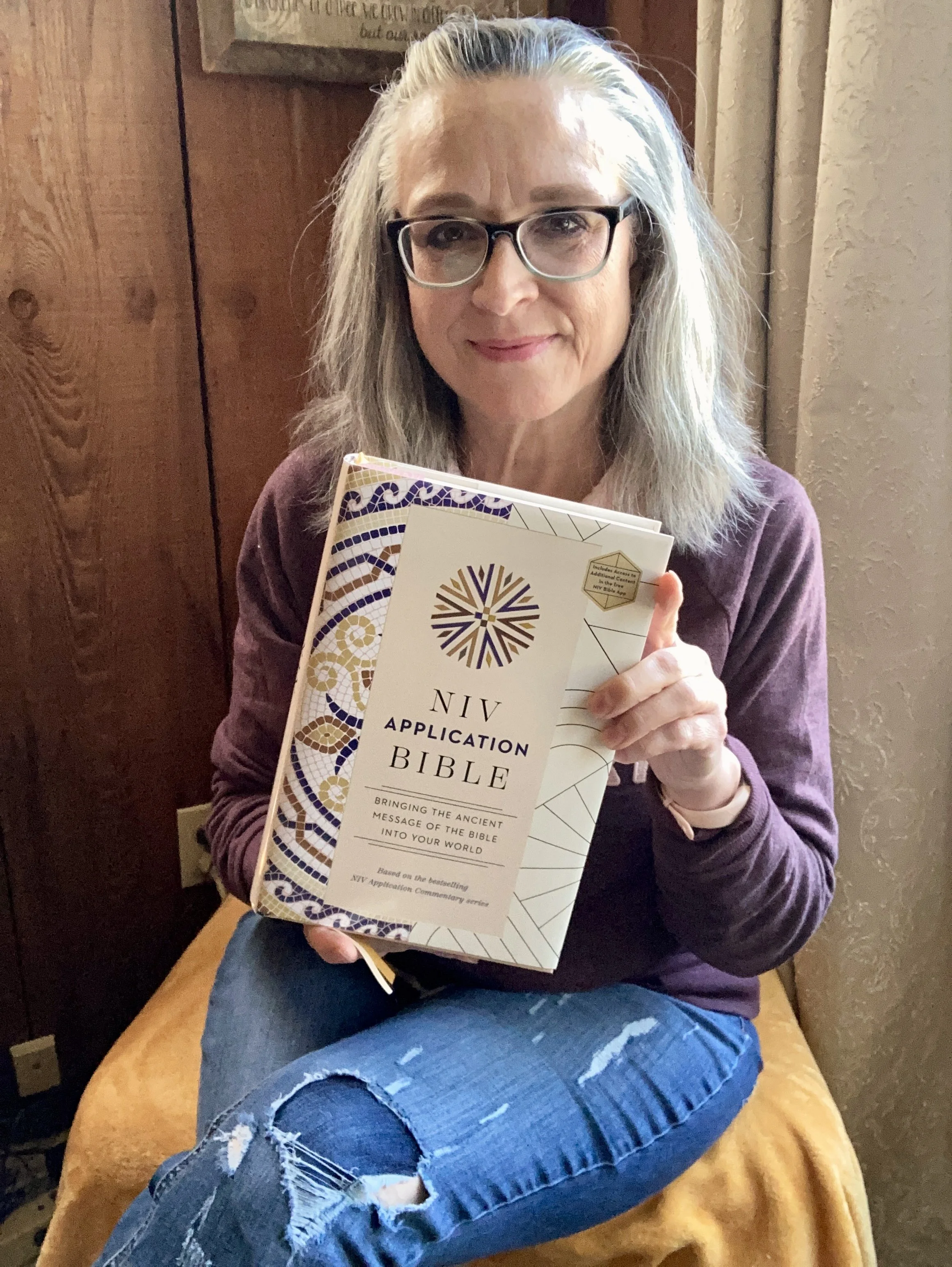
Book Review: The NIV Application Bible

(This Bible was given to me for an honest review on my blog and social media platforms. This is a paid review. All opinions are my own.)

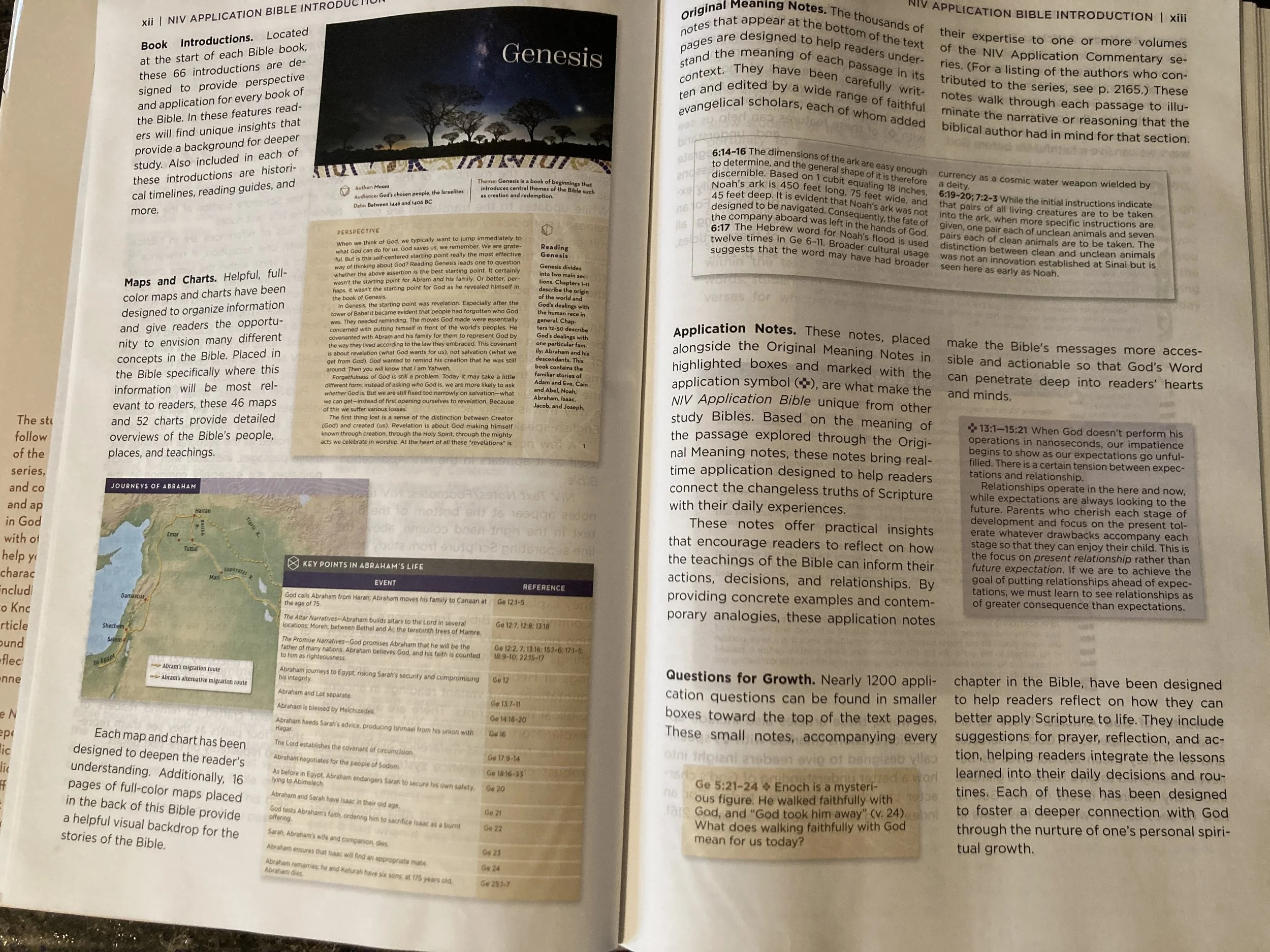
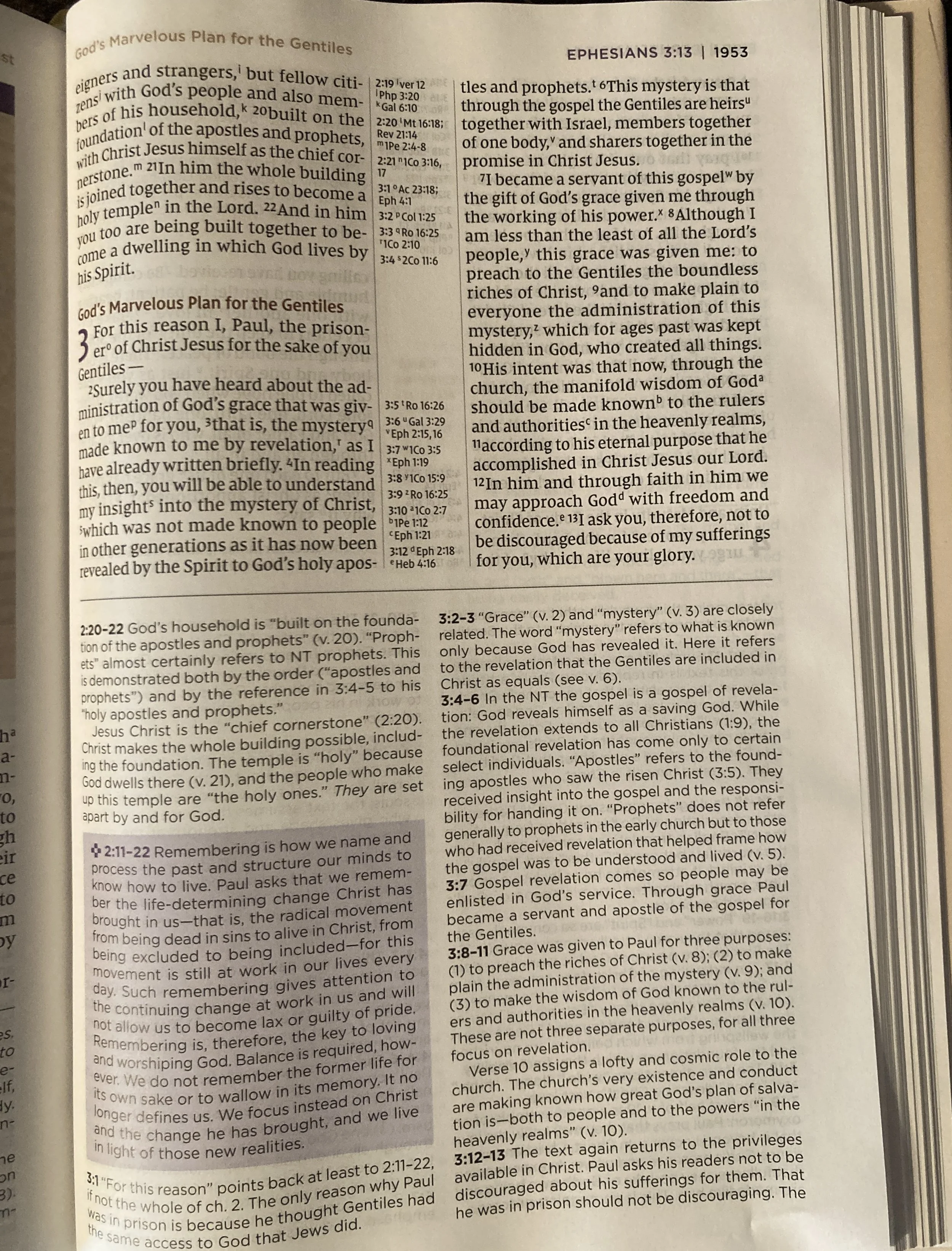
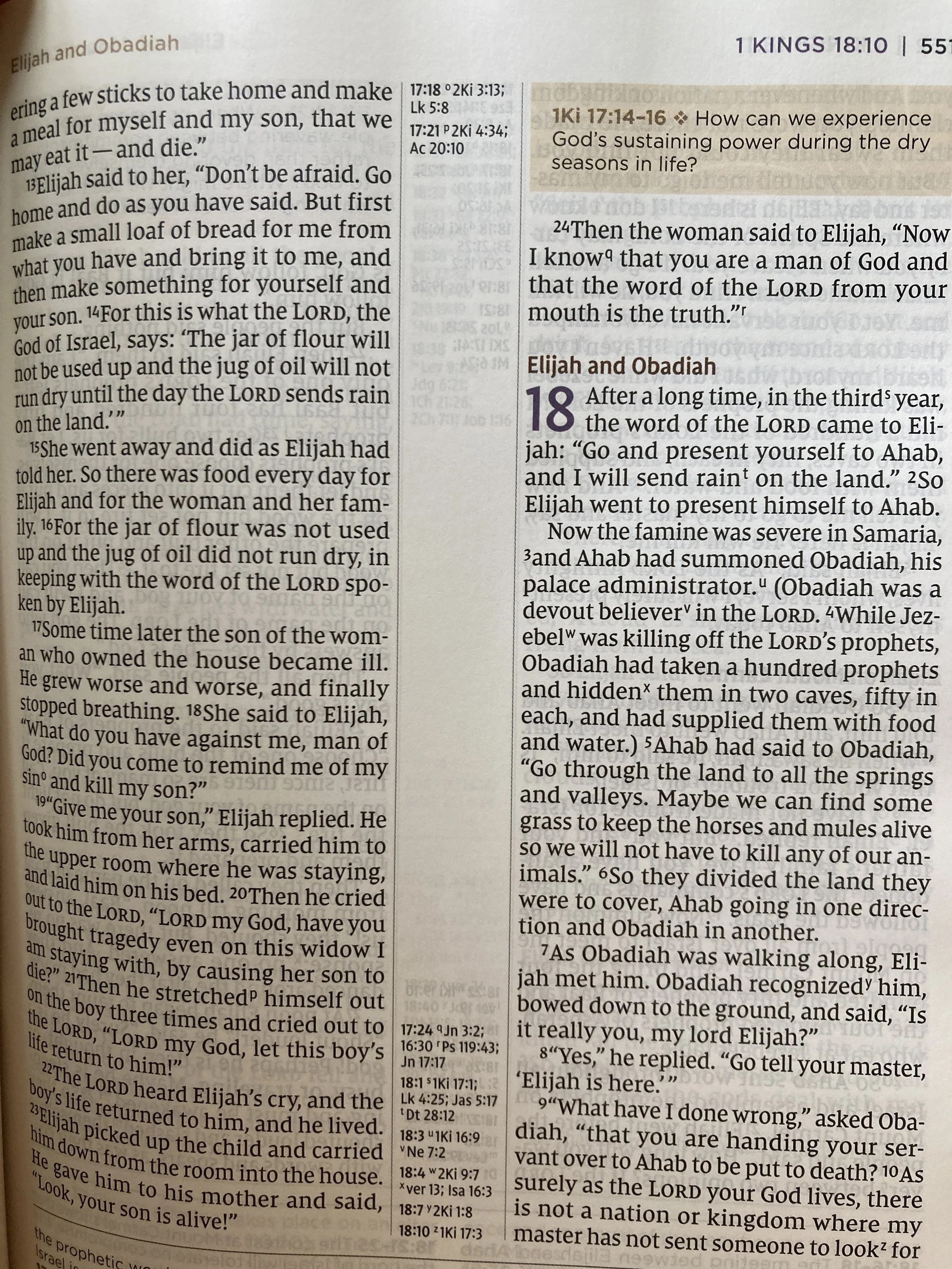
There are a number of Bible translations which are commonly used today including the NIV, or New International Version. I personally grew up with the King James Version, but as a teen was introduced to the New American Standard Version (1995), which I still have a fondness for. Recently I started using the English Standard Version, so when the opportunity came to review an NIV translation, I thought it would be nice to add it to my collection. Not only that, but it is a study Bible, which often gives a wealth of additional information. This is the NIV Application Bible.

This Bible is an amazing resource and I am looking forward to using it on a regular basis when I want to delve deeper. Let’s explore a few of the features of this helpful study tool.

Introduction:

The introduction does a nice job of telling you how the NIV Application Bible came about and highlights all the special features which we will look at one by one.

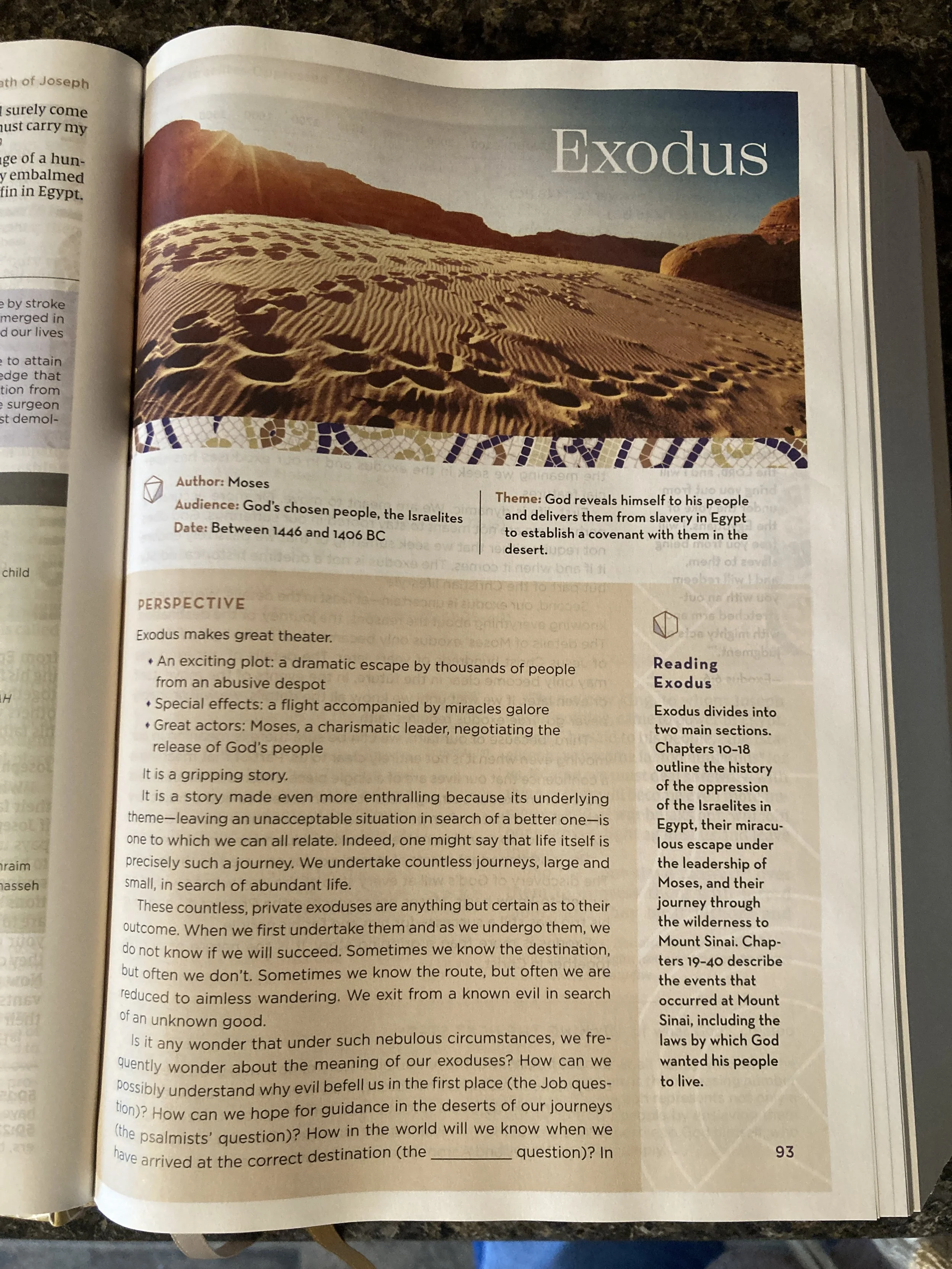
Book Introduction:

I love that each book is separated with a beautiful photograph, and a full page that includes information like the author, the audience, the time frame and a short theme focusing on what the book is about. It also gives a perspective, which allows for additional thought, and how the book is divided up.

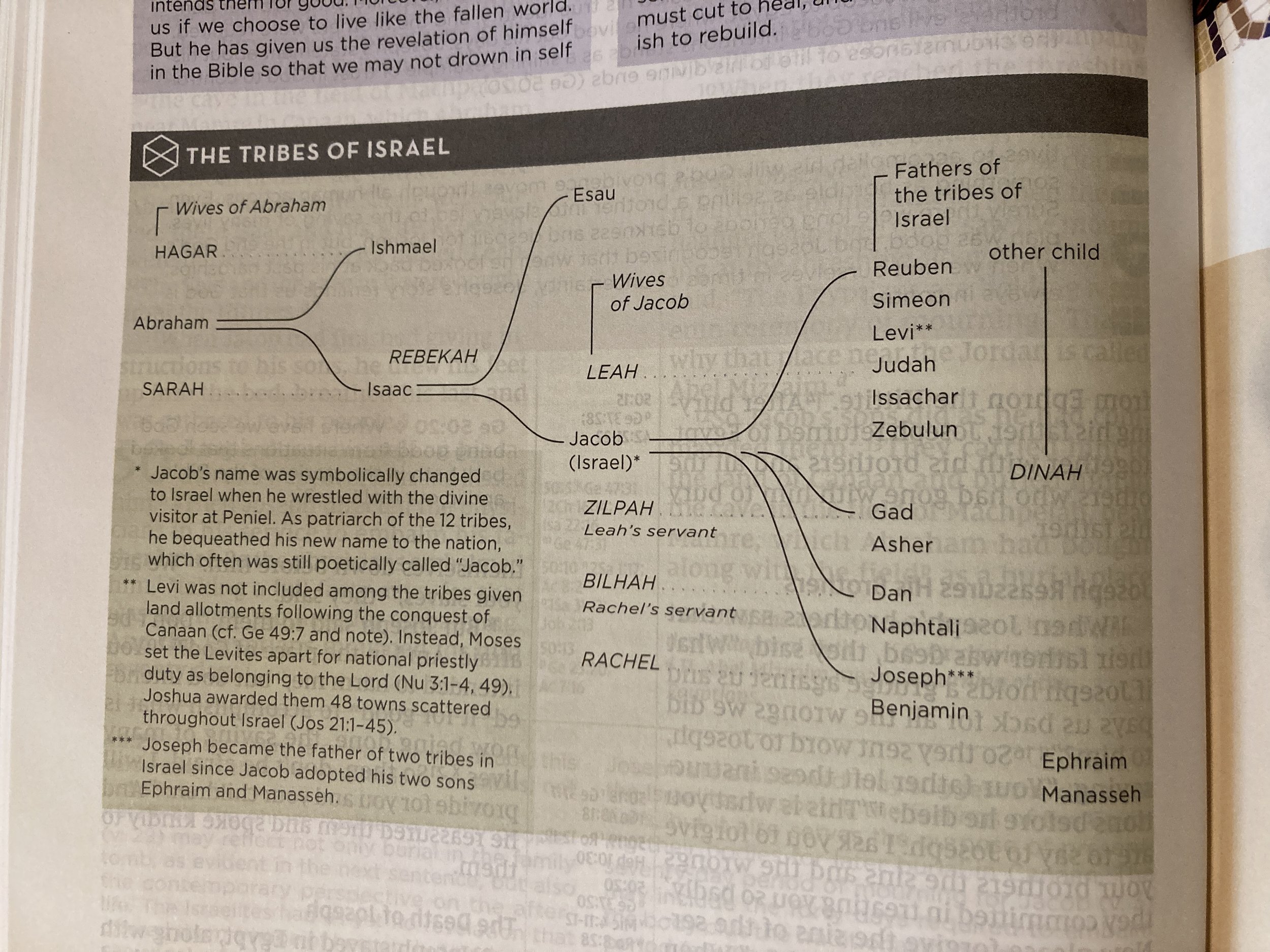
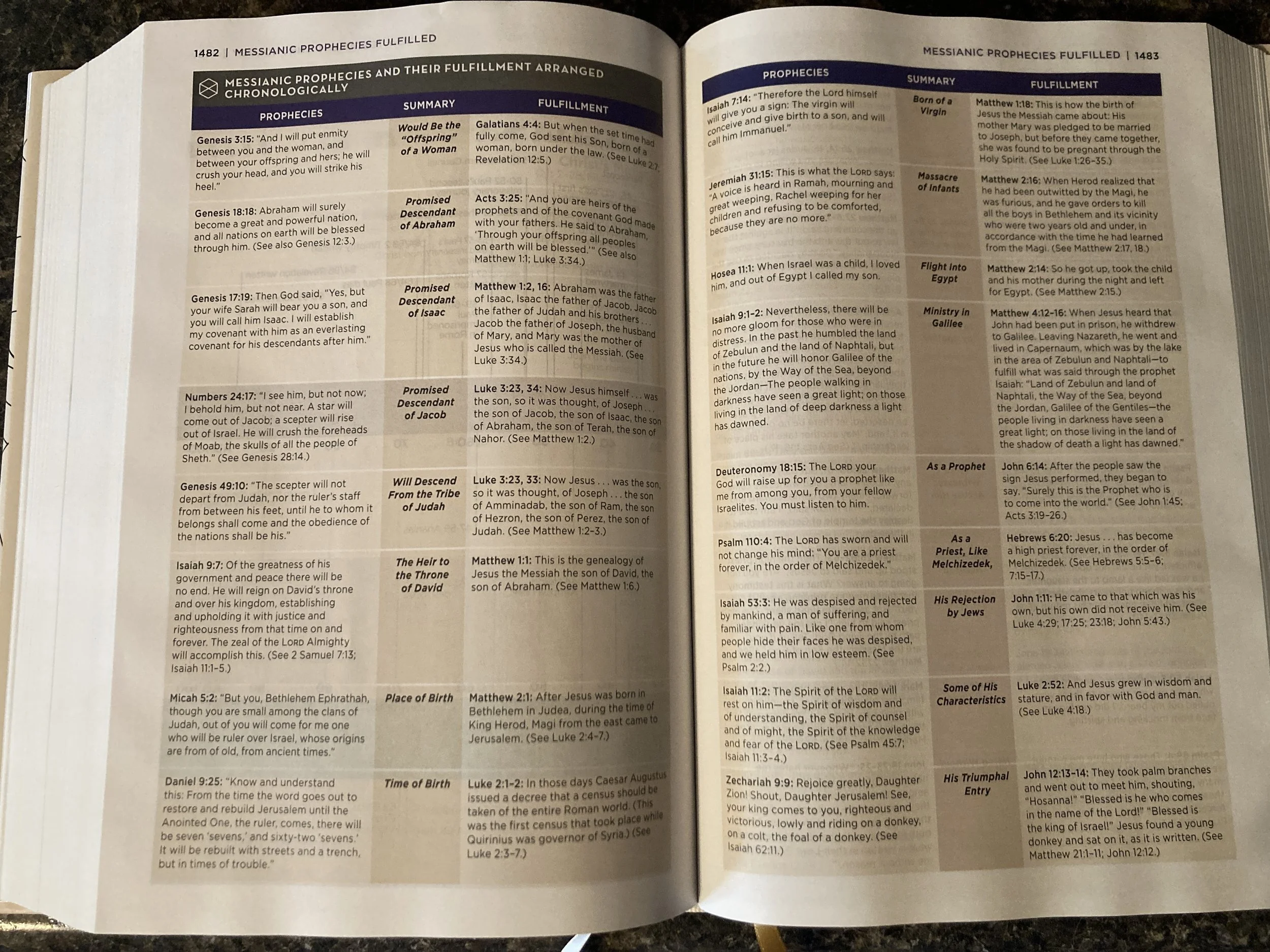
Maps and Charts:

Like many Bible translations this Bible has a number of map pages at the back, but what I really like about this NIV Application Bible is that the maps are interspersed throughout the Old and New Testament giving us a look at where the events occurred as we are reading them.

There are numerous charts which add to the study aspect of this Bible. The two shown here give an overview of the tribes of Israel and a chronological look at the Messianic Prophecies and their fulfillment.

Original Meaning Notes and Application Notes

These are easily seen at the bottom of each page of Biblical text. The Original Meaning Notes are in regular type, and the Application Notes are highlighted in a blue box. Both sets of notes add to the understanding of the meaning of the text and have been “written and edited by a wide range of faithful evangelical scholars, each of whom added their expertise to one or more volumes of the NIV Application Commentary series.” (NIV Application Bible, Introduction p. xiii.)

Questions for Growth

Throughout the NIV Application Bible you will also find small tan boxes that contain questions pertaining to the scriptures where they are found. These are meant to be used for personal reflection and include thoughts on how to incorporate what has been read into our prayers and actions for a closer, more personal walk with God.

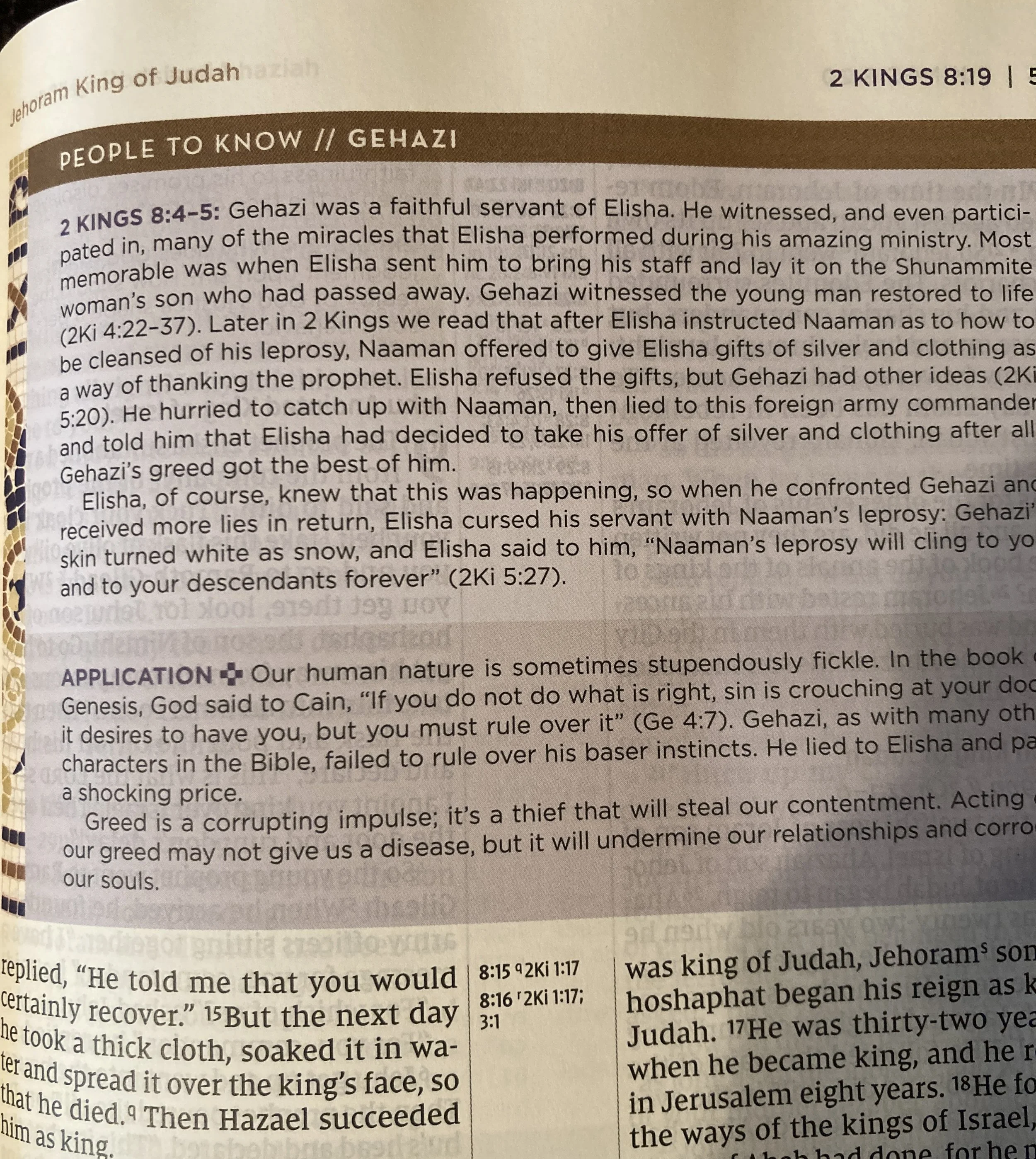
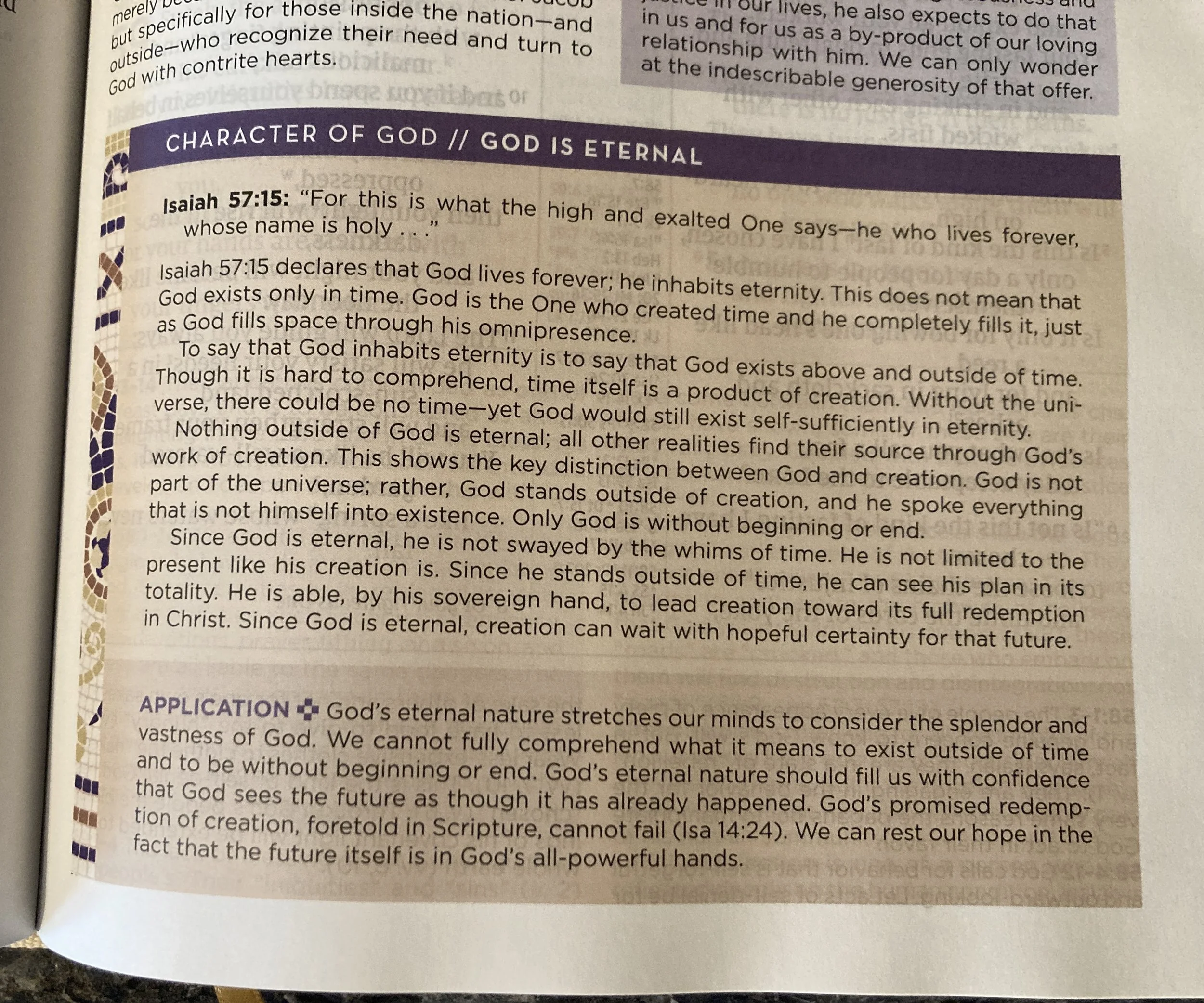
People to Know Articles and Character of God Articles

These two features give the reader an added resource for additional study and understanding. The People to Know Articles give insight into the people involved in the events in Scripture, showing how God used them and also providing application ideas for our own lives.

The Character of God Articles give insights into many of God’s characteristics exploring further who He is and how these characteristics affect our lives. These also have an application section.

If you are looking for a great study tool to add to your Biblical study resources I definitely recommend the NIV Application Bible. It offers easy to read text, understandable translation from the original texts, and many added details that will make it a Bible you turn to again and again.

Mulling It Over: Romans 8:35-36

This month we are going to look at Romans 8:35-36. Last time we looked at two questions that needed to be answered. Here we find one more question written in two ways, that begs a response.

35 Who will separate us from the love of Christ? Will tribulation, or distress, or persecution, or famine, or nakedness, or peril, or sword?

36 Just as it is written,

’For Your sake we are being put to death all day long;
We were considered as sheep to be slaughtered.’”
— Romans 8:35-36 (NASB 1995)

As we learned in the last installment we are God’s elect, and as such there is no one who can bring a charge against us. Only God has the right to judge, because he is the only one who can do it with purity and without prejudice.

We also learned that while the world condemns, for those who are in Christ Jesus there is no condemnation. He is the one who died, who was raised from the dead, who sits at God’s right hand and who intercedes for us.

Image by Alexa from Pixabay

With this knowledge we are now faced with the most important questions of all: Who will separate us from Christ? Will tribulation, distress, persecution, famine, nakedness, peril or sword? This list Paul gives is meant to be inclusive of whatever trial or tribulation a Christian might find themselves in. Many of us have never known persecution, famine, nakedness, peril or sword, but that doesn’t mean we never will. The world is becoming more under the influence of our shadowed enemy and he regularly does all that he can to make us feel separated from our precious Savior’s love and care. However, that is all he can do.

These questions are followed by a description from Psalm 44:22. What does this mean, and why does it follow these questions? Our knowledge and understanding of the Old Testament remind us that as God’s people we will suffer. Christ, Himself, said, “…in this world you will have tribulation, but take heart I have overcome the world.” (John 16:33)

The phrase, “For Your sake we are being put to death all day long…” was part of a Maskil written by the Sons of Korah. A Maskil was a contemplative, didactic (meant to teach), and skillful psalm. In other words it was not written off the cuff, or in response to a difficulty being experienced. Many of David’s psalms are wholehearted emotional songs both of praise and thanksgiving or of discouragement and despair. This psalm was thought through and had the purpose of teaching us, not only about God, but about our struggle to find Him when we are suffering.

Let’s look a little more closely at this psalm.

O God, we have heard with our ears,
Our fathers have told us
The work that You did in their days,
In the days of old.
— Psalm 44:1 (NASB 1995)

Image by Robin Higgins from Pixabay

As the psalm begins the author(s) remember what they have learned from their forefathers. They understand how God moved and was involved in the lives of His people.

4 You are my King, O God;
Command victories for Jacob.
5 Through You we will push back our adversaries;
Through Your name we will trample down those who rise up against us.
6 For I will not trust in my bow,
Nor will my sword save me.
7 But You have saved us from our adversaries,
And You have put to shame those who hate us.
8 In God we have boasted all day long,
And we will give thanks to Your name forever. Selah.
— Psalm 44:4-8 (NASB 1995)

They recognize God as King. They know that it is not their own efforts that will save them, but God will give them the victory. However, in the next set of phrases we see that this same God who had given them victories and fought for them, allowed them to be brought low.

9 Yet You have rejected us and brought us to dishonor,
And do not go out with our armies.
10 You cause us to turn back from the adversary;
And those who hate us have taken spoil for themselves.
11 You give us as sheep to be eaten
And have scattered us among the nations.
— Psalm 44:9-11 (NASB 1995)

Image by M W from Pixabay

The psalmist is left questioning. He even goes on to suggest the unwritten question: Why?

17 All this has come upon us, but we have not forgotten You,
And we have not dealt falsely with Your covenant.
18 Our heart has not turned back,
And our steps have not deviated from Your way,
19 Yet You have crushed us in a place of jackals
And covered us with the shadow of death.
— Psalm 44:17-19 (NASB 1995)

Image by nadia Clarence from Pixabay

The author allows himself to question to the very end of the psalm, but he also makes that statement in verst 22. He knows it is for God’s purpose that God is silent. He knows it is for God’s glory that we suffer.

20 If we had forgotten the name of our God
Or extended our hands to a strange god,
21 Would not God find this out?
For He knows the secrets of the heart.
22 But for Your sake we are killed all day long;
We are considered as sheep to be slaughtered.
23 Arouse Yourself, why do You sleep, O Lord?
Awake, do not reject us forever.
24 Why do You hide Your face
And forget our affliction and our oppression?
25 For our soul has sunk down into the dust;
Our body cleaves to the earth.
26 Rise up, be our help,
And redeem us for the sake of Your lovingkindness.
— Psalm 44:20-26 (NASB 1995)

Image by Ara_a from Pixabay

I think it is important to end this post focusing on the very last phrase of the psalm, “….redeem us for the sake of Your lovingkindness.” For those of us who have been studying the Word, and maturing in our Christian walk we have wrestled with the very same thoughts that the author of this psalm did. “Why did you leave us? Where did you go? Why have you let us be cast down? We have been faithful, but still we suffer?”

We can certainly look at our own circumstances or those of the people around us that we love and care about and see the suffering. But, we can always appeal to His lovingkindness. God does not have to save us, or rescue us or give us comfort, but He does. Our struggles and feelings will come and go, but when we place our focus on Him and remain in Him (John 15), He will always be found faithful.

Nothing can separate us from the love of Christ, no matter how we feel; no matter how far away we might think He is, He is always with us.

9 Just as the Father has loved Me, I have also loved you; abide in My love.
— John 15:9 (NASB 1995)

Mulling It Over: Romans 8:31-32 - What Shall We Say?

We are looking once again at Romans 8. I have been going through different chapters of the book of Romans in the New Testament on my own in recent months. I have started the practice of writing out several verses at a time, word for word as they are written in my English Standard Version of the Bible. After I write the verses out, I ask the question what do these verses tell me about God. It has been a wonderful practice to not only hand write, and yes I am doing it in cursive, but also to dwell on who God is and what He has done for us that has given us the ability to come into His presence as one of His children.

Image by Amanda Truscott from Pixabay

I have not written out Romans 8 as of yet, but it has been eye opening to go through this chapter over the last year and a half with all of you who read this little blog. Today we take a closer look at a few very familiar verses that I am sure many of you can quote.

31 What then shall we say to these things? If God is for us, who is against us?
32 He who did not spare His own Son, but delivered Him over for us all, how will He not also with Him freely give us all things?
— Romans 8:31-32 (NASB 1995)

Let’s do our usual and look at these verses a phrase at a time.

What then shall we say to these things? This question is a referring back to the previous verses. Verses 1 - 25 remind us of our deliverance from bondage, and the awaiting transformation to glory. Verses 26 - 30 remind us of our position in Him. What can we possibly say to all of that? Can we condemn God, saying He is a malevolent being who does not care for us; that he has not provided a way for us to have peace with Him; that He cares not for our well being? How could we say such untruths when it is clear that He provided the way, and He gives us all we need, and even in our weakest moments His own Spirit is praying for us; interceding according to the Father’s will.

If God is for us, who is against us? I can hear the voices accusing, “If God is really for us then why are there all these problems? Why is our world is such a state of chaos? Why is there so much hate? Why is there so much pain?”

I do not want to throw out pat answers or give a couple of other verses to support this idea and send you on your way. This is tough. Once again, however, I must remind all of us of our Savior’s very own words.

33 I have said these things to you, that in me you may have peace. In the world you will have tribulation. But take heart; I have overcome the world.
— John 16:33 (ESV)

Once again, we have to refer back to Genesis 3 when the serpent, Satan, tempted Eve. He didn’t just tempt her flesh, he tempted her ability to trust in her Creator. Isn’t that true of the world ever since? Why did Adam and Eve sin? Because they did not believe that God really loved them and wanted the best for them. They believed, with the help of Satan’s manipulation of God’s words, that they would be better off making their own choices and decisions.

Image by Briam Cute from Pixabay

We still live in that shadow of mistrust. We begin to doubt God’s Word, we stop going to church, we start reading and listening to philosophies and voices that tear apart Christian thoughts and beliefs, and we start focusing on what is going to make us happy. We become rights based. No matter how much faith we put in our founding fathers, the reality is they were fallen men, and only God and His truth can be fully trusted. The only true rights we have are those given to us by the Creator of life. Without Him we are nothing.

Why do we have trouble, problems, struggles and trials; because sin entered a perfect world, but the beautiful thing is God provided a way. It doesn’t require my work, my money, my time, my identity it only requires my faith. It isn’t just faith in a verse here or there, but in the whole inspired Word of God. When we start throwing scripture out the window we tear down the foundation He laid for our redemption, justification and glorification. We open the door to racism, fascism, humanism and communism. We make up justifications for our behaviors saying like Madonna sang, “I was born this way.” We descend into mind numbing chaos revolving around a continuous search for peace, identity and value.

But God….

It is God who is for us. It is God who created this little blue and green gem we live on. It is God who gave us the law as a foreshadow of a more perfect way, and then gave us His son Jesus Christ who died on a cross for our sin so that we might be made right with the Father.

Image by Pexels from Pixabay

15 For you have not received a spirit of slavery leading to fear again, but you have received a spirit of adoption as sons by which we cry out, “Abba! Father!”
— Romans 8:15 (NASB 1995)

It is God who imprinted His very own image on us and no matter how hard we try to run from that imprint we are distinctly God’s because of that image. God is not against us. He is the only one who is truly, purely for us, because He loves us and recognizes each one of us as His handiwork.

He who did not spare His own son, but delivered Him over for us all… This needs little explanation. God sent Jesus as a baby to Mary. He was born, and lived a human life for approximately 33 years. The last three of those years he ministered and taught His disciples doing miracles and teaching about His Father and the Kingdom of God. Most of the Jews in His time did not believe what he said, even accusing him of having a demon (see John 8:48). Eventually, it was His own people, the Jews, who condemned Him to death via Pilate. He died an agonizing death on a cross, but it was what He did after that made all the difference. If Jesus hadn’t risen from the dead, we would still be slaves to sin. It was God’s power displayed in this act of resurrection that gives us the ability to leave the world of shadow and emerge into His light.

…how will He not also with Him freely give us all things? So what does this mean? We know the triune God isn’t Santa Clause. We don’t just ask Him for anything we want like He is our very own Genie in a Bottle. When you grow in your relationship with Christ you come to realize He provides everything you need: peace, love, joy, strength, rest, hope, thanksgiving…these are not physical things, but He is also providing our physical needs as well. Things like jobs to buy food and pay our bills; family and friends to provide a space of security and joy; a home to live in, blankets on our beds…the list is pretty much endless. He will always come through and give you exactly what you need when you need it. I have found, the more I rely on Him for every single thing, the more He provides when I haven’t even asked.

Image by Pete Linforth from Pixabay

“For every beast of the forest is Mine, The cattle on a thousand hills.
— Psalm 50:10 (NASB 1995)

I hope these verses were a pertinent reminder of how very secure you are in Christ, and I hope that helps you to walk with peace, joy and confidence in Him.

Have a great weekend!

A Year of Waiting - Respite

The word respite is a waiting word, but one that usually gives the idea of a welcome break. A respite is defined by Webster’s Online Dictionary as (noun) a period of temporary delay, an internal rest or relief; as (verb) to grant a temporary period of relief to, or to grant a respite to, or to put off or delay. A respite is a term also applied to giving a caregiver a break from caring for an ill loved one.

As I type this my husband and I are on, what I would call, a respite. We got away for the purpose of rest and relief. Although, I think a true respite would be to completely unplug, with no phone or internet, something that is rarely attained, even when we purpose to do it. However, just getting a change of scenery and getting outside can provide a similar benefit to a true respite.

Image by Julia from Pixabay

Doesn’t that picture make you want to get away? Ha, ha. Getting away is something both my spouse and I find cathartic to the chaos filled, fast paced and anxiety inducing lives we are often living. Even though we no longer have children at home, we live close to our girls, and in turn our grandsons. This is a wonderful thing and I count myself very blessed to have both of our grandsons in our lives and to be a part of helping our daughters and their significant others take care of and have input in their lives.

In addition to family my spouse’s job keeps him busy, and I have my blog and all the other responsibilities of maintaining a home, grocery shopping, making meals, laundry, the list goes on. As with most people we are also constantly bombarded by images, noise, and input in the form of news, social media, and everything else we have access to on the internet.

As I have in all the past posts on A Year of Waiting, I find a definite connection to our waiting on the Lord. So often, God brings circumstances into our lives to bring us into a waiting position. We are to wait for Him, whether it is for deliverance, justice, healing, rescue, hope, glory or perfection. Waiting is much less about what we are waiting for and more about who brought us to a place of waiting.

Image by Jeff Jacobs from Pixabay

The Old and New Testaments are full of examples of men and women who had to wait. Noah had to wait while building the ark for the actual flood, over 100 years of waiting. Abraham waited a lifetime for a son. Hannah waited for a child. The people of Israel waited 400 years before they were lead out of slavery from the Egyptians. Simeon waited his whole life for the One who would save Israel. Jesus waited approximately 30 years before starting his public ministry. Life is filled with waiting.

When we look closely at the word respite we see it is a waiting that is meant for good. Indeed, I believe that all waiting brought about by God’s orchestration is meant for our good. As I mentioned in my original post at the beginning of this year, Word for 2024: Wait, waiting can be to keep us safe, give us rest, or give us time to think through a decision or recover from a difficult circumstance or tragedy.

Unfortunately, finding a respite in these busy, chaos filled, and tragic times can be difficult. It really takes a choice and often a predetermined plan. Whether you need to find time to spend with God or time to regroup and reenergize, or time to grieve and heal, the best way to get a respite is to schedule it in just like you would a doctor’s appointment, a trip to the gym, or a visit with a friend.

Image by SerenityArt from Pixabay

Don’t think of it so much in terms of quantity as in quality. An individual who is providing long term care for a sick or aging family member finds they are much better able to cope when they can just walk a way, even for a short time period. Whether it be 15 or 30 minutes for a walk outside, a two hour walk around the mall, or an entire weekend in a different location you can find respite in the smallest of changes and moments.

Also, recognize what might work for me, might not work for you. Not everyone likes the outdoors. I can actually sit out on our patio on a sunny day and feel like I am getting away from whatever struggle I am dealing with. Both my spouse and I love to take walks and hike, but not everyone does. The point is to find what works for you.

Respite is a type of waiting that is important for all of us to do. God made the Sabbath for our benefit, and for His glory, but it seems in this day and age, we have forgotten how to rest and be still, whether you believe the Sabbath is on Saturday or Sunday. God knew how restless a people we would be and also how fatigued we would become from our nonstop lifestyle.

10 “Cease striving and know that I am God;
I will be exalted among the nations, I will be exalted in the earth.”
— Psalm 46:10 (NASB 1995)
28 “Come to Me, all who are weary and heavy-laden, and I will give you rest.
29 Take My yoke upon you and learn from Me, for I am gentle and humble in heart, and you will find rest for your souls.
30 For My yoke is easy and My burden is light.”
— Matthew 11:28-30 (NASB 1995)

I hope you will find time for a respite, and find time to go to the Creator of your soul who truly knows how to give you rest.

Mulling it Over - Romans 8:30

Last month we looked at Romans 8:29, and had a short discussion on the theological points of predestination and free will. We also looked at what followed this idea of predestination, that we are being conformed to the image of Christ.

Today we are going to look at verse 30. Once again, we are proceeding slowly, so that we might truly understand and let the Spirit drive home the truths revealed in these Scriptures.

30 and these whom He predestined, He also called; and these whom He called, He also justified; and these whom He justified, He also glorified.
— Romans 8:30 (NASB 1995)

and these whom He predestined,

We discussed this in last month’s post. The end result is God is able to both predestine and give us a free will. We tend to limit God, because we think if it is beyond our understanding then it must not be the case. We need to recognize God’s wisdom is a mystery and is not always completely known to us.

6 Yet we do speak wisdom among those who are mature; a wisdom, however, not of this age nor of the rulers of this age, who are passing away;
7 but we speak God’s wisdom in a mystery, the hidden wisdom which God predestined before the ages to our glory;
8 the wisdom which none of the rulers of this age has understood; for if they had understood it they would not have crucified the Lord of glory;
— I Corinthians 2:6-8 (NASB 1995)

For instance, a 7 day, literal creation has stumped many a Christian over the decades. This is not a problem for me. As my husband always says, “Seven days? What took Him so long?” Ha, ha. Unfortunately, rather than taking God at His word, and according to His word, man has come up with alternative theories to better coincide with the evolutionary theory touted by Darwin. The Day Age Theory, and The Gap Theory are two of the most popular.

Image by Andrew Martin from Pixabay

I just wanted to reiterate, we are the Creation, not the Creator, and we are limited in our understanding of the many layers of God. With that said, lets move on.

He also called;

This idea of calling has also had its day on the debate floor. Questions that have been around for years include: Is everyone called? Is calling just for special people at certain times? Is calling only for people going into full time Christian service, like a missionary or a pastor, etc?

Image by Steve Buissinne from Pixabay

I see calling as a general term, much like predestination. We are all predestined, meaning God wants all of us to become His children by belief in Christ. In the same way we are all called. The difference lay in the fact that we must respond to His calling. We must choose to believe. Of course that presupposes you believe in free will. :)

God is faithful, through whom you were called into fellowship with His Son, Jesus Christ our Lord..
— I Corinthians 1:9 (NASB 1995)

Let me reiterate, I am not a theologian. I had three years of Bible school, but that doesn’t mean I have exhaustively studied every topic. However, I do believe God gives us His wisdom, understanding and knowledge as we delve into His deeper layers through His Holy Spirit. That being said, if you ever think I am in error in the ideas I bring to you, I welcome your thoughts.

and these whom He called, He also justified;

The word justify is defined in several ways: to judge, regard or treat as worthy of salvation; to prove or show to be just, right, or reasonable. Justification is the process by which Christ takes on our sin through His death on the cross enabling us to be worthy of God’s calling. In essence Christ’s blood covered us so that we might be made right before God.

Image by Sang Hyun Cho from Pixabay

24 being justified as a gift by His grace through the redemption which is in Christ Jesus;
— Romans 3:24 (NASB 1995)

…and these whom He justified, He also glorified.

The predestination, calling and justification all lead to the perfect end result, our glorification. The older I get, the more I look forward to this glorification process. At 60 I am experiencing all the things that age brings with it. I have become acquainted with chronic illness, my hair is thinning, my joints ache, and my brain is almost always in the phase of post menopausal fog.

Image by kapokia from Pixabay

Jesus told us we would have trouble in this world.

33 These things I have spoken to you, so that in Me you may have peace. In the world you have tribulation, but take courage; I have overcome the world.
— John 16:33 (NASB 1995)

We don’t have to look very far to see trouble. The southeast part of the U.S. has see two large hurricanes in the last two weeks. Out west there continue to be wildfires consuming thousands of acres of trees. We are entering in to flu and Corona season, in addition to that allergens are ever present and driving many of our sinus cavities wonky. We have political and societal unrest in the United States and there is still a war going on in Ukraine and the Middle East.

Jesus told us we would have trouble, but He didn’t want us to stay in that mindset. He told us He would give us peace, and He has overcome the world.

This mentality of looking towards glory is not a bad thing. Yes, we still need to be present. We need to live our lives as the brightest lights of Christ that we can be so others might come to know Him. How much easier it is to do this when we know that we are called, justified and one day will be glorified.

Just like the Morning Glory flower we need to turn our faces towards the light of God and His truth and open ourselves up completely to what He is trying to do in our lives. Only in doing that will we become the beautiful reflection of Him that we are meant to be.

A Year of Waiting - Tarry

The word tarry as defined in Webster’s Online Dictionary means: to delay or be tardy in action or doing; to linger in expectation; wait; to abide or stay in or at a place; stay, or sojourn. Tarry is an older word used in the first few senses in the 14th century. Ask yourself, how often do I use the word tarry today? We don’t usually say, “I tarried at the train station.” “I’m going to tarry at the seashore.” “I’m sure to tarry in line at the concert.” It sounds rather archaic.

Image by Thomas from Pixabay

When it comes to this word journey I have been on for the year 2024, I like the way tarry opens up other doors and windows to this idea of waiting. As I have noted previously, waiting can be a complete drag, and most of us would not sign up for an adventure in waiting, but our lives are full of lines, traffic jams, delays, and prospects of a future that require we wait.

When I hear the word tarry, I do not think of a long term situation. However, if we look at the King James Version of scripture, which uses a synonym, sojourn we see that the span of time could be quite lengthy.

Now the sojourning of the children of Israel, who dwelt in Egypt, was four hundred and thirty years.
— Exodus 12:40 (KJV)

Still we get the sense that it was not intended to be forever. When God speaks of a long term living situation He often uses the word dwell, or abide. We took a closer look at the word abide in February. You can see that post here.

1 Behold, how good and how pleasant it is
For brothers to dwell together in unity!
2 It is like the precious oil upon the head,
Coming down upon the beard,
Even Aaron’s beard,
Coming down upon the edge of his robes.
3 It is like the dew of Hermon
Coming down upon the mountains of Zion;
For there the Lord commanded the blessing—life forever.
— Psalm 133 (NASB 1995)

Psalm 133 has a tone I would associate with a long term living situation. God intended that we dwell together in unity in a place where we experience the blessing of life forever. In this psalm it is a reference to Zion, which we can also look at as eternity with God. With the state many of our current churches are in it can be hard to imagine being able to dwell with those same brothers or sisters together forever in unity. Ha, ha. However, God said it will be true. We won’t just be tarrying, but putting down roots and dwelling.

Image by Filip Loczek from Pixabay

Since we already looked at the idea of abide, I wanted to spend some time thinking about what it means to tarry with God. I have learned, it is essential that we tarry with God as much as we can, especially when our lives are pulling us in so many directions. You might feel on any given day, “I don’t have time to abide. I am too busy.” However, if we don’t find the time, God will give us the time, and that is not always preferable as it usually comes with some sort of difficulty. God is not mean hearted, He loves you purely with everlasting love, and He knows exactly what you need, and that is directly linked to the time you spend with Him.

Let me give you a personal example. I was really struggling for several weeks this past month. I was exhausted, discouraged and my heart felt so heavy. Grief was a blanket I was regularly wrapping up in. Grief over my mom being in a nursing home and not being able to be there to help with her care. Grief over my children who have walked away from the truth of the scripture and the love of Jesus. Grief over the state of our country and the fear of the looming downward spiral. Grief over relationships. Grief over loved ones with cancer and other illnesses. Grief over other people’s kids who were struggling with addictions and various other issues. Grief over my own health. The list goes on.

Image by Tern70 from Pixabay

I am learning the importance of acknowledging these feelings and allowing myself to feel them. They are real, after all, and are felt on the deepest levels. However, we all know we can’t live in those dark places. We always need to return to the light, otherwise the darkness will become an all too comfortable place to abide and dwell.

I felt God pulling me. Whispering to me, “Amy, come to Me. Spend time with Me. Only I can meet every need and help you bear every burden.” I know this to be true, but as you know our flesh wars against us every chance it gets. Finally, one sunny afternoon, I took my Bible and my prayer journal out on the patio and began a search through the scriptures. I was looking for Psalm 34:18

The Lord is near to the brokenhearted And saves those who are crushed in spirit.
— Psalm 34:18 (NASB 1995)

I knew it was in the psalms, but I couldn’t remember where, so I just started leafing through. God brought me two different passages.

8 Depart from me, all you who do iniquity,
For the Lord has heard the voice of my weeping.
9 The Lord has heard my supplication,
The Lord receives my prayer.
— Psalm 6:8-9 (NASB 1995)

Image by wal_172619 from Pixabay

1 “I love You, O Lord, my strength.”
2 The Lord is my rock and my fortress and my deliverer,
My God, my rock, in whom I take refuge;
My shield and the horn of my salvation, my stronghold.
3 I call upon the Lord, who is worthy to be praised,
And I am saved from my enemies.
— Psalm 18:1-3 (NASB 1995)

Image by Enrique from Pixabay

When we tarry with God we can find peace and joy, even in the midst of our grief and pain. When we tarry we spend time, even just a small amount of time, doing the following:

1 - Remembering God’s character - He hears our weeping, our supplication and He receives our prayers. Don’t you love that? God isn’t ashamed of our emotions. He wants us to come and ask. He is our Abba, Father and He loves us. He wants to hear our prayers. He doesn’t just hear them, He receives them. He takes them on as His own. Remember The Bee Keeper? If you don’t, buzz on over to that post for a refresher.

2 - Acknowledging His abilities - He is our strength. He is our rock, our fortress, and our deliverer. He is our shield. He is our salvation. He is our stronghold. He is our refuge. All of these things are His abilities, and He gives them to us without reserve. He can protect, give strength, and get us through anything that comes our way.

7 Then the earth shook and quaked;
And the foundations of the mountains were trembling
And were shaken, because He was angry.
8 Smoke went up out of His nostrils,
And fire from His mouth devoured;
Coals were kindled by it.
9 He bowed the heavens also, and came down
With thick darkness under His feet.
10 He rode upon a cherub and flew;
And He sped upon the wings of the wind.
11 He made darkness His hiding place, His canopy around Him,
Darkness of waters, thick clouds of the skies.
12 From the brightness before Him passed His thick clouds,
Hailstones and coals of fire.
13 The Lord also thundered in the heavens,
And the Most High uttered His voice,
Hailstones and coals of fire.
14 He sent out His arrows, and scattered them,
And lightning flashes in abundance, and routed them.
15 Then the channels of water appeared,
And the foundations of the world were laid bare
At Your rebuke, O Lord,
At the blast of the breath of Your nostrils.
— Psalm 18:7-15 (NASB 1995)

3 - Renewing our understanding of Him - I have read Psalm 18 numerous times, but the Scripture, being that it is living and active, spoke to me anew. The above verses floored me. He is not just a gentle and loving God; He is a powerful, mighty force able to move mountains with a thought. He has, can and will display holy anger when the time is right for His wrath and will to be accomplished. It sets my heart to quaking, but also fills me with hope. He will have the final word, and all that is dark, and ugly, and painful will be burned away in His purest, most holy light.

16 He sent from on high, He took me;
He drew me out of many waters.
17 He delivered me from my strong enemy,
And from those who hated me, for they were too mighty for me.
18 They confronted me in the day of my calamity,
But the Lord was my stay.
19 He brought me forth also into a broad place;
He rescued me, because He delighted in me.
— Psalm 18:16-19 (NASB 1995)
49 Therefore I will give thanks to You among the nations, O Lord,
And I will sing praises to Your name.
— Psalm 18:49 (NASB 1995)

4 - Thanking Him for all He has done - If you can only tarry for a few minutes, I think this is the best bench to sit on. Gratitude is known to change hearts, minds, health, and perspective. When we sit for a few minutes on God’s goodness and provision to us it gives us the ability to keep going because we come away with hope. With God there is always hope.

Take it from me, if you are struggling with grief, pain, bitterness or other unresolved feelings and situations it certainly is helpful to talk it out with a trusted friend or counselor, but also don’t forget to tarry for a little while with Jesus. He makes all the difference.

Mulling it Over - Romans 8:28

This week we are only going to focus on one verse from Roman’s 8. Last month we looked at verses 26 and 27. We learned more about all the Holy Spirit does for us in helping us to live the Christian life in this flesh. We were also reminded of His work to help our weaknesses by praying for us with depth and clarity, as He always prays the Father’s will for us.

Today’s verse brings the last two verses into sharp focus.

28 And we know that God causes all things to work together for good to those who love God, to those who are called according to His purpose.
— Romans 8:28 (NASB 1995)

Let’s dissect this verse phrase by phrase.

And we know….

Image by Gerd Altmann from Pixabay

This is an interesting way to start this verse. How do we know? What is it we know? How is it that we know it? How does the author know that we know? Does the author know and we don’t know?

We will find out what we know in the next phrase, but let’s just sit here for a minute. How do we know? We know because of the work of the Holy Spirit. Remember last week we had a list of things the Holy Spirit does for us. Two of these stand out: the Spirit dwells in us if Christ is in us (vs. 9), and the Spirit testifies with our spirit we are children of God.

Jesus Christ, the Son, knows the mind of the Father.

14 I am the good shepherd, and I know My own and My own know Me,
15 even as the Father knows Me and I know the Father; and I lay down My life for the sheep.
— John 10:14-15 (NASB 1995)
30 I and the Father are one.”
— John 10:30 (NASB 1995)

If Christ knows the Father, then when we receive Him, we also receive the Father, our Abba, Father. So too, the Holy Spirit dwells in us. He testifies with our spirit that we are sons and daughters of God and so we know. We know whatever it is He, the triune God wants us to know.

…that God…

Make no mistake, God is in this. He is continuously at work in our world, even during those “dark nights of the soul.”

‘O Lord God, You have begun to show Your servant Your greatness and Your strong hand; for what god is there in heaven or on earth who can do such works and mighty acts as Yours?
— Deuteronomy 3:24 (NASB 1995)
There are varieties of effects, but the same God who works all things in all persons.
— 1 Corinthians 12:6 (NASB 1995)
for it is God who is at work in you, both to will and to work for His good pleasure.
— Philippians 2:13 (NASB 1995)

…causes….

Image by falco from Pixabay

Sovereignty is something we must address when it comes to God causing things to take place. The word sovereign means one possessing supreme power. We typically refer to a king or queen as a sovereign as within their kingdom they possess supreme power, and ascendency.

Those of us who live in democratic societies might cringe at the idea of being beneath one who is sovereign. We have become so brain washed to the idea of independence and rights that we tend to forget we still live in community and need a system of checks and balances to keep anyone from having too much power.

However, when it comes to a supreme God; an all loving and completely good God it can be an easier pill to swallow, that He is ultimately in control. He allows and he prevents. He protects, and He holds back protection. He provides and He withholds.

What is it that this mighty being is causing, and for what purpose is He allowing it to happen.

….all things to work together for good…

It doesn’t say that God is causing only the good things to work together for good. He is causing ALL things to work together for good. The good, the bad, and the ugly; the light and the darkness; the times of prosperity and the times of poverty; the times of strength and the times of weakness. In His sovereign ability to see it all, He alone can work it all out for good.

…to those who love God…

Image by Ylanite Koppens from Pixabay

There is a descriptor here. He doesn’t work everything out for good for everyone on the planet. He only does this for those who love Him, and…

…to those who are called according to His purpose.

We might be asking ourselves the question, “What is His purpose?” Believe me the last three and a half years for me have been a questioning time. I don’t question His character, but I once in a while I do question His purposes. The question, “What are you doing, God,” often comes to my mind. It is okay to question, but we don’t want our questioning to become doubt that leads to frustration and bitterness.

19 And He said, “I Myself will make all My goodness pass before you, and will proclaim the name of the Lord before you; and I will be gracious to whom I will be gracious, and will show compassion on whom I will show compassion.”
— Exodus 33:19 (NASB 1995)

When Moses asked God if he could see His glory, God agreed. God says of Himself, He is good, as we can see in the above verse. The fact that a good God can make all things work together for good makes sense. However, we can also see in that verse that He will be gracious to whom He will be gracious and He will show compassion on whom He will show compassion. I don’t think this is God’s way of flipping off people who are struggling. I believe it is a confirmation of His sovereignty and we are being reminded that it is He who is ultimately in control.

Image by Gerd Altmann from Pixabay

God doesn’t change. The God of the Old Testament is still the same God, but there is now a new covenant through Jesus Christ. Jesus really does make all the difference. It is because of Jesus, and the Holy Spirit that God works all things together for good.

Being called according to His purpose, is quite simply living day to day in His presence. This isn’t a call to some grandiose life, or a suddenly acquisition of a super hero cap and ability to fly. We are simply called to live according to God’s purpose: to obey Him and glorify Him in everything we do. This we can do no matter where we find ourselves on life’s journey. No matter if you are homeless, employed, divorced, married, single, young, old, in perfect health or struggling with chronic illness, you are called according to His purpose.

I hope you find His words encouraging. Life is hard, but our God is good, all the time.

Have a great week.
Mulling It Over - Romans 8:18-25 - Part 2: The Groaning and the Hope

It has been months since I did a Mulling it Over post on this Faith page. When last we came together here, I was studying the 8th chapter of Romans. We learned from the very first verse that in Christ Jesus we are not condemned. He came, not to condemn, but to save that which was lost. We were lost in our sin, but when we gave our hearts to Him we became something different.

We learned that the law of the Old Testament was weak and only a shadow of what God truly wanted. Because of this weakness, God sent His only Son, Jesus, to do what the Law could not. Having just celebrated another Easter reminds us of the wonderful, awful, necessity for this sacrifice of Christ’s own body on the the cross. The perfect lamb of God opened the gateway to the throne room of His Father.

Now, as we live on this earth, entombed in our flesh, we struggle day after day to walk in the spirit, not the flesh, but it is only by setting our minds on the Spirit, and feeding the Spirit that we are able to put aside that flesh and regularly abide in Christ. We are not under obligation to the flesh, and if we have that same Spirit who raised Jesus from the dead we can put to death the deeds of the flesh.

When we put our faith in Christ we have been adopted as the sons and daughters of God. This gives us the right to cry out to God and call Him, Abba! Father! This sonship enables us to be heirs to the Kingdom of God and all the rights and privileges therein. (To see all the previous posts click on the links: Romans 8:1-2, Romans 8:3-4, Romans 8:5-8, Romans 8:9-11, Romans 8:12-13, Romans 8:14-17, Romans 8:18-25 - Part 1 )

Today we are looking back at a few things we already covered in Part 1, but with this chunk there is a lot to cover, so we are going to look at it in pieces, rather than phrase by phrase.

18 For I consider that the sufferings of this present time are not worthy to be compared with the glory that is to be revealed to us.
19 For the anxious longing of the creation waits eagerly for the revealing of the sons of God.
20 For the creation was subjected to futility, not willingly, but because of Him who subjected it, in hope
21 that the creation itself also will be set free from its slavery to corruption into the freedom of the glory of the children of God.
22 For we know that the whole creation groans and suffers the pains of childbirth together until now.
23 And not only this, but also we ourselves, having the first fruits of the Spirit, even we ourselves groan within ourselves, waiting eagerly for our adoption as sons, the redemption of our body.
24 For in hope we have been saved, but hope that is seen is not hope; for who hopes for what he already sees?
25 But if we hope for what we do not see, with perseverance we wait eagerly for it.
— Quote Source

I would like to look at these verses as a comparison of place, not only physical locale, but spiritual position.

Physical:

Image by munki from Pixabay

When sin came into our world with the first choice of disobedience, corruption came with it. Life which was meant to be eternal, gradually shortened. Living things grew old. Not only that, but disease began to ravage humanity and all other created things. Plants contracted blights, animals became infested with parasites, and humans knew pain in both childbirth and aging.

Spiritual:

Image by Gerd Altmann from Pixabay

Sin distanced us from the Creator. Not only were we driven from the Garden, but we lost the personal relationship with our God. We became the naughty sheep that needed to be tended across the wilderness, and God our keeper. He created boundaries with the Law, a shadow of that which He originally intended, but a necessity to tie a Holy, Pure God, to a stiff necked and sinful people.

When we compare these two areas we can divide the above verses into a compare and contrast of sorts.

Physical/Suffering - Spiritual/Glory -

  • Anxious longing (vs. 19) - Glory revealed (vs. 18)

  • Waiting (vs. 19 & 23 & 25) - Sons of God revealed (vs. 19)

  • Subjected to futility (vs. 20) - Creation set free (vs. 21)

  • Not self-determined (vs. 20) - Children of God set free and glorified (vs. 21)

  • Enslaved to corruption (vs. 21) - Adoption as sons (& daughters) (vs. 23

  • Groaning (vs. 22 & 23) - Redemption of our bodies (vs. 23)

  • Pain in childbirth (vs. 22) - Fulfillment of hope (vs. 24 & 25)

  • First fruits of the Spirit (vs. 23)

  • Persevering (vs. 25)

This entire section of Romans 8 is about what is and what will be. What is plays out in this physical realm, and includes suffering. We suffer all throughout life on this fallen planet. Some suffer far more than others, but we all suffer. For the Christ follower this doesn’t just include the same trials and struggles as others, but has the added component of a waiting and longing for what will be: our life in glory with our Lord.

Paul includes the suffering of creation, which I find interesting, but it makes sense. God’s plan was for a beautiful place full of life and energy. It was a place of freedom. Man lived in concert with his Creator and his creation. The world, and all that was in it was for man’s pleasure and care.

Image by 12019 from Pixabay

Creation groans and longs for its former glory. Storms, hurricanes, typhoons, earthquakes, forest fires; these are all signs of a creation yearning to be what it was originally intended to be. It wasn’t given the choice of suffering, as the Creator subjected it to futility, so that we would have hope.

Let’s just pause there a minute. God allowed this amazing thing He had created to become less than so that you and I would have hope. I don’t know about you, but being able to go outside, touch a fuzzy kitten, see the trees changing in the fall, hear the ocean waves crashing, or a stream gurgling, and smelling the seasons as they change always gives me hope and reminds me that my God is near even when the world is in chaos.

Image by Fabien from Pixabay

Not only does Creation feel this yearning and goes through the pains of childbirth, waiting for its return to glory, we do too. I know as I age I identify more closely with this groaning and suffering. I know that one day I will be in a glorified body with nor more coughing, sinus issues, achy knees and wrists, and no more desire for things that are not good for me. I will know fully, just as I am fully known! (I Corinthians 13:12) Our hope will be full, and we will stand before our Abba, Father. What glory that will be.

Finally, the last verse in this section is pertinent to where we are right now. We must wait for hope to be fulfilled, and wait for it eagerly with perseverance. Remember, my word for the year is Wait? God in His rich and lavish love is reminding us that we are in a waiting time, but glory is coming. Creation knows this to be true, and we can do.

Dear friends, with perseverance wait eagerly for hope.

Faith Topics: Why is it Necessary to Study the Bible?

Let’s face it, life is busy, especially if you are working, have children, or are involved in any sort of activities outside the home. People just have a lot to do these days. If I am a Christian and believe in eternal security (once saved, always saved) what’s the point of studying the Bible? Isn’t it enough to hear it on Sunday morning? Isn’t reading it once in a while more than sufficient to keep me grounded in my Christian faith?

Image by wal_172619 from Pixabay

There are several thoughts I have on this topic and I think it is an important issue to address. Let’s start by looking at what scripture itself has to say.

16 All Scripture is inspired by God and profitable for teaching, for reproof, for correction, for training in righteousness; 17 so that the man of God may be adequate, equipped for every good work.

— 2 Timothy 3:16-17 (NASB 1995)

This verse gives us several good reasons to study God’s word.

1 - All of Scripture is inspired by God.

Image by Aritha from Pixabay

If you were interested in learning more about a certain historical figure, Hollywood star or famous pop singer would you go to the Tabloids or would you want to go to the direct source? An autobiography is going to be more revealing about a person than a few short paragraphs about where they were last seen and who they were last hanging out with. If we claim to be Christians and want to live a Christ like life then the place to go is the Word of God to receive information that is most accurate and truthful. God, Himself, inspired the men who wrote the words. I believe this is the most accurate historical document we have.

2 - All of Scripture is profitable for teaching, reproof, correction, and for training in righteousness.

Image by Dolf Maurer from Pixabay

Think about this for a minute. If you read a magazine, a textbook, or a fictional piece, each one may give you some sort of benefit. You might learn how to cook a certain dish from a recipe book. You might learn more about what vitamins to take as you age from a magazine on aging. You might find yourself swept away by a riveting adventure which helps you relax. However, unlike the Bible most things we read are not able to do everything the Bible can do.


The Bible is a historical account of the Nation of Israel, giving us a history lesson. The Bible is a book of poetry and love. The Bible gives us steps to ease anxiety, love our neighbor, and forgive those who have hurt us. The Bible teaches us how to live, how to love and how to have a relationship with an amazing God.

3 - All Scripture enables us to be adequate and equipped for every good work.

You know what I like most about that last phrase? The word adequate. It doesn’t tell us that we will be perfect. It doesn’t say we will be all knowing, powerful, or rich. It says we will be adequate. Webster’s Online Dictionary defines the word adequate as: Sufficient for a specific need or requirement; good enough. God gives us what we need when we need it. He doesn’t give us more. Why do you think this is? It might have something to do with humility and dependence.

Our ability to be equipped for every good work, isn’t dependent on our ability. It is dependent on God. This fact takes us back to the first two points…it’s all from Him, and it is meant for teaching, correction, training, etc. We have to be continuing to learn and study and grow.

Another familiar verse in the Bible about why we should study it is the following:

Study to shew thyself approved unto God, a workman that needeth not to be ashamed, rightly dividing the word of truth.
— 2 Timothy 2:15 (KJV)

I went for the King James Version of this verse, as it is the verse I remember growing up with. It is one of the few versions that uses the word study and links it to the ability to understand accurately what God’s word is saying. We don’t need to be ashamed if we know God’s word, what it says and what it means. If we look at the New American Standard version, it reads a little differently, but the end result is still the same. We are to be diligent workmen, who don’t need to be ashamed, because we know how to handle God’s word.

Be diligent to present yourself approved to God as a workman who does not need to be ashamed, accurately handling the word of truth.
— 2 Timothy 2:15 (NASB 1995)

If we just look at this one verse we can come up with several more reasons we should study God’s Word.

1 - To be able to present ourselves to God.

Image by svklimkin from Pixabay

Accepting Jesus as our Lord and Savior is merely the first step in a life time of growth and knowledge as we get to know Him more and more. Not only are we getting to know Him better, but He is making us more like Christ. When we know His word, we can bring that to Him and show that we know Him and His desires for us. Knowing and studying His word is like giving a gift back to him. We are saying that we agree with what He has said.

2 - To be an unashamed workman.

Image by 652234 from Pixabay

Often what makes us feel ashamed in our Christian walk, is not what Jesus has done for us, or our belief in Him, but our inability to talk about those things. I believe one of the important ways we become better able to talk about our faith and defend it is by knowing what the Bible says. Regular study of the Word helps us to walk with Him without feeling unable to share our faith.

3 - To be able to accurately handle truth.

Image by Markus Winkler from Pixabay

Regular study of God’s word will not only make us more confident, but will enable us to know what is true and what is untrue. There are many who believe the Bible is just another book. They might even acknowledge that it has historical significance, but they do not believe everything in it to be true. They argue that everything from creation and the flood, to the virgin birth and resurrection were just fabrications put together by a random string of zealots to lead people into some sort of cult like living. The problem with many of these supposed arguments is that they really don’t take into account the actual words of the scriptures. A question both my husband and I ask people who say they don’t believe is, “Have you ever read the book?” Most often the answer is, “No.”

Let’s not depend on the world to tell us whether to believe the Bible or not. Let’s allow the Holy Spirit to do what He is best at, revealing the truth in the living, God breathed, words of Scripture. Paul admonished us in the book of Colossians:

8 See to it that no one takes you captive through philosophy and empty deception, according to the tradition of men, according to the elementary principles of the world, rather than according to Christ.
— Colossians 2:8 (NASB 1995)

Paul also instructed Timothy about not listening to the “irreverent babble”.

20 O Timothy, guard what has been entrusted to you, avoiding worldly and empty chatter and the opposing arguments of what is falsely called “knowledge”—
21 which some have professed and thus gone astray from the faith.
— I Timothy 6:20-21 (NASB 1995)

I hope this gives you a little motivation to start looking at the Scriptures with more time and care, for in studying His Word we will be blessed with a deeper relationship with Him.

A Year of Waiting - Abide

Back in January I published a post on my word for the year 2024. The word was wait. At that time I decided I was going to spend once a month looking at different words and definitions related to the word wait. This month we are going to dive into the word abide.

Image by 32520394 from Pixabay

When I hear the word abide I think of an image like the one above. This is a fictional place where I would like to abide, or live. I want to dwell there, not just visit. To me abiding feels more cozy and desirable than the word wait, but what if you don’t like your abode? What if you would like to move to a different place to abide, but you can’t. At that point you might feel more like a prisoner than a resident.

We learn a lot about a word by looking at its definition. Webster’s Online Dictionary defines abide in this way:

- to continue in a place: sojourn (intransitive verb)

- to remain stable or fixed in a state (intransitive verb)

- to bear patiently: tolerate (transitive verb)

- to endure without yielding: withstand (transitive verb)

- to wait for; await (transitive verb)

- to accept without objection (transitive verb)

Grammar tends to drive most of us crazy, but I found the differentiation between transitive and intransitive curious. Since it has been a long while since I took an English class, I had to look at what those words meant and how that affects these meanings.

A transitive verb is one that makes sense only if it exerts its action on an object. An intransitive verb will make sense without an object. Some verbs can be used both ways.
— Grammarly (online)

I can say, “I abide in a house in California.” I can also say, “I cannot abide a house in California.” If I just said, “I cannot abide…” then you would have no idea what it is that I am not abiding. In the first sentence it is obvious, albeit an odd way of saying it, that I live in a house in California. You could have shortened the sentence and just said, “I abide in California.” Okay, that is enough grammar for one day. Ha, ha.

So when I use the word abide as it pertains to the idea of waiting what definition is most appropriate? Would it be odd to say, I believe all the definitions pertain. Let’s dig deeper.

One of the most familiar passages in scripture where Jesus talks about abiding is found in John 15.

1 I am the true vine, and my Father is the vinedresser.
2 Every branch in me that does not bear fruit he takes away, and every branch that does bear fruit he prunes, that it may bear more fruit.
3 Already you are clean because of the word that I have spoken to you.
4 Abide in me, and I in you. As the branch cannot bear fruit by itself, unless it abides in the vine, neither can you, unless you abide in me.
5 I am the vine; you are the branches. Whoever abides in me and I in him, he it is that bears much fruit, for apart from me you can do nothing.
6 If anyone does not abide in me he is thrown away like a branch and withers; and the branches are gathered, thrown into the fire, and burned.
7 If you abide in me, and my words abide in you, ask whatever you wish, and it will be done for you.
8 By this my Father is glorified, that you bear much fruit and so prove to be my disciples.
9 As the Father has loved me, so have I loved you. Abide in my love.
10 If you keep my commandments, you will abide in my love, just as I have kept my Father’s commandments and abide in his love.
11 These things I have spoken to you, that my joy may be in you, and that your joy may be full.
— John 15:1-11

When Jesus says, “Abide in Me…” He is talking about continuing or sojourning in Him. Basically, when we make Christ our Lord and Savior He wants us to come live with Him. He is also saying to remain stable or fixed in Him.

Image by Jill Wellington from Pixabay

The image of a grape arbor comes to mind when Jesus is talking. The base part of a grape plant, the vine, becomes like a mini tree trunk. The branches are the long arms that extend from the vine and the part that produces the beautiful clusters of grapes. The grape clusters don’t just happen. They have to be part of the bigger vine, the part that digs down into the soil and brings nutrients to the rest of the plant. Just as the branches have to be part of the vine to grow and produce, we have to be part of Christ to bear the fruit of the His Spirit.

This is where I want to make a connection between abiding and waiting. There are seasons in life where you might feel useless, or like you are not bearing any fruit. We start to question our relationship with Christ, and maybe even doubt our salvation, but lets look back at those transitive uses of the word abide. There are times where we have to bear patiently, endure without yielding, wait for, and accept without objection.

Image by Petra from Pixabay

Perhaps the whole point behind Jesus’ talk on abiding in Him was not only about bearing fruit, but about the changes that He knew we would all face living life in a fallen world. Just like the grape arbor we face all manner of storms, from wind and hail, to lightening, to torrential rains, to snow and ice. During those times we have to wait, stand firm, and sink our roots ever deeper into the good soil of our Heavenly Father. Most importantly we need to learn to accept without objecting. Our Father is a good Father, and He knows exactly what the arbor needs to produce the best fruit. During these times of waiting out the storms we can remember what Jesus said. “As the Father has love me, so I have loved you. Abide in my love.”

Finally, Jesus ends with the statement, “These things I have spoken to you, that my joy may be in you, and that your joy may be full.” Christ has made clear, by abiding in Him, not only will we bear fruit, but we will know the Father’s love and our Savior’s full joy.

If you are in a waiting time, don’t be discouraged. Look at it as the opportunity it is to abide and know your Savior even better.

Have a great weekend!

Maintaining the Presence of Peace

If you have been following along, you know I have been talking about the last name of Jesus mentioned in Isaiah 9:6, Prince of Peace. Even though we often refer to that scripture at Christmas, I believe it is one that we should look at again and again. We need to be reminded who this One is that we call Lord and Savior.

Image by Benjamin Balazs from Pixabay

While it is true that we always have the Prince of Peace with us, as I explain last week, we don’t always feel His peace. We all to often allow life and all of its difficulties and distractions to take the place of peace in our hearts.

Many of you are probably familiar with the “love bank” idea created by Dr. Willard F. Harley, clinical psychologist and author of a variety of relationship and marriage books, including His Needs, Her Needs. The sum up is that the more we put into someone else’s love bank, the more they will feel loved. When we criticize, demand, or do unkind things we make withdrawals from the their love bank, thus causing damage to the relationship.

Image by Gerd Altmann from Pixabay

I believe we can use a similar analogy when it comes to peace in our lives. When we read God’s word, pray, have fellowship with others, and abide in Him we add to our “peace bank”. When we neglect those activities, or do things that go against God and His truth, we make withdrawals from the bank. It is easy to suddenly find ourselves lacking funds in our bank account when we have been living life in our own strength and might.

For this final post on the Prince of Peace, I would like to look at some of the tools we can use to ensure our peace banks never run low. I want to look at a few specific ideas. As I said earlier, prayer, God’s word, etc. help us maintain peace, but I want to look at specific thoughts in this regard.

1 - Prayer

Image by Pexels from Pixabay

a - Prayers of confession and repentance. There is nothing faster at removing our peace than unconfessed sin. I like the idea of keeping “short accounts”. Did I hurt someone’s feelings at work today? Did I gossip when I was with my lady friends at lunch? Did I speak harshly towards my spouse? We must be ever vigilant to keep our minds and hearts clean before our Prince of Peace.

If we confess our sins, He is faithful and righteous to forgive us our sins and to cleanse us from all unrighteousness.
— 1 John 1:9 (NASB 1995)

b - Prayers of release. As a parent, and grandparent, this is one of the hardest things to do. You might wonder, if I let it go, how is that going to give me peace? Don’t I have to do something about it? Actually, the most important thing we can do is to lay our fears, doubts and desires at the foot of the cross. We need to find our Lord to be the most trustworthy friend we will ever have. Let go of those things that are troubling you and let Him be God.

Be anxious for nothing, but in everything by prayer and supplication with thanksgiving let your requests be made known to God.
— Philippians 4:6

2 - Scripture

Image by peachknee from Pixabay

a - Using God’s Word for meditation. When we are having difficulty with peace going back to God’s word and mulling it over helps to bring back our connection to the Prince of Peace. I always have a journal and at least a pen when I read passages from the Word. The Holy Spirit is always able to give us new insights, even from passages we have read over and over. I am not afraid to underline and write notes in my Bible either. Being centered on His holy Word will always reconnect us to our wonderful Prince of Peace.

And I shall lift up my hands to Your commandments, Which I love; And I will meditate on Your statutes.
— Psalm 119:48 (NASB 1995)

b - Using God’s Word for battle. I have discussed my walkabouts on here before, but as a refresher, a walkabout is when I pace around my house praying out loud for the purpose of spiritual warfare. I do this often when I am praying for my children, grandsons and my spouse, although, many people end up on my walkabout list, because so many are struggling. During these times of intense communication with God, I take the Words He has inspired in the Bible and I pray them back to Him.

And take the helmet of salvation, and the sword of the Spirit, which is the word of God.
— Ephesians 6:17 (NASB 1995)

The Word of God is not passive. According to Hebrews 4:12 it is, “living and active.”

For the word of God is living and active and sharper than any two-edged sword, and piercing as far as the division of soul and spirit, of both joints and marrow, and able to judge the thoughts and intentions of the heart.
— Hebrews 4:12 (NASB 1995)

3 - Changing our thought life.

Image by Engin Akyurt from Pixabay

This might seem obvious, and certainly spending more time in prayer and the Word of God will help. However, I thought it important to give this a little more emphasis since we can change our thoughts by doing other things as well. The mind is not the only part of our bodies affected by a lack of peace. Anxiety, anger, lust, bitterness, and lack of forgiveness can affect our digestive systems, cause aches and pains and can rev up the inflammation triggers all over our bodies. One of the main areas we can control is our thoughts.

a - Scriptures to help our thoughts:

Finally, brethren, whatever is true, whatever is honorable, whatever is right, whatever is pure, whatever is lovely, whatever is of good repute, if there is any excellence and if anything worthy of praise, dwell on these things.
— Philippians 4:8 (NASB 1995)
You will keep him in perfect peace,
Whose mind is stayed on You,
Because he trusts in You..
— Isaiah 26:6 (NKJV)
The Lord will give strength to His people; The Lord will bless His people with peace.
— Psalm 29:11 (NASB 1995)
Those who love Your Law have great peace, And nothing causes them to stumble.
— Psalm 119:165 (NASB 1995)
The steadfast of mind You will keep in perfect peace, Because he trusts in You.
— Isaiah 26:3 (NASB 1995)
And the peace of God, which surpasses all comprehension, will guard your hearts and minds in Christ Jesus.
— Philippians 4:7 (NASB 1995)

I am particularly fond of this last verse. The word guard in this verse evokes the idea of a battalion of soldiers standing guard over our hearts and minds in Christ Jesus. This is what God’s word says about His peace. His peace is beyond our comprehension, meaning we can have it, even when it doesn’t make any sense, and it will be like a company of warriors watching over our hearts and minds.

Image by Amber Clay from Pixabay

c - Other ways to maintain our peace:

There are plenty of secular things people do to give them peace of mind from meditation, and medication, to music, to exercise and getting outside. All of these are good, but don’t forget, as a Christ follower your peace ultimately comes from the Prince of Peace. Nothing else will give you true, deep, lasting peace like Jesus.

I hope you have enjoyed this look at the word peace, and our Prince of Peace, Jesus Christ. Please let me know in the comments how our Prince has given His peace to you.

Mulling it Over - Romans 8:18-25 Part 1: Of Suffering and Longing

Another month has gone by and we have come back around to Mulling Over Romans chapter 8. This chapter is full of information that is pertinent to our walk with Christ and to our future with Him. I know it can be hard to think about the future when our days are so full of the present, but one day we will know fully our inheritance in Christ Jesus. As it is, our lives at this point are merely reflections of Christ, and many of us have dirty mirrors. God is often trying to clean those mirrors with a glorified bottle of Windex and a rough cloth, and that can make us uncomfortable, but remember our goal is to be like Christ, so clean on Father, clean on!

Image by Simon Kadula from Pixabay

18 For I consider that the sufferings of this present time are not worthy to be compared with the glory that is to be revealed to us.
19 For the anxious longing of the creation waits eagerly for the revealing of the sons of God.
20 For the creation was subjected to futility, not willingly, but because of Him who subjected it, in hope
21 that the creation itself also will be set free from its slavery to corruption into the freedom of the glory of the children of God.
22 For we know that the whole creation groans and suffers the pains of childbirth together until now.
23 And not only this, but also we ourselves, having the first fruits of the Spirit, even we ourselves groan within ourselves, waiting eagerly for our adoption as sons, the redemption of our body.
24 For in hope we have been saved, but hope that is seen is not hope; for who hopes for what he already sees?
25 But if we hope for what we do not see, with perseverance we wait eagerly for it.
— Romans 8:18-25 (NASB 1995)

This is a longer section so we’ll take it a chunk at a time.

For I consider…

I wanted to take these three words by themselves because they are so important. One of the things I often hear Christians accused of is that they don’t think. They take the scriptures, and the historicity of their belief system on blind faith. While it is true that we are walking by faith, it is also true that we, with the Holy Spirit’s help, are able to think just as intellectually about our faith as someone who has studied for years and has multiple degrees.

Webster’s Online Dictionary defines the word consider in the following ways: to think about carefully; to think of especially with regard to taking some action; to take into account; to regard or treat in an attentive or kindly way; to gaze on steadily or reflectively; to judge or classify; regard; suppose; reflect or deliberate.

When we look at the book of God, the Bible, we need to consider what we are reading. We also need to look at life and consider what it means, and how what we are doing, or going through pertains to our faith, or how our faith pertains to it. We aren’t meant to just bull doze our way through life giving no regard to how our actions or words are affecting the people around us.

Image by Paul Brennan from Pixabay

In this particular passage the word consider relates directly to the words that follow.

…that the sufferings of this present time are not worthy to be compared with the glory that is to be revealed to us.

I have been emphasizing this idea of suffering over the last few months, not because I am trying to be a downer, but because suffering is inevitable. We all, at some point in time, will suffer. We will know illness, loss, grief, sadness, anger, fear and the overwhelming reality of a busy life in a chaotic and fallen world. It is not bad or wrong to consider our suffering.

12 Beloved, do not be surprised at the fiery ordeal among you, which comes upon you for your testing, as though some strange thing were happening to you;
13 but to the degree that you share the sufferings of Christ, keep on rejoicing, so that also at the revelation of His glory you may rejoice with exultation.
— I Peter 4:12-13 (NASB 1995)

Paul, however, did not want us to be solely focused on our suffering. In fact, He says that whatever we are currently suffering through is not worthy to be compared with the glory that is going to be revealed to us. Let’s just sit there for a minute.

Think about all the bad stuff you have been through. Some of you have lived through the typical minor inconveniences life offers like, car break downs, the fridge stops working, or the toilet backs up. Others have walked a bumpier path. You have lost a job, a home or been through a divorce. Still others have seen suffering in the form of addictions, jail time, death of a loved one, or a chronic, incurable disease. No matter what the suffering, it is not worthy of being compared to the glory that awaits us! Isn’t that amazing? What hope is ours that the suffering we are going through on this planet will pale in comparison to the joy and glory we will know when we see Jesus face to face.

For the anxious longing of creation waits eagerly for the revealing of the sons of God.

Have you ever thought about the fact that the world: the trees, birds, fish, animals, rocks and so on have longings? Is it possible for creation to be anxious as it waits for the revealing of the sons of God? Stay with me here. I am not talking about something weird or spooky. Let’s back up a minute.

In the beginning God created the heavens and the earth (Genesis 1). If God created them, don’t they have His signature on them in a similar way that we have His signature on us. Granted we are human beings and we are made in the image of God, while creation was not, but that does not mean that creation is unable to recognize its creator and recognize the position of humanity as its caretaker.

There is a reason creation waits eagerly which we see in the next verse.

For the creation was subjected to futility, not willingly, but because of Him who subjected it, in hope…

The creation did not want to be cursed. It enjoyed its relation to its Creator and to its caretaker. It rejoiced in the growing and the greening, the fullness and the fellowship. When sin came into the world, God didn’t just send Adam and Eve out of the the beautiful garden of Eden, but the creation changed. It became rife with weeds and thorns. Where once all animals lived in harmony, now certain animals became predators and all others became prey. In addition, creation no longer bore the fruit of the relation between it and its Creator, but was subject to futility, disease, rot and death.

Image by Ilo from Pixabay

But God…

In hope…

…that the creation itself will also be set free from its slavery to corruption into the freedom of the glory of the children of God.

This was God’s hope from the foundation of the world. He knew it all before it began. He knew when He set into motion the creation of a planet and the filling of that sphere of rock and stone with all that is living, and breathing, moving and reaching…He knew that His beautiful creation would suffer and die. So He also created the plan, the One, the Savior, the Son. It was only by this, the gift of pure, unselfish love, that the whole of creation would be able to be set free. But, it will not happen until we are face to face, fully knowing as we have been fully known (1 Corinthians 13:12); when we become His perfect reflection.

Next time we will continue our look at this section of Romans 8 by looking at the Groaning and the Hope.

Have a great weekend!

Wonderful Words of Life: The Perfect Work of Struggle

For the last five months I have been getting mental health counseling from a licensed therapist. After everything I went through in 2021 with my health, and subsequent bouts with Covid, sinus infections and other aches and pains, in addition to past hurts and traumas in our family I felt it was time to start a journey towards better mental health.

Image by Total Shape from Pixabay

Even though we have made great strides to lessen the stigma surrounding mental health struggles, there are still many people who will not seek help even though their lives could be greatly improved by it. A person does not have to be on the verge of suicide or struggling with addictions, or PTSD to need counseling. In fact, it is better if we seek help before we get to the breaking point, or before we begin seeking other, more self destructive habits to compensate for the pain or numbness we are feeling.

In addition, I believe as Christ followers we are doing a great disservice to our brothers and sisters if we do not recommend licensed therapeutic counsel when so many people in our churches and congregations are struggling with their identity, their marriages, their children, and with the constant input of information that is often not beneficial, but detrimental to their well being.

As a Faith Blogger, I want to give you good, and accurate information and most of what I share with you is Scriptural teaching which I have learned in my years of walking with Christ. I don’t have a psychology degree, nor do I have a certificate in counseling. However, I do have the Holy Spirit, and His guidance in my life as I have maneuvered the bumpy waters of this journey called life.

27 As for you, the anointing which you received from Him abides in you, and you have no need for anyone to teach you; but as His anointing teaches you about all things, and is true and is not a lie, and just as it has taught you, you abide in Him.
— I John 2:27 (NASB 1995)

Image by Jeff Jacobs from Pixabay

We all can have the wisdom of God because as believers in Christ we are directly linked to the triune God head: the Father, Son and Holy Spirit. The above verse reminds us that we received an anointing from Him who abides in us. In other words, Jesus anointed us with the Holy Spirit. We see this outpouring of the Holy Spirit in Acts 2. The Holy Spirit is one with the Father and the Son, so they all know and operate in one mind. The Holy Spirit makes plain to us the things of God. Problems arise when I try to take that which is straight forward and simple and make it into a convoluted mess. The above verse reminds us that the Holy Spirit teaches us about all things, and that teaching is true, not a lie.

All of this is a preface to the wonderful words of life found in the book of James.

2 Consider it pure joy, my brothers and sisters, whenever you face trials of many kinds,
3 because you know that the testing of your faith produces perseverance.
4 Let perseverance finish its work so that you may be mature and complete, not lacking anything.
— James 1:2-4 (NIV)

You might be wondering how can I think these are wonderful words when it tells us we are going to face trials of many kinds, and that our faith is going to be tested. Let’s take a closer look.

Consider it pure joy…

Image by inno kurnia from Pixabay

What sort of joy is this pure joy? If we look at the definition of pure we see that it means without any other particles or pollutants, as in pure water, or pure white snow. Pure joy is free from that which doesn’t belong such as all the fleshly characteristics that we so often exhibit when going through difficulty.

…whenever you face trials of many kinds…

What in blazes does having this pure joy have to do with facing various trials? How is that even possible? We’ll get to that in a moment.

…because you know that the testing of your faith produces perseverance.

This also seems a bit of a stretch doesn’t it? I mean how do struggles and trials produce perseverance?

Let perseverance finish its work, so that you may be mature and complete, not lacking anything.

Image by J Garget from Pixabay

It looks as though this scripture is telling us that perseverance works to make us mature and complete to the point that we are not lacking anything.

Let’s back away from these segments and look at this as a whole picture. We, as Christ followers, have learned that we will have trouble in this life. Didn’t Jesus tell this to his disciples?

These things I have spoken to you, so that in Me you may have peace. In the world you have tribulation, but take courage; I have overcome the world.”
— John 16:33 (NASB 1995)

Christ knew we would have trouble in this world. He walked as a man for approximately 33 years. He knew what is was to be hungry, thirsty and tired. He knew the frustration of not being understood and of being falsely accused. He was separated from His true family and lived his life here knowing what was to come. He did it for us.

Our ability to have joy when undergoing difficulty is completely dependent on our relationship with Christ. Are we independent, living by our own means and resources, or our we Christ dependent, living and depending on the resources available to us through the King of Kings who has adopted us? We can face any trial or trauma and persevere because He gives us the ability. It is not something we dredge up ourselves; an inner strength of our own making, it is in Him because He is able.

Image by Hassas Arts from Pixabay

As we lean back in our Savior’s arms, waiting on Him, seeking Him, praying in Him, abiding in Him, we persevere. As we persevere, we grow and mature. Not only do we mature, but we become complete, not lacking anything. That to me is amazing. It gives me the hope I need when I am faced with insurmountable hardship. Difficulty is part of this life, but it always has a purpose, and that purpose is making us complete.

I am sure some of you are asking the question, Why doesn’t God just by pass the difficulties and make us mature and complete without all the frustration and pain of struggle and heartbreak? He could, couldn’t He? Of course, but easier does not always mean better. God knows what is best, and by faith that is what I believe.

Don’t give up! Life is hard, but in hardship you are becoming exactly what God wants you to be.

Mulling it Over - Romans 8:12-13

This week’s Mulling it Over passage is going to continue to look at Romans chapter 8. The book of Romans is full of doctrine that relates specifically to our standing before God without Christ and with Christ. It deals, in detail, with the flesh versus the Spirit and how that plays out in our lives culminating either in the devastation and destruction of the one (flesh), or the fullness and life of the other (Spirit).

Image by Jeff Jacobs from Pixabay

Today I am only going to look at two verses.

12 So then, brethren, we are under obligation, not to the flesh, to live according to the flesh—
13 for if you are living according to the flesh, you must die; but if by the Spirit you are putting to death the deeds of the body, you will live.
— Romans 8:12-13 (NASB 1995)

Verse 12 tells us, “…we are under obligation…” What does it mean to be under obligation? Being obligated means I have a duty or responsibility to someone or something. In this case Paul is telling us we have a responsibility “…not to the flesh, to live according to the flesh.” We are duty bound to not be living according to the flesh. That sounds pretty serious, doesn’t it? The next verse tells us why.

Verse 13 begins with a devastating statement. “For if you are living according to the flesh, you must die…” Whoa! Now wait a minute. How can we not be living according to the flesh? We are, after all, walking in our skin, or flesh. In a manner of speaking we are always living in the flesh.

Image by Andrew Martin from Pixabay

The idea of “living according to the flesh” isn’t speaking just of the physical, fleshly body we are stuck in while on this earth. Living according to the flesh, means that we are letting our flesh rule our lives. We are living for our desires, our passions, our lusts and our self. We want what we want, when we want it. If you are a Christ follower and think you no longer live according to the flesh, don’t fool yourself. We are in a constant state of dying at all times. Look at the rest of verse 13.

“…But if, by the Spirit you are putting to death the deeds of the the body, you will live.” The tense of the word “putting” means we are doing it on a regular basis. If it had been in the past, it would have said, “…if, by the Spirit you put to death…” This would have changed the meaning making it that we only had to put our flesh to death once.

Image by Gerd Altmann from Pixabay

Before you get discouraged let’s remember what Christ did on the cross. Verse 3 of Roman’s 8 reminds us that God sent his own Son to condemn sin in the flesh. Jesus was made flesh for us and then put to death for us. The moment we align ourselves with Christ we have His blood covering us and giving us the ability to die to sin, and flesh. We are dead, because of what sin has done, but alive because of what Christ has done.

How do we put this flesh to death on a regular basis? If you are like me, you might find yourself easily sliding into old habits like feeling sorry for yourself, thinking you are not enough, turning to food or purchasing items to make you feel better. These are all “fleshly” rather than “Spiritual” forms of coping. I am learning, to battle and put to death the flesh there are several things I need to do.

Image by Firmbee from Pixabay

1 - Keep short accounts. Checking in with God regularly helps me to keep my mind and heart where it needs to be and keeps me from focusing on the flesh.

Image by StockSnap from Pixabay

2 - Find some accountability. I have a good friend that I know I can text any time and she will pray for and with me. I also have a group of women I meet with virtually once a week for a Bible study, that I know I could check in with any one of them if I am struggling with my flesh.

Image by Pexels from Pixabay

3 - Memorize God’s word. This is one I don’t do nearly enough, in fact hardly at all, and of that I am ashamed. God’s word is our sword, and if you want a quick way to put your flesh to death, the sword of the Spirit is it.

Image by Himsan from Pixabay

4 - Pray without ceasing. You all know this from 1 Thessalonians 5:17, but we need to make it a reality in our lives. Praying doesn’t have to be an on your knees posture. It isn’t about physical posture, but heart posture, although, getting on my knees or even flat on my face on the floor does wonders for my prayer life and for my dying to the flesh.

Image by bangindsoft from Pixabay

5 - My sister-in-law gave me some great advice, which she had gotten from a book she was reading, take life 24 hours at a time. When you wake up in the morning, before you even get out of bed, dedicate the next 24 hour period to God, submitting to His divine appointments. Sometimes, life just doesn’t go as planned, but when we begin to see that each 24 hour day is a gift from Him, even the bad stuff can be used for our growth and His glory. This is Spirit living, not flesh living.

Believe me ladies when I say, I am struggling right now to live in the Spirit rather than the flesh, but even taking the time to mull over these two verses has brought me back to His center, and that is the only way we can really live.

Next month we will delve deeper into Romans 8.

Mulling it Over - Romans 8:9-11

In this series we are looking at the eighth chapter of Romans. It is commonly believed that Paul’s letter to the church at Rome was written from Corinth and was written to provide guidance and encouragement. The church in Rome was probably rather large and had been established early on after Pentecost. Today we are going to unpack Romans 8:9-11, only 3 verses, but a lot of information.

Image by Abstract Vibe from Pixabay

9 However, you are not in the flesh but in the Spirit, if indeed the Spirit of God dwells in you. But if anyone does not have the Spirit of Christ, he does not belong to Him.
10 If Christ is in you, though the body is dead because of sin, yet the spirit is alive because of righteousness.
11 But if the Spirit of Him who raised Jesus from the dead dwells in you, He who raised Christ Jesus from the dead will also give life to your mortal bodies through His Spirit who dwells in you.
— Quote Source

Let’s take this a verse at a time.

Verse 9 - The emphasis here is that the individuals being written to are believers. They already have the Spirit of Christ. Paul reminds them they are not in the flesh, but in the spirit, if indeed the Spirit of God dwells in you. From reading other writings of Paul and even in this letter, we know there were plenty of false teachers around, and in turn false believers.

How can someone be a false believer in Christ? For an answer to that we have to look at the Parable of the Sower and the Seeds.

3 And He spoke many things to them in parables, saying, “Behold, the sower went out to sow;
4 and as he sowed, some seeds fell beside the road, and the birds came and ate them up.
5 Others fell on the rocky places, where they did not have much soil; and immediately they sprang up, because they had no depth of soil.
6 But when the sun had risen, they were scorched; and because they had no root, they withered away.
7 Others fell among the thorns, and the thorns came up and choked them out.
8 And others fell on the good soil and yielded a crop, some a hundredfold, some sixty, and some thirty.
9 He who has ears, let him hear.”
— Matthew 13:3-9 (NASB 1995)

Image by Florian Pircher from Pixabay

From this parable we learn that the seed, which represents the Word of God, can have four outcomes after it is sown:

1 - It can be eaten up by birds, meaning those who hear it have no interest at all.

2 - It can fall on rocky soil, where it takes root, but because it has no depth it withers away, meaning those who heard it, took it to heart, but in never took deep root, and as soon as the camp high is over they forget about it.

3 - It can fall among thorns, and the thorns take over and choke it out. I am unsure with this one whether the seed actually developed at all, or if it never has a chance, because the thorns, or the cares of life, difficulties and struggles overpower its development.

4 - It can fall on good soil where it takes root and grows and yields a crop one hundred fold. These seeds take root in a person’s heart who is truly searching for the truth and here they grow, and grow, and eventually they deliver the word to others, and so on.

Which of these would you say is the person in whom God’s Spirit dwells? Remember the word dwell means to abide or take up residence. Are you a person in whom God’s Spirit dwells?

Going back to verse 9 of our Roman’s passage. Pauls continues, “…if anyone does not have the Spirit of Christ, he does not belong to Him.” It is important to know whose spirit we have allowed to take up residence in us. If it isn’t God’s spirit, then it is Satan’s, there is no middle ground.

Image by StockSnap from Pixabay

Verse 10 - In this verse the emphasis is on Christ’s part. “If Christ is in you…” Once again, Paul is reiterating the importance of knowing Christ and of inviting Him in to dwell with you. It is Jesus Christ who took us from death to life. It is only through Him that we are able to be righteous.

You can be a good person doling out kindness, love, generosity, and helps, but still be dead in your sins. Remember:

For by grace you have been saved through faith; and that not of yourselves, it is the gift of God; not as a result of works, so that no one may boast.
— Ephesians 2:8-9 (NASB 1995)

Image by D. from Pixabay

Verse 11 - The truth is driven home once again, if God’s Spirit is in us, the same Spirit that raised Jesus from the dead, then He will give life to our mortal bodies. This work is done in the afterlife, through His Spirit, but it is also done in this life. There is never one more alive, than the one who is in complete communion with his/her God.

Speaking from my own experience, I know the days that I give to Him, and the days I spend time with Him are the days I have focus, energy and joy. Unfortunately, so often I don’t do this. I roll out of bed feeling fatigued, and I think about doing some exercise, and spending time with God in His word, but it doesn’t happen. I get distracted by my phone, or my spouse, or the dishes that are still sitting in the sink, or my grocery list and on and on it goes.

Image by Alexa from Pixabay

If there is only one thing in life I need to do better, it is this: living in His Spirit. I need to allow Him to consume me and give me the gift of His presence every single moment of every single day.

Wonderful Words of Life - Information or Transformation: Part 2

Last week I shared a quote from D. L. Moody.

The Bible was not given for our information but for our transformation.
— D. L. Moody

Image by Gerhard Bögner from Pixabay

The reason I started with this last week under my Faith Inspiration column was due to the fact that a single quote like this one can be so inspiring, and can cause us to look deeply into God’s word. I fleshed out the idea of our part in our own transformation, by choosing to read, study and meditate on God’s word. This week I wanted to discuss God’s part in the transformative process. To me those words about His power and work in our lives are wonderful words. Let’s dive in.

Image by Jimmy Lau from Pixabay

Last week I used the analogy of a butterfly to explain our part in the transformation process. We know God is the one who gave the butterfly the ability to transform, but the insect itself has to make the cocoon and push it’s way out once the transformation is complete.

This week I want to use the transformation of leaves in the fall as the analogy for God’s part in the transformative process. A deciduous tree goes through the process of leaf change every fall. As the weather cools, the tree gets less sunlight and in turn the chlorophyll in the leaves breaks down, leaving behind other pigments like yellow and orange. A few trees go through a chemical change where sugar gets trapped in the leaves producing new pigments called anthocyanin which are typically red. (Information from Smithsonian’s online article Why Do Leaves Change Colors in the Fall?)

This transformative process in trees is a process the Creator of the tree put in place. It is something that He instilled in the tree with the idea that as the season changes from summer to fall, the tree will begin that transformation. The tree doesn’t go to the mall and pick out a new gown to wear to the Autumn ball, the tree transforms as God makes it happen.

While the transformation in our walk with Him happens in part by our choosing to study and know Him more deeply, our complete redemption, justification and sanctification is the work of God. Let’s review those two passages.

20 For our citizenship is in heaven, from which also we eagerly wait for a Savior, the Lord Jesus Christ;
21 who will transform the body of our humble state into conformity with the body of His glory, by the exertion of the power that He has even to subject all things to Himself.
— Philippians 3:20-21 (NASB 1995)

When we die, or when Jesus comes again, we will receive new, transformed bodies. Our humble state of living in the flesh will be brought into conformity with His glory. Revelation 21 says there will be a new heaven and a new earth, and that there will be no more death, crying, mourning or pain. The old will be passed away.

Image by NoName_13 from Pixabay

15 But to this day whenever Moses is read, a veil lies over their heart;
16 but whenever a person turns to the Lord, the veil is taken away.
17 Now the Lord is the Spirit, and where the Spirit of the Lord is, there is liberty.
18 But we all, with unveiled face, beholding as in a mirror the glory of the Lord, are being transformed into the same image from glory to glory, just as from the Lord, the Spirit.
— 2 Corinthians 3:15-18 (NASB 1995)

This next passage reconfirms this idea that the transformation comes from the Lord. The physical Israelites were unable to truly understand the prophecies in the Old Testament, because they were unable to accept that Jesus was the fulfillment of those prophecies, thus the veil that still lies over their hearts. However, whoever turns to and believes in the work that Jesus did through His death and resurrection, Jew or Gentile, he/she has the veil removed and they are filled with the Holy Spirit receiving liberty.

Having the veil removed we are able to see the glory of the Lord and are being transformed into that same image, the image of Christ, from glory to glory. It is from the Lord; a work that He set into motion and accomplishes by His Spirit.

Going back to our beautiful trees, we see that they are transformed from glory to glory. The beauty of their starkness in the winter is now being transformed into the newness as the greening of spring is taking place. However, their true beauty does not compare until their leaves begin to die in the fall. That is when the hidden mysteries of their Creator are fully known. We will not fully know, until we meet Him face to face.

12 For now we see in a mirror dimly, but then face to face; now I know in part, but then I will know fully just as I also have been fully known.
— 1 Corinthians 13:12 (NASB 1995)

The fact that God is transforming us into the image of His beloved Son, so that one day we will be glorified, just as He is glorified gives me hope. I hope it does for you as well.

Have a great weekend!